



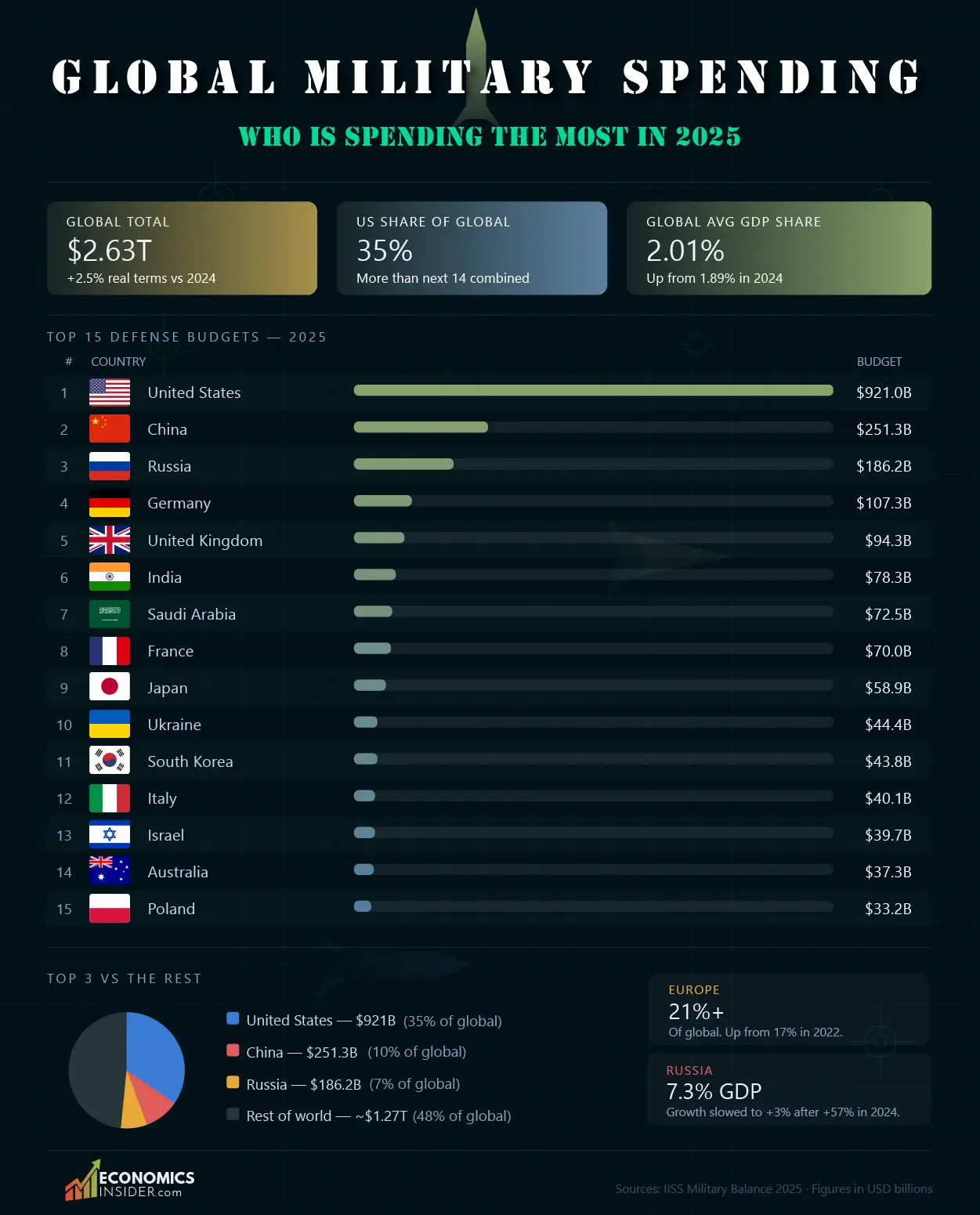
Global defense spending reached $2.63 trillion in 2025, up from $2.48 trillion in 2024. It also hit a new milestone, with average military spending by country rising to 2.0% of global GDP, compared with 1.8% in 2024.
The United States, China, and Russia accounts for a huge chunk of the global total military spending by country. The US alone spent $921 billion on defense in 2025. Similarly China spent $251 billion, and Russia spent $186.2 billion. Together, these three countries spent over $1.35 trillion — more than half of everything the entire world spent on defense.
Heightened geopolitical disputes, wars, and military modernization efforts have led to rising defense spending in Europe, Asia, and the Middle East.
Key Takeaways
- The defense budget of America is $921 billion, which is almost four times the Chinese budget and almost five times the Russian budget.
- Europe has now become responsible for over 21% of the world’s defense expenditure, which was only 17% last year.
- The world’s defense budget has risen by 2.5% in 2025, with a major rise in budgets seen in Europe and the Middle East.
Military Spending by Country (Top 15 Countries)
The table below shows the top 15 countries by military spending in 2026, based on IISS Military Balance 2026 figures in USD billions.
| Rank | Country | Region | Defense Budget 2025 (USD) |
|---|---|---|---|
| 1 | 🇺🇸 United States | North America | $921.0B |
| 2 | 🇨🇳 China | Asia | $251.3B |
| 3 | 🇷🇺 Russia | Europe / Asia | $186.2B |
| 4 | 🇩🇪 Germany | Europe | $107.3B |
| 5 | 🇬🇧 United Kingdom | Europe | $94.3B |
| 6 | 🇮🇳 India | Asia | $78.3B |
| 7 | 🇸🇦 Saudi Arabia | Middle East | $72.5B |
| 8 | 🇫🇷 France | Europe | $70.0B |
| 9 | 🇯🇵 Japan | Asia | $58.9B |
| 10 | 🇺🇦 Ukraine | Europe | $44.4B |
| 11 | 🇰🇷 South Korea | Asia | $43.8B |
| 12 | 🇮🇹 Italy | Europe | $40.1B |
| 13 | 🇮🇱 Israel | Middle East | $39.7B |
| 14 | 🇦🇺 Australia | Oceania | $37.3B |
| 15 | 🇵🇱 Poland | Europe | $33.2B |
🇺🇸 United States — $921 Billion
The United States remains the world’s biggest military spender with $921 billion. The country’s defense budget is larger than the next fourteen countries combined. That means the US leads all nations in military spending by country, outspending China, Russia, Germany, the UK, India, Saudi Arabia, France, Japan, Ukraine, South Korea, Italy, Israel, Australia, and Poland — all at once.
The country’s huge budget supports military bases across every continent and maintains the world’s most advanced air force and navy.
🇨🇳 China — $251.3 Billion
China has the second-highest budget for military spending by country, standing at $251 billion. Beijing continues to modernize its navy, air force, missile systems, and cyber capabilities.
China’s growing military power is the main reason why many Asian nations have been forced to increase their military spending. Though China has much lower military spending compared to the United States, it remains the strongest rival in Asia.
🇷🇺 Russia — $186.2 Billion
Russia ranks third with $186.2 billion in defense spending. The country’s military costs remain high because of the Ukraine war and continued weapons production.
Russia’s military spending growth slowed sharply in 2025 compared with earlier years. While total spending remained very high, it rose by just 3% in real terms, down from an extraordinary 56.9% surge in 2024.
Defense still uses a very large share of the country’s economy. This shows how much Moscow is prioritizing military needs.
Asia — An Arms Race in Slow Motion
Asia remains one of the fastest-growing defense regions in the world. Fears about China’s military expansion, Taiwan’s situation, and conflicts across Asia are causing military budgets to rise.
Major Asian spenders in the top 15 military spending by country ranking include:
- 🇨🇳 China – $251.3B
- 🇮🇳 India – $78.3B
- 🇯🇵 Japan – $58.9B
- 🇰🇷 South Korea – $43.8B
Japan is enhancing its military capacity, whereas South Korea prioritizes dealing with threats posed by North Korea. India is also modernizing its military and improving its defenses along the borders.
Europe — A Historic Shift in Defense Spending
The most rapid expansion in defense budgets occurred on the European continent post-2022. Europe currently represents more than 21% of global military expenditures, compared to 17% in 2022. The ongoing conflict between Russia and Ukraine has caused many nations to raise their defense budgets.
Germany has emerged as the leading cause behind this shift, given that its defense budget of $107.3 billion places it at the fourth position in the global military spending by country ranking.
Key European countries by highest military spending in 2026 include:
- 🇩🇪 Germany – $107.3B
- 🇬🇧 United Kingdom – $94.3B
- 🇫🇷 France – $70.0B
- 🇮🇹 Italy – $40.1B
- 🇵🇱 Poland – $33.2B
- 🇺🇦 Ukraine – $44.4B
The Middle East
The Middle East continues to be a high-spending region. Saudi Arabia’s $72.5 billion places it seventh in the world. Israel, at $39.7 billion, has seen significant spending growth since 2023, driven by ongoing regional conflicts.
The region as a whole has been one of the main growth areas for defense spending globally, with some nations spending extraordinary shares of their GDP on their militaries. Algeria, for instance, spent 8.8% of its GDP on defense in 2025 — the second-highest rate in the entire world.
Conclusion
In 2025, defense expenditures kept growing due to the impact of war, rivalry, and global uncertainty. America is undoubtedly the dominant military power, with expenditures exceeding those of all other nations by far. China is becoming a serious challenge with steady growth in its budget allocation, whereas Russia continues heavy wartime spending.
At the same time, Europe, Asia, and the Middle East are allocating larger funds for military activities, which implies that the global military rivalry may continue in the coming years.