



















The United States is the biggest economy in the world, and it is also the biggest debtor nation. U.S. total debt has now surpassed the $39 trillion figure. The amount is so huge that it surpasses the total value of the economies of many nations combined.
Thus, the question arises, ‘Who holds all this American debt?’ Is America heavily dependent on foreign countries like China and Japan, or is most of the debt actually held within its own economy? Here, we will break down who actually owns the U.S. national debt.
Key Takeaways
- Most of the U.S. debt is held domestically, mainly by investors, pension funds, and institutions.
- Foreign countries also hold a large share of the U.S. debt, but no single country controls the major portion of it.
- A major portion of the U.S. debt is owed within the government itself, including Social Security funds.
Who owns US debt
The US debt ownership is divided into its two main components:
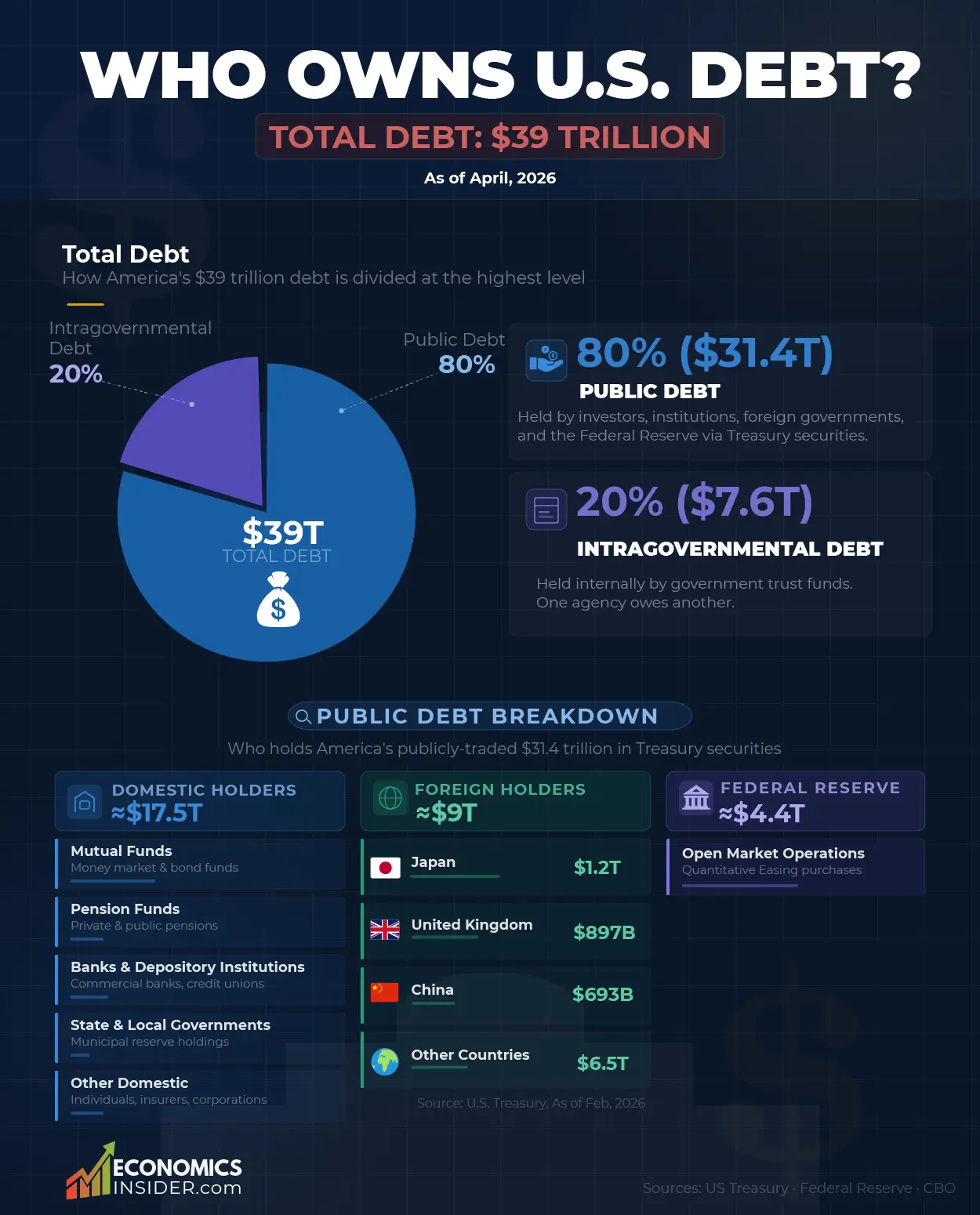
- Public Debt → about $31.5 trillion
- Intragovernmental Debt → about $7.5 trillion
Public debt is the portion borrowed from investors outside the federal government.
Intragovernmental debt is money the government owes to its own programs.
Public Debt ($31.5T)
Public debt makes up the majority of total U.S. debt, which is equal to approximately $31.5 trillion. This is the money the government borrows from investors, both within the country and outside the country, to fund its spending.
Domestic Investors
The biggest share of public debt is held by domestic investors. This includes:
- Mutual funds and pension funds
- Banks and financial institutions
- Individual investors
- Insurance companies and other institutions
Pension and mutual funds alone hold a large portion of total public debt. These funds manage retirement savings, which means a major part of U.S. debt is connected to the financial future of everyday Americans.
Banks and institutions also invest in U.S. Treasury bonds due to their safe and reliable nature. This shows that the U.S. is largely borrowing money from within its own economy.
Foreign Investors
Foreign countries also hold a large share of public debt, around $9 trillion. Japan is the biggest holder of U.S. debt, with about $1.2 trillion. The United Kingdom is next, holding around $897 billion. China comes after that, with about $697 billion.
In recent years, there has been a shift between the two biggest economies, such as China and japan in holding US treasury securities.
China has been gradually reducing its holdings of U.S. debt. In February 2025, China held about $784 billion of U.S. Treasury securities, but now its holdings have declined to around $693 billion.
The reason for this decrease can be attributed to political and economic tensions that have been growing between the two largest economies. Moreover, China is looking to diversify its foreign exchange holdings; therefore, it is gradually reducing its U.S. Treasury holdings.
This decline is linked to rising political and economic tensions between the two largest economies in the world. Additionally, China is diversifying its foreign reserves into other assets. It is also part of the de-dollarization trend, where countries try to reduce their reliance on the U.S. dollar and the financial system.
On the other hand, Japan has moved in the opposite direction. In February 2025, Japan held around $1.12 trillion of U.S. treasury securities, and its holdings have now increased to approximately $1.23 trillion. This shows that Japan continues to be a consistent buyer of U.S. debt.
Federal Reserve
The Federal Reserve also holds a large portion of public debt, about $4.4 trillion. It buys government bonds as part of its monetary policy. This helps the Fed to manage interest rates and support the economy during times of crisis or slowdown.
Intragovernmental Debt
The second major part of U.S. debt is intragovernmental debt, which is around $7.5 trillion. This is money that one part of the government owes to another.
The biggest example of Intragovernmental Debt is the Social Security Trust Fund. When Social Security collects more money than it needs, it invests the surplus in U.S. Treasury bonds. In this way, the government borrows from its own program. Other government trust funds work in a similar way.
What the US Debt Structure Means
First, the debt is mostly supported by domestic investors. Therefore, it makes the U.S. borrowing more stable compared to countries that rely heavily on foreign borrowing.
Second, U.S. Treasury bonds are still seen as one of the safest investments in the world. That is why both domestic and foreign investors continue to buy them.
However, there are also risks. As debt increases, the government has to pay more in interest. If interest rates rise, these payments become even larger. As a result, the U.S. is paying approximately $1 trillion on Interest payment every year. Over time, this can put pressure on government spending and Social Security-related programs.
Conclusion
So, who owns US debt? The answer is not just foreign countries. In reality, most of the debt is held within the United States by its own investors, institutions, and government programs. Foreign countries do play a role, but they do not dominate the system.
Therefore, this system of borrowing gives the U.S. more strength and stability in managing its finances. However, the growing size of the debt remains a critical challenge for the U.S. economy that cannot be ignored.