









Last updated: October 15, 2026
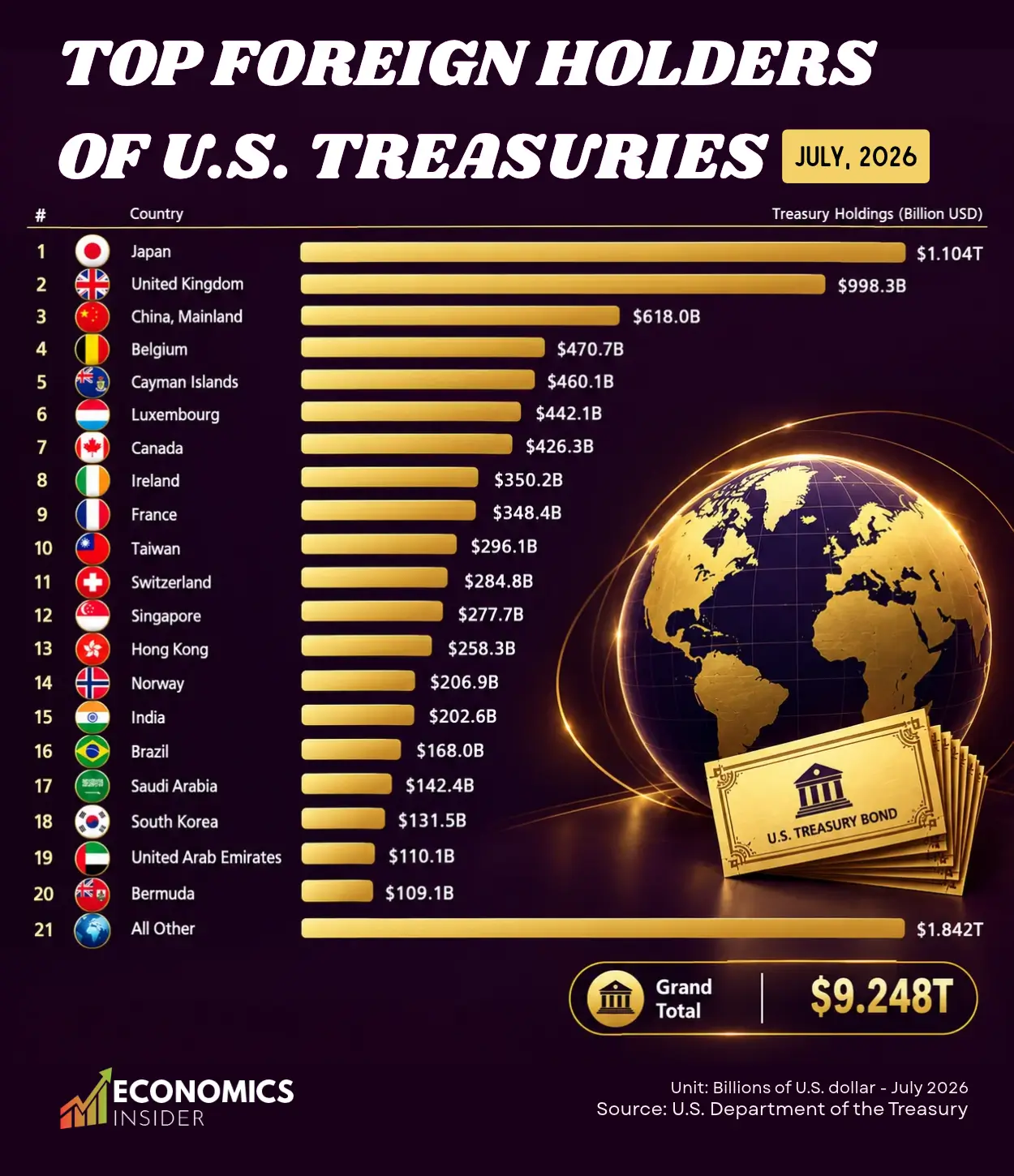
The United States continues to hold the largest national debt in the world, which has surpassed $40 trillion. A major portion of this debt is funded through U.S. Treasury securities, which are bought by foreign governments and investors. Foreign governments and investors hold nearly $9.25 trillion in U.S. Treasury bonds. A year ago, in July 2025, that figure stood at $9.11 trillion. So overall, foreign holdings have grown by about $139 billion in twelve months. It shows that global appetite for U.S. Treasury securities has remained relatively strong despite years of trade tensions and talk of de-dollarization.
Among the Largest US Treasury Holders, Japan leads the list, followed by the United Kingdom and China. Japan remains the largest holder of U.S. Treasuries with $1.104 trillion, down from $1.155 trillion a year earlier. Additionally, China’s Treasury holdings have fallen to $618 billion, compared to $696 billion one year ago.
The United Kingdom is steadily increasing its US Treasury holdings and currently holds $998 billion, which is about 11.4% higher than the $896 billion it held a year ago. The top five countries together hold about $3.65 trillion in US Treasury securities. Among them, Japan and China reduced their holdings compared to last year, while the United Kingdom, Belgium, and the Cayman Islands increased theirs.
Key Takeaways
- Despite years of debate about countries moving away from the dollar, foreign ownership of U.S. Treasuries grew by about $139 billion over the past twelve months.
- The UK is becoming a bigger player. Its $102 billion increase over the year is the largest absolute increase among the three leading holders.
- China’s retreat continues. China now holds about $78 billion less than it did a year ago, reflecting a continued reduction in its U.S. Treasury holdings.
What Are Treasury Securities and How Do They Work?
Why do countries invest in U.S. Treasuries, and what does this mean for the U.S. economy? Treasury securities are U.S. government-issued debt instruments that are often purchased by foreign governments and investors to earn interest over time. They are a type of safe, interest-bearing asset backed by the U.S. government. The U.S. government uses these securities to fund its public spending related to defense, healthcare, and infrastructure. The trust in these instruments helps the U.S. borrow at low interest rates, even while carrying massive debt.
The Largest US Treasury Holders in 2026
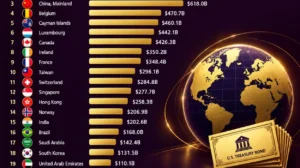
The list of the largest US Treasury holders is dominated by major global economies. The table below shows the top countries with the largest holdings of U.S. Treasury securities in 2026.
| Sr. No. | Country | Treasury Holdings (Jul-26) |
|---|---|---|
| 1 | 🇯🇵 Japan | $1.104T |
| 2 | 🇬🇧 United Kingdom | $998.3B |
| 3 | 🇨🇳 China, Mainland | $618.0B |
| 4 | 🇧🇪 Belgium | $470.7B |
| 5 | 🇰🇾 Cayman Islands | $460.1B |
| 6 | 🇨🇦 Canada | $426.3B |
| 7 | 🇱🇺 Luxembourg | $442.1B |
| 8 | 🇮🇪 Ireland | $350.2B |
| 9 | 🇫🇷 France | $348.4B |
| 10 | 🇹🇼 Taiwan | $296.1B |
| 11 | 🇨🇭 Switzerland | $284.8B |
| 12 | 🇸🇬 Singapore | $277.7B |
| 13 | 🇭🇰 Hong Kong | $258.3B |
| 14 | 🇳🇴 Norway | $206.9B |
| 15 | 🇮🇳 India | $202.6B |
| 16 | 🇧🇷 Brazil | $168.0B |
| 17 | 🇸🇦 Saudi Arabia | $142.4B |
| 18 | 🇰🇷 South Korea | $131.5B |
| 19 | 🇦🇪 United Arab Emirates | $110.1B |
| 20 | 🇧🇲 Bermuda | $109.1B |
| — | 🌎 All Other | $1.842T |
| — | Grand Total | $9.248T |
The data is sourced from the U.S. Department of the Treasury.
Top Foreign Holders of U.S. Treasury Securities
These countries account for the majority of foreign-held U.S. debt and play a significant role in global finance.
🇯🇵 Japan
Japan holds $1.104 trillion in US Treasury assets, which ranks it at the top spot among the Largest US Treasury Holders. The country’s holdings of U.S. Treasuries decreased by about 4.5%, falling from $1.155 trillion in July 2025 to $1.104 trillion in July 2026.
Japan has remained one of the largest U.S. Treasury holders, even as it deals with its own currency pressures and interest rate adjustments at home. Japan’s central bank and institutional investors purchase U.S. securities to help manage the exchange rate and maintain stable foreign reserves.
🇬🇧 United Kingdom
The UK is a major global investor and holds a massive $998 billion of US Treasury securities, up sharply from $895.9 billion in July 2025. This marks a gain of nearly $102 billion in a single year. That’s the biggest absolute increase among the three largest holders. The UK has remained the second-largest holder of U.S. Treasuries and has narrowed the gap with Japan over the past year.
The country is continuously increasing its U.S. Treasury securities. Additionally, the UK’s position among the Largest US Treasury Holders shows its important role in international financial markets and investment in U.S. assets.
🇨🇳 China Keeps Selling
China holds $618 billion in U.S. Treasuries as of July 2026 — down about $78 billion, or 11.2%, from $695.6 billion a year earlier. It is the third-largest holder of US Treasuries after Japan and the United Kingdom. U.S.–China relations have remained strained amid ongoing trade tensions and economic rivalry.
| Month | China, Mainland |
|---|---|
| Jul-26 | $618.0B |
| Jun-26 | $633.4B |
| May-26 | $659.3B |
| Apr-26 | $651.1B |
| Mar-26 | $653.3B |
| Feb-26 | $694.2B |
| Jan-26 | $695.3B |
| Dec-25 | $684.4B |
| Nov-25 | $683.9B |
| Oct-25 | $687.7B |
| Sep-25 | $699.2B |
| Aug-25 | $699.7B |
| Jul-25 | $695.6B |
| Jun-25 | $731.4B |
China has been gradually reducing its U.S. Treasury holdings for several years now, and this data confirms that trend continued through July 2026. It’s not a sudden exit, but a gradual pullback. For context, China was once the largest foreign holder of U.S. debt. It lost that title to Japan years ago, and the gap has only widened since. From a peak of around $1.3 trillion in 2013, its US Treasury bond holdings have declined to approximately $618 billion in 2026.
U.S. vs. China: GDP Output Comparison from 2014 to 2025
🇧🇪 Belgium
Belgium holds $471 billion in U.S. Treasury securities in July 2026, which is a 10.6% increase from $425.4 billion in July 2025. This is a substantial increase, showing that Belgium’s reported holdings of U.S. Treasury securities have grown over the past year. U.S. Treasuries are widely used by international investors because of their liquidity and role in global financial markets.
🇰🇾 Cayman Islands
With $460 billion in holdings, the Cayman Islands is the fifth-largest holder of U.S. Treasury securities in July 2026. It is a major offshore financial center located in the western Caribbean Sea.
You might notice that the Cayman Islands holds more U.S. Treasury securities than Canada and France. This isn’t necessarily the Cayman government holding U.S. bonds. It reflects securities held through Cayman-registered funds and financial vehicles by investors from around the world. Think of it as a proxy for a large pool of international investment money. That figure was $436.8 billion a year ago, so holdings have increased by about $23 billion, or 5.3%.
🇱🇺 Luxembourg
Luxembourg is a major financial centre in Europe, about 25 per cent of its GDP being generated by the financial sector. It ranks sixth among the countries mentioned in terms of the amount of U.S. Treasuries it holds, with $442 billion, an increase from $403.8 billion in July 2025. The country is one of the richest in the world as a result of its GDP per capita, which is among the highest in the world. Moreover, it hosts a large number of international banks and investment funds.
Other countries besides these also possess substantial holdings of U.S. Treasury securities, such as Canada, Ireland, France and Taiwan. In July 2026 Canada had $426.3 billion, which was an increase on the $381.8 billion it had the previous year, even though its holdings had varied greatly from month to month. During the same period Ireland’s holdings rose from $320.2 billion to $350.2 billion.
Over the past twelve months, Taiwan, Switzerland, and Singapore have displayed different trends. Taiwan’s holdings declined from $308.8 billion to $296.1 billion, while Switzerland’s fell from $303.2 billion to $284.8 billion. Singapore, on the other hand, increased its holdings from $252.4 billion to $277.7 billion.
Emerging Markets Holding of U.S. Treasury securities
Among larger developing economies, the trends diverge.
Saudi Arabia increased its holdings from $131.6 billion in July 2025 to $142.4 billion in July 2026 — a gain of about $11 billion. The UAE also increased its holdings, from $107.7 billion to $110.1 billion. Both Gulf states held more U.S. Treasury securities in July 2026 than a year earlier, although their holdings fluctuated during the period.
India moved in the opposite direction compared with July 2025. It held $219.7 billion in July 2025 but had dropped to $202.6 billion by July 2026 — a reduction of about $17 billion over the year. India’s holdings have, nevertheless, regained the ground lost recently, increasing from $186.4 billion in June 2026 to $202.6 billion in July. Alterations in the Treasury’s holdings may indicate wider reserve-management decisions, such as changes made to foreign currency assets and gold.
Brazil also reduced the amount it held, decreasing its holdings from $201.8 billion in July 2025 to $168 billion in July 2026. This amounts to a drop of around $34 billion, or 16.7 per cent, over the year.
Over the twelve-month period South Korea’s holdings remained relatively stable, decreasing slightly from $132.3 billion to $131.5 billion.
Conclusion
Collectively, foreign governments and investors held approximately $9.25 trillion in U.S. Treasury securities in July 2026. Japan remains the largest foreign holder, with about $1.104 trillion, followed by the United Kingdom at $998 billion and China at $618 billion. The United States makes use of these securities as a means of borrowing money in order to finance its national debt.
The government raises money by selling Treasury bonds to both domestic and foreign investors in order to meet its budget deficits and fund public spending. Even though some of the major holders have reduced their holdings, the total amount held by foreigners increased by about $139 billion between July 2025 and July 2026.