











In 2025, global electricity demand reached 31,779 terawatt-hours (TWh), up from 30,930 TWh in 2024. That is an increase of 2.8%. The latest data from Ember shows that clean electricity is growing faster than overall demand. Total clean power—including renewables and nuclear— grew from 12,655 TWh in 2024 to 13,542 TWh in 2025. Its share of global electricity generation rises from 40% to 42%.
At the same time, fossil fuels are still the largest part of the global power system. Fossil generation still accounts for 57.4% of all electricity generation.
Key Takeaways
- In just one year, solar power added 636 terawatt-hours of electricity to the global grid. That is a 30% jump in a single year.
- Despite all the progress, coal generated more electricity in 2025 than solar, wind, and nuclear combined.
Global Electricity Generation BY Source 2026
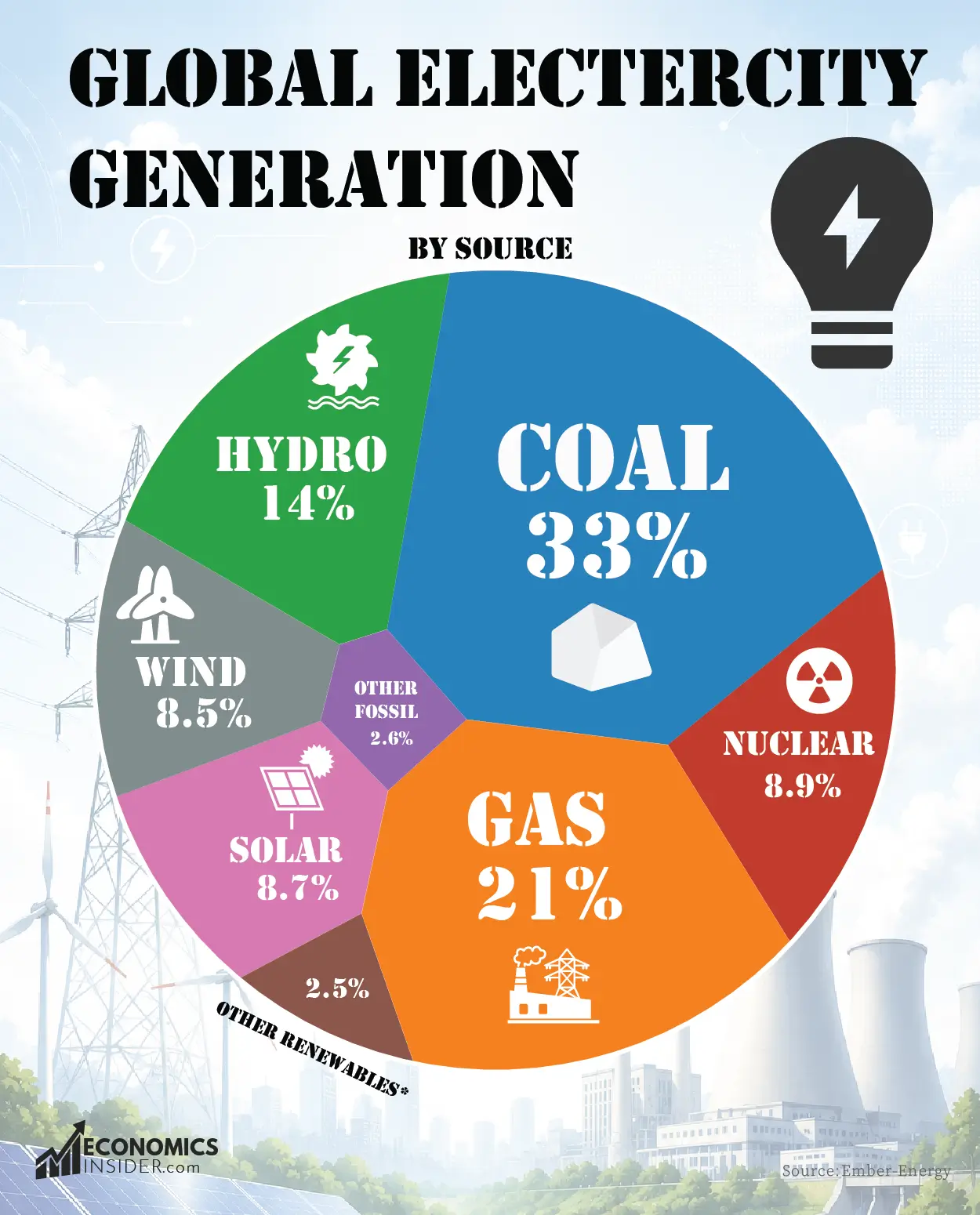
The table below shows global electricity generation across major energy sources in 2026. The data is based on annual electricity generation estimates from Ember Energy.
| Category | 2025 Electricity generation (TWh) | 2025 Share of generation (%) |
|---|---|---|
| Electricity demand | 31,779 | — |
| Total clean | 13,542 | 42.60% |
| Total renewables | 10,730 | 33.80% |
| Solar | 2,778 | 8.70% |
| Wind | 2,715 | 8.50% |
| Hydro | 4,437 | 14.00% |
| Other renewables* | 800 | 2.50% |
| Nuclear | 2,812 | 8.90% |
| Total fossil | 18,238 | 57.40% |
| Coal | 10,476 | 33.00% |
| Gas | 6,919 | 21.80% |
| Other fossil** | 842 | 2.60% |
Coal Is Still The major Source of Electricity
In 2025, coal power plants around the world produced 10,476 terawatt-hours of electricity. To put that in perspective, that is about 33% of all the electricity generated globally. One in every three light bulbs, one in every three phone chargers, one in every three factory machines — powered by coal.
Yes, coal did fall slightly. It produced 63 fewer terawatt-hours than in 2024, a drop of about 0.6%. That is progress. But it is slow progress when you consider the scale of what needs to change to meet climate goals.
Why does coal stick around? Mainly because it is cheap and is already installed. Countries like China, India, and several in Southeast Asia still rely heavily on coal, not because they like it, but because building out alternatives takes time and money.
Global Oil Production: How the U.S. and OPEC Are Shaping the Oil Market
Solar Is Having Its Moment
Solar went from producing 6.9% of global electricity in 2024 to 8.7% in 2025. It grew by nearly 30% in a single year, adding 636 terawatt-hours to reach a total of 2,778 terawatt-hours globally. That is more electricity than solar has ever produced, and the growth rate is remarkable.
Solar is also now producing more electricity than wind for the first time — 2,778 terawatt-hours versus 2,715 for wind. That is a symbolic milestone. Wind was long considered the workhorse of renewable energy, but solar has pulled ahead.
Wind Power
Wind energy grew by 8.2% in 2025, adding 205 terawatt-hours to reach a total of 2,715 terawatt-hours. Wind remains one of the most important clean energy sources in the world. In countries like Denmark, the United Kingdom, and Germany, wind power supplies a large chunk of the national electricity grid.
Clean Energy Is Gaining Ground
In 2024, clean energy sources made up 40.9% of global electricity. In 2025, that rose to 42.6%. That is a meaningful jump in a single year.
Fossil fuels, as a group, produced slightly less electricity than the year before. This matters because it means the world is no longer automatically reaching for coal and gas every time electricity demand goes up. Clean energy is now absorbing that growth instead.
The clean energy share will likely cross 50% within the next few years if current trends hold. But getting there requires honesty about the gaps. Coal alone still accounts for one-third of global electricity. Gas adds another 22%. Combined, fossil fuels still supply 57% of the world’s electricity.
Conclusion
In 2025, solar power growing 30% in a single year, which shows that clean technology can scale fast once the economics work in its favor. At the same time, coal is still the world’s number one source of electricity — by a wide margin. Fossil fuels still power more than half the global grid. The transition away from them is real, but it is happening slowly.