


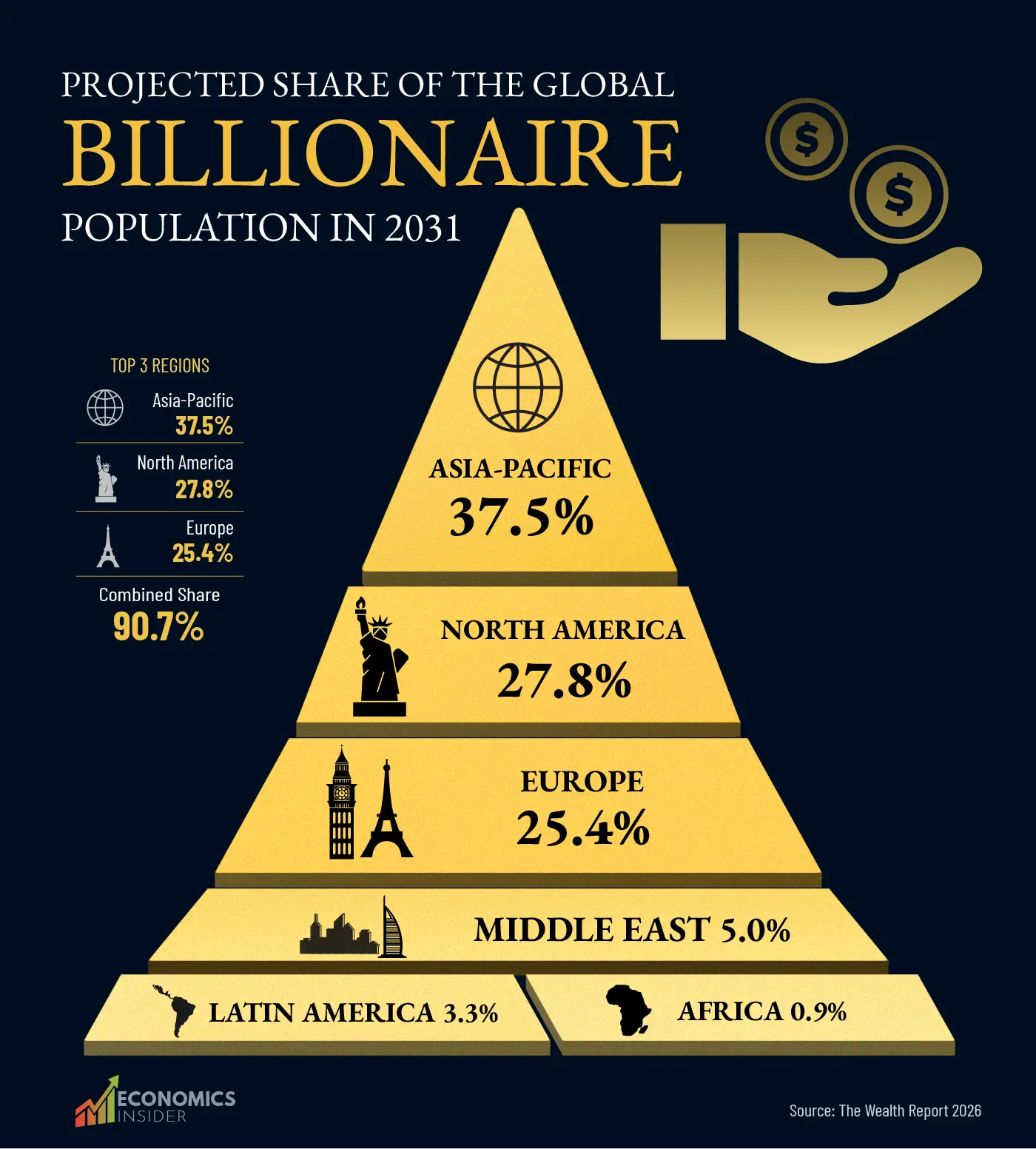
According to the latest wealth report, Asia-Pacific holds the largest share of the world’s billionaires at about 36%, and its share is projected to rise to 37.5% by 2031. The Middle East is the fastest-rising region of the decade, more than doubling its share from 2.4% in 2021 to a projected 5.0% by 2031.
Africa, meanwhile, holds the fewest billionaires of any region. By 2031, its share is projected to remain almost unchanged from where it stood in 2021 — barely nudging from 0.7% to 0.9%.
Key Takeaways
- The Middle East is the fastest-growing billionaire region in the world, more than doubling its global share from 2.4% in 2021 to a projected 5.0% in 2031.
- Asia-Pacific’s dominance is real but quietly eroding — its share falls by more than seven percentage points between 2021 and 2026 before partially recovering.
- Europe is the only major region showing steady, consistent growth in both absolute numbers and global share across the full ten-year period.
Global Billionaire Population by Region
The data is taken from the Wealth Report, 2026. It tracks billionaire populations by region over a ten-year projection window spanning 2021, 2026, and 2031.
| Region | 2021 Share | 2026 Share | 2031 Share |
|---|---|---|---|
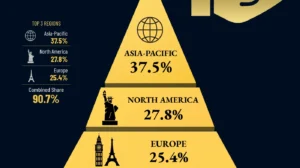
| Asia-Pacific | 43.0% | 35.9% | 37.5% |
| North America | 28.5% | 31.0% | 27.8% |
| Europe | 22.0% | 25.1% | 25.4% |
| Middle East | 2.4% | 4.1% | 5.0% |
| Latin America | 3.4% | 3.0% | 3.3% |
| Africa | 0.7% | 0.9% | 0.9% |
The Middle East Is Emerging as a Growing Wealth Center
Middle East has the fastest-rising share of global billionaires. Starting at just 2.4% of the global billionaire total in 2021, it more than doubles to 4.1% by 2026, and climbs further to 5.0% by 2031. That is a rise of 2.6 percentage points over ten years.
Countries like Saudi Arabia, the UAE, Qatar, and Kuwait have spent heavily on economic diversification — moving away from dependence on oil and building industries in finance, tourism, logistics, and technology. The result is a new generation of wealth being created in a region that previously generated far fewer billionaires relative to its financial weight in the world.
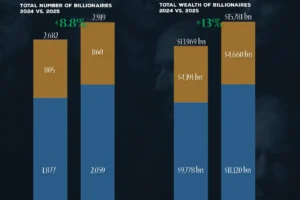
How Billionaires and Their Wealth Changed from 2024 to 2025
Asia-Pacific Remains the World’s Largest Billionaire Hub
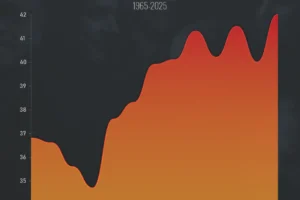
At 43% in 2021, Asia-Pacific holds the largest share of global billionaires by a wide margin. No other region comes close. By 2026, that share drops to 35.9% — a fall of more than seven percentage points in just five years. It does not mean Asia-Pacific billionaires are losing wealth in absolute terms. It means other regions are producing billionaires faster, gradually diluting Asia-Pacific’s dominance.
Despite this decline, Asia-Pacific is projected to remain the world’s largest hub for billionaires, accounting for 37.5% of the global billionaire population by 2031. Much of Asia-Pacific’s original strength came from China’s extraordinary economic expansion.
Europe Maintains a Stable Position
Europe starts at 22% in 2021, rises to 25.1% by 2026, and adds another small gain to 25.4% by 2031. This makes Europe the only major region that shows steady and uninterrupted growth across the full ten-year period. Germany, France, Switzerland, and Sweden in particular tend to be strong contributors to European billionaire counts.
North America Continues to Punch Above Its Weight
The rise of North America’s share of the global billionaire population from 28.5% in 2021 to 31.0% in 2026 shows the region’s massive wealth creation, although its share is projected to drop to 27.8% by 2031. North America — particularly the United States — captures an outsized share of billionaire creation. The US remains the world’s largest single producer of ultra-high-net-worth individuals.
What This Means for Global Income Inequality
Oxfam’s 2026 report documents how billionaire wealth crossed $18.3 trillion globally in 2025. This represents a rise of more than 16% in a single year, a pace three times faster than the average annual growth seen over the previous five years. Since 2020, billionaire wealth has grown by 81%. The rise in billionaire wealth in 2025 alone — $2.5 trillion — would have been enough to eradicate extreme poverty 26 times over.
Meanwhile, the number of people living in poverty has barely changed since 1990, according to World Bank data. If current growth rates continue and inequality does not decrease, it will take more than a century to end poverty.
Conclusion
The geography of billionaire wealth is genuinely shifting. The Middle East is rising fast. Europe is growing steadily. North America is peaking and levelling off. Asia-Pacific region keeps having the largest number of global billionaires, but gradually losing its commanding share.