














The United States has accumulated one of the largest debt burdens in the world. While most attention goes to the federal government, American states borrow money just like people and companies do. They take on debt to build roads, run schools, pay pensions, and keep hospitals open. According to the latest data from the Reason Foundation, U.S. states collectively owe trillions of dollars in outstanding debt. Some states have borrowed heavily to support large populations and infrastructure, while others have kept their borrowing relatively low.
However, state debts form just one component of the total debts of America. Apart from the debts incurred by states, the federal government also owes more than $39 trillion worth of national debt. It is the highest national debt that has ever been experienced in any country in the world.
Key Takeaways
- 1. California alone owes close to $497 billion, more than any other state and more than double the debt of the next closest state.
- 2. The top five states account for over half of all state debt in the country.
- 3. South Dakota carries the least debt of any state, at just under $2.5 billion, which is about 200 times smaller than California’s debt.
Ranking Every U.S. State by Total Debt
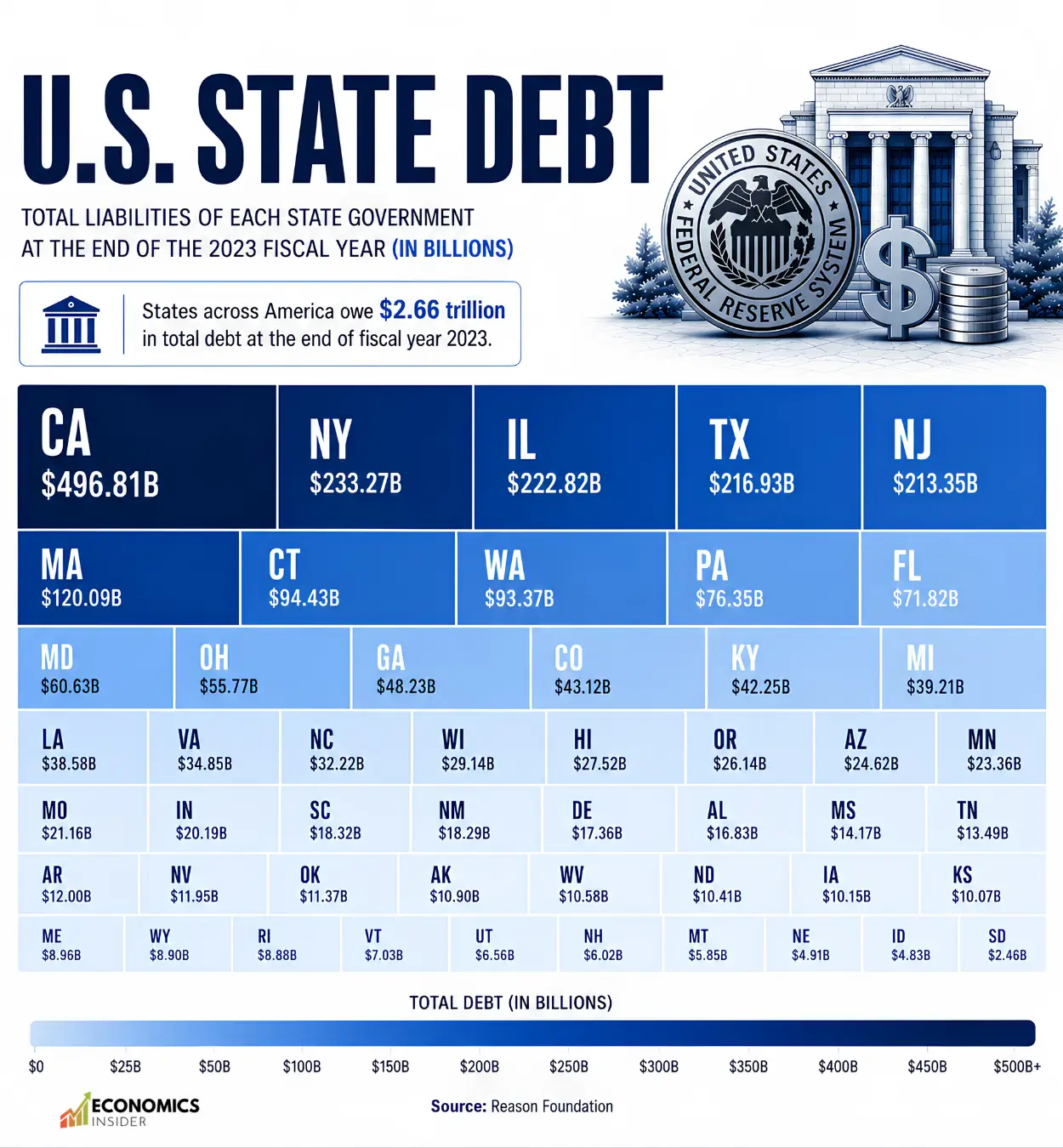
The table below uses data from the Reason Foundation and ranks every U.S. state by its total debt at the end of fiscal year 2023.
| State | Total Debt |
|---|---|
| California | $496.81B |
| New York | $233.27B |
| Illinois | $222.82B |
| Texas | $216.93B |
| New Jersey | $213.35B |
| Massachusetts | $120.09B |
| Connecticut | $94.43B |
| Washington | $93.37B |
| Pennsylvania | $76.35B |
| Florida | $71.82B |
| Maryland | $60.63B |
| Ohio | $55.77B |
| Georgia | $48.23B |
| Colorado | $43.12B |
| Kentucky | $42.25B |
| Michigan | $39.21B |
| Louisiana | $38.58B |
| Virginia | $34.85B |
| North Carolina | $32.22B |
| Wisconsin | $29.14B |
| Hawaii | $27.52B |
| Oregon | $26.14B |
| Arizona | $24.62B |
| Minnesota | $23.36B |
| Missouri | $21.16B |
| Indiana | $20.19B |
| South Carolina | $18.32B |
| New Mexico | $18.29B |
| Delaware | $17.36B |
| Alabama | $16.83B |
| Mississippi | $14.17B |
| Tennessee | $13.49B |
| Arkansas | $12.00B |
| Nevada | $11.95B |
| Oklahoma | $11.37B |
| Alaska | $10.90B |
| West Virginia | $10.58B |
| North Dakota | $10.41B |
| Iowa | $10.15B |
| Kansas | $10.07B |
| Maine | $8.96B |
| Wyoming | $8.90B |
| Rhode Island | $8.88B |
| Vermont | $7.03B |
| Utah | $6.56B |
| New Hampshire | $6.02B |
| Montana | $5.85B |
| Nebraska | $4.91B |
| Idaho | $4.83B |
| South Dakota | $2.46B |
How Much Do All States Owe Together?
Add up the debt of every state, and the number comes out to roughly $2.66 trillion. That is a huge amount of money, but it is spread very unevenly. A handful of large states carry most of the weight, while many smaller states owe relatively little.
When dividing the total debt evenly across all 50 states, the average would be about $53 billion per state. But almost no state is actually close to that number. Most states owe far less than the average, and a small group of states owe far more.
U.S. Budget Deficit by Year (2011–2025): Why the US Deficit Keeps Growing
The States Carrying the Most Debt
California sits at the very top with $496.81 billion in debt. That is more than twice as much as New York, which comes in second place with $233.27 billion. Illinois, Texas, and New Jersey round out the top five, each owing over $210 billion.
The top five states together owe about $1.38 trillion, which is just over half of the entire country’s state debt total. These are also some of the most populated and economically active states, so it makes sense they run bigger budgets and take on more borrowing.
The States Carrying the Least Debt
At the other end of the list, South Dakota owes the least, at just $2.46 billion. Idaho, Nebraska, Montana, and New Hampshire follow close behind, each with debt under $7 billion.
Put together, the ten lowest-debt states owe about $64 billion combined. That is less than one-eighth of what California owes by itself. These are generally smaller states with smaller populations and smaller state budgets, so lower debt is expected.
Why the Gap Is So Big
Part of the reason for this gap comes down to population and economic size. But population size does not explain everything. Texas has a large population too, yet it owes noticeably less than New York, which has fewer people. This shows that states policy choices, borrowing habits, and how they chooses to fund its pensions and public projects also play a major role in how much debt piles up over time.
Wrapping Up
State debt in America is not spread out evenly at all and it is an important part of the broader U.S. public debt. While the federal government carries by far the largest share of America’s borrowing, state governments also rely on debt to build infrastructure and fund long-term investments.
A small number of large states, led by California, carry the biggest share of the country’s $2.66 trillion in total state debt. On the other hand, many smaller states, like South Dakota and Idaho, keep their debt levels low.