

The Middle East oil and gas reserves are among the largest ever discovered, and the countries that built their economies on manufacturing, transport, and industry have been drawing from that well ever since. But when you look at exactly how much of each country’s oil and gas comes from the Middle East, some of the numbers are startling.
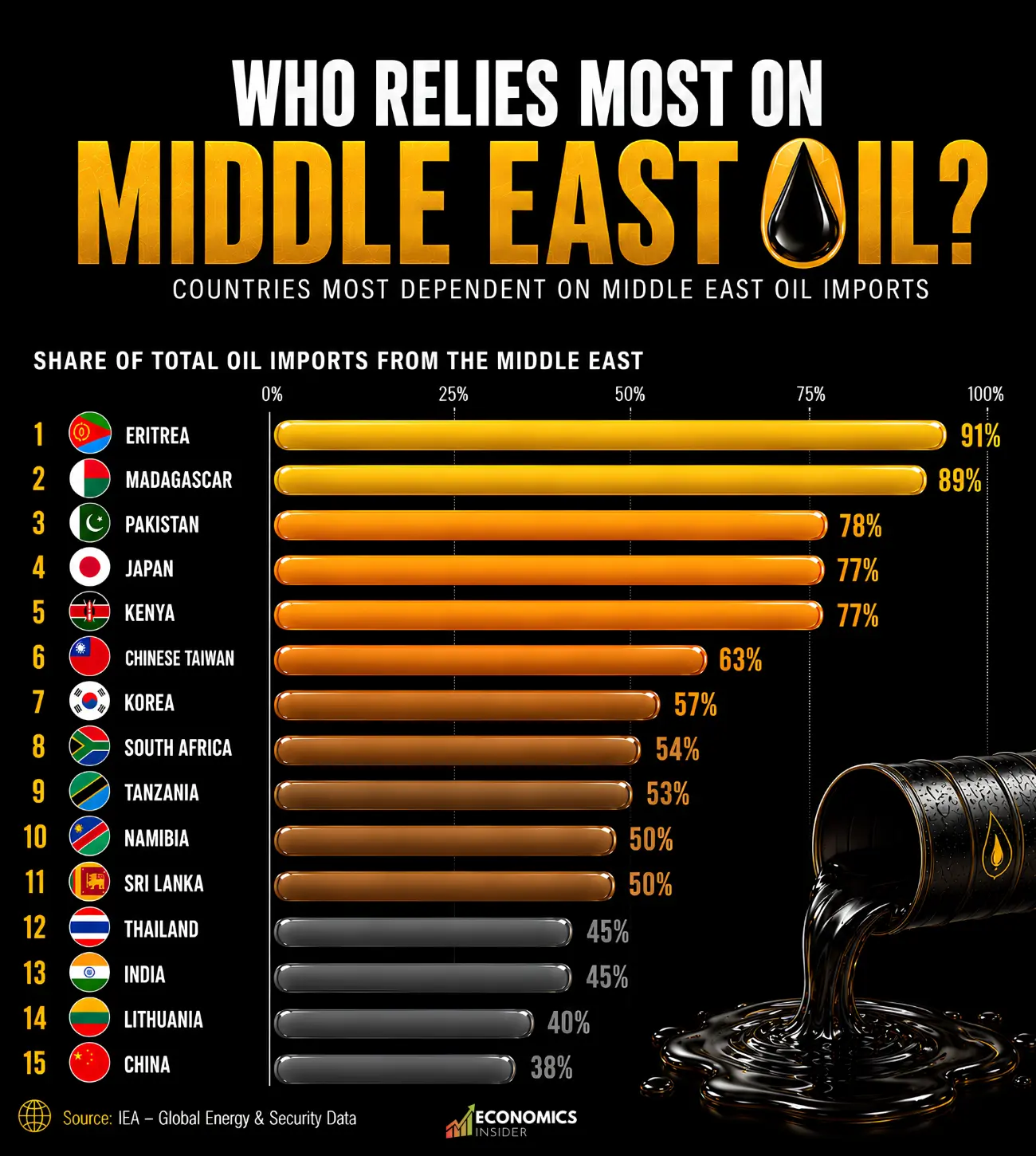
Eritrea sources 91% of its oil and gas from the region. Madagascar is at 89%. Japan — the third-largest economy in the world — sits at 77%.
Any changes that may occur in the Middle East will lead to an increase in fuel costs, an increase in prices, and economic activities in other countries. The latest developments in the Middle East have reminded the world about how dependent some countries have remained in terms of importing oil from this area.
Key Takeaways
- Nine of the fifteen most oil-dependent countries source more than half their entire fuel supply from the Middle East.
- The world’s biggest manufacturing economies — Japan, South Korea, Taiwan, and China — run their factories, power grids, and export industries almost entirely on Gulf oil and gas.
Countries Most Dependent on Middle East Oil Imports
The table below ranks 15 countries by the share of their oil and gas imports that came from the Middle East in 2024. The data is sourced from the International Energy Agency (IEA).
| Rank | Country | Share of Imports from the Middle East (2024) |
|---|---|---|
| 1 | 🇪🇷 Eritrea | 91% |
| 2 | 🇲🇬 Madagascar | 89% |
| 3 | 🇵🇰 Pakistan | 78% |
| 4 | 🇯🇵 Japan | 77% |
| 5 | 🇰🇪 Kenya | 77% |
| 6 | 🇹🇼 Chinese Taipei (Taiwan) | 63% |
| 7 | 🇰🇷 Korea | 57% |
| 8 | 🇿🇦 South Africa | 54% |
| 9 | 🇹🇿 Tanzania | 53% |
| 10 | 🇳🇦 Namibia | 50% |
| 11 | 🇱🇰 Sri Lanka | 50% |
| 12 | 🇹🇭 Thailand | 50% |
| 13 | 🇮🇳 India | 45% |
| 14 | 🇱🇹 Lithuania | 40% |
| 15 | 🇨🇳 China | 38% |
East African and Indian Ocean nations such as Eritrea, Madagascar, Kenya, Tanzania, Namibia, and Sri Lanka dominate the top half of the list.
Asia-Pacific: Factories That Run on Gulf Oil
The countries located in the Asia-Pacific are manufacturing and export powerhouses with almost no meaningful domestic oil or gas production. They built their industrial models around cheap, reliable energy from the Gulf, and decades later, they still depend on it.
Japan
Japan produces virtually no oil or gas of its own. Every barrel of crude it refines, every tanker of liquefied natural gas it burns to generate electricity — 77% of it originates in the Middle East. Saudi Arabia, the UAE, Kuwait, and Qatar are Japan’s energy backbone. Without that supply, Japanese industry does not run.
South Korea & Taiwan
South Korea and Taiwan are world leaders in semiconductors, steel, electronics, and shipbuilding. All of it runs on energy. Korea sources 57% of its oil and gas from the Middle East. Taiwan is at 63%. The chips powering your phone and laptop were almost certainly made using electricity and fuel that originated in the Gulf.
Pakistan
Pakistan sits at 78%, the highest on the Asia-Pacific side. Unlike Japan or Korea, Pakistan is not a manufacturing giant — but it is a country of over 230 million people with enormous energy needs for heating, cooking, transport, and power generation. Its proximity to the Gulf and limited domestic production make it one of the most dependent nations on the list.
India & China
Despite their scale and growing domestic energy output, India and China remain deeply tied to the region. India sources 45% of its oil and gas from the Middle East. Saudi Arabia alone is consistently India’s largest single oil supplier. China, despite years of deliberate diversification toward Russia, West Africa, and South America, still sits at 38% — meaning more than a third of the world’s largest energy consumer’s hydrocarbons flow from Gulf fields.
Who Holds the World’s Largest Strategic Oil Inventories in 2026?
East Africa
For the East African and Indian Ocean countries on this list — Eritrea, Madagascar, Kenya, Tanzania, and Namibia — the dependency is almost entirely about fuel for transport, power, and cooking.
None of these countries produces meaningful quantities of oil or gas domestically. They import refined petroleum products — diesel, petrol, kerosene, jet fuel — and they buy them almost entirely from Middle Eastern refineries or through Gulf trading hubs.
Geography makes this inevitable. The Arabian Peninsula sits just across the Red Sea and Indian Ocean from East Africa. Tankers from Jeddah, Muscat, or Fujairah can reach Mombasa or Dar es Salaam faster and more cheaply than tankers from any other major oil-producing region.
Eritrea
Eritrea, at 91%, reflects both geography and isolation. The country sits directly on the Red Sea coast, across the water from Saudi Arabia and Yemen. Its small and heavily sanctioned economy has few alternative trading partners, and its fuel needs are met almost entirely by nearby Gulf suppliers.
Madagascar
Madagascar, at 89%, is more about distance than politics. The island sits far from West African oil exporters and South American refineries. The nearest reliable fuel supply chain runs through the Gulf and down the Indian Ocean — and that is where Madagascar buys its oil and gas.
Kenya and Tanzania, the two largest East African economies on the list, are both at 77% and 53%, respectively.
Lithuania: Europe’s Energy Pivot
Lithuania, at 40%, is the only European country on the list. For decades, Lithuania was almost entirely dependent on Russian pipeline oil and gas. That dependency ended abruptly after Russia’s full-scale invasion of Ukraine in 2022. European governments moved urgently to cut Russian energy imports, and Lithuania was among the fastest to act.
The replacement energy came largely from the Middle East. Qatar became a major supplier of liquefied natural gas to European buyers.
Conclusion
The global economy’s relationship with Middle Eastern oil and gas was never temporary. Decades of infrastructure investment, refinery capacity, shipping routes, and long-term supply contracts have locked in dependencies that do not unwind quickly.
Pakistan, Japan, Taiwan, and South Korea are among those nations that continue to depend on Middle Eastern oil, and there are also many nations in Africa that depend on Middle Eastern oil for most of their needs.