
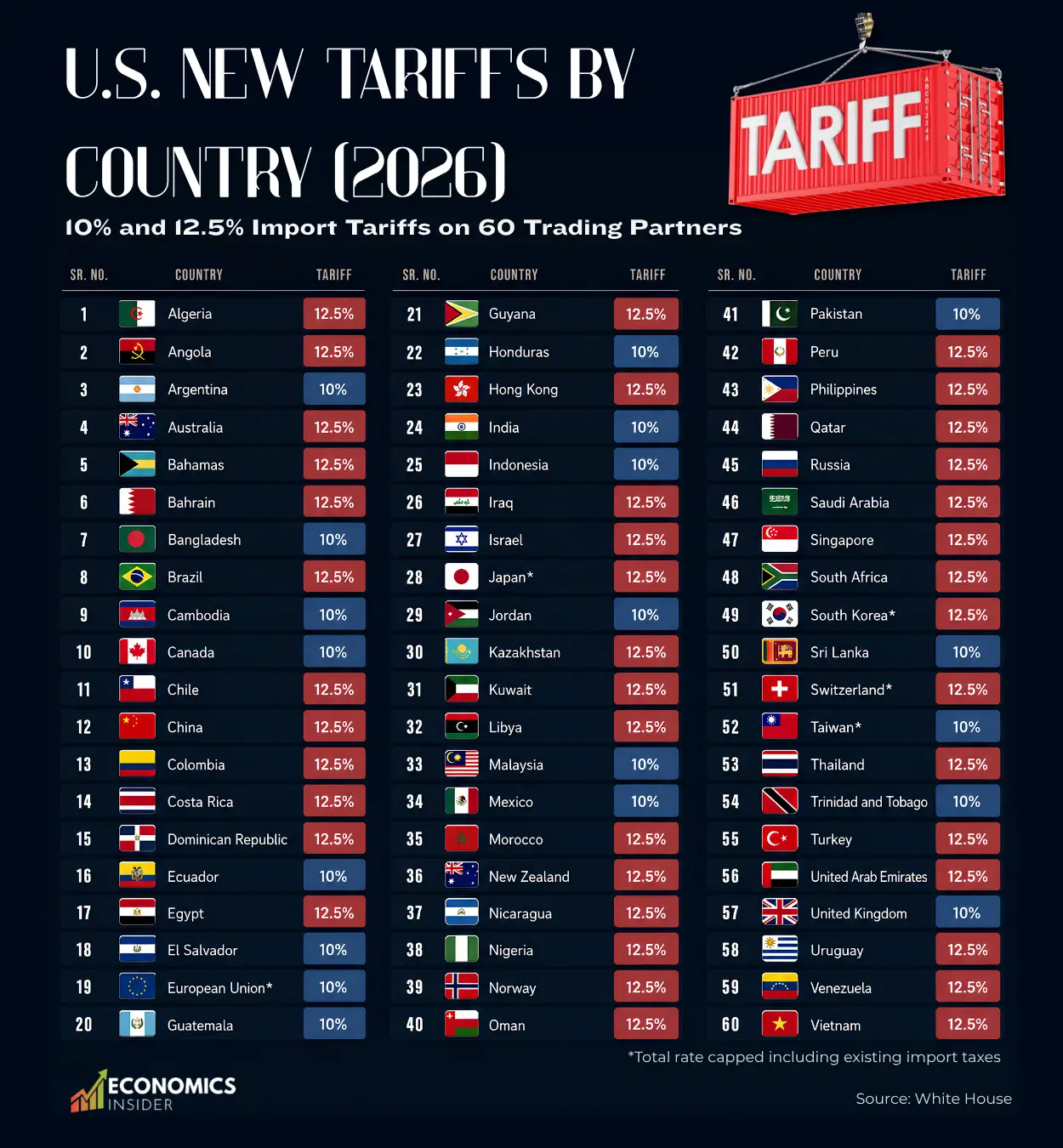
On July 24, 2026, a new round of American tariffs kicked in. This time, the list covers more than 60 countries, including almost every major trading partner the United States has: China, the European Union, Japan, India, Canada, Mexico, the United Kingdom, and dozens more. The rates land between 10% and 12.5%, depending on the country.
This is the continuation of the Liberation Day tariffs Trump first rolled out back in April 2025. it affects many of America’s largest trading partners, including China, the European Union, Japan, Canada, India, South Korea, Vietnam, and the United Kingdom.
Key Takeaways
- The new U.S. tariffs replace a temporary flat 10% tariff that was set to expire, and they now vary by country, mostly landing at 10% or 12.5%.
- The administration says the tariffs are aimed at countries that have not done enough to keep goods made with forced labor out of their supply chains.
U.S. Imposes New Tariffs on More Than 60 Trading Partners
The following countries and economies are subject to the new U.S. import tariffs of either 10% or 12.5%. The data is sourced from the White House and BBC, that reflects the latest U.S. tariff schedule.
| Sr. No. | Country | Tariff |
|---|---|---|
| 1 | 🇩🇿 Algeria | 12.50% |
| 2 | 🇦🇴 Angola | 12.50% |
| 3 | 🇦🇷 Argentina | 10% |
| 4 | 🇦🇺 Australia | 12.50% |
| 5 | 🇧🇸 Bahamas | 12.50% |
| 6 | 🇧🇭 Bahrain | 12.50% |
| 7 | 🇧🇩 Bangladesh | 10% |
| 8 | 🇧🇷 Brazil | 12.50% |
| 9 | 🇰🇭 Cambodia | 10% |
| 10 | 🇨🇦 Canada | 10% |
| 11 | 🇨🇱 Chile | 12.50% |
| 12 | 🇨🇳 China | 12.50% |
| 13 | 🇨🇴 Colombia | 12.50% |
| 14 | 🇨🇷 Costa Rica | 12.50% |
| 15 | 🇩🇴 Dominican Republic | 12.50% |
| 16 | 🇪🇨 Ecuador | 10% |
| 17 | 🇪🇬 Egypt | 12.50% |
| 18 | 🇸🇻 El Salvador | 10% |
| 19 | 🇪🇺 European Union* | 10% |
| 20 | 🇬🇹 Guatemala | 10% |
| 21 | 🇬🇾 Guyana | 12.50% |
| 22 | 🇭🇳 Honduras | 10% |
| 23 | 🇭🇰 Hong Kong | 12.50% |
| 24 | 🇮🇳 India | 10% |
| 25 | 🇮🇩 Indonesia | 10% |
| 26 | 🇮🇶 Iraq | 12.50% |
| 27 | 🇮🇱 Israel | 12.50% |
| 28 | 🇯🇵 Japan* | 12.50% |
| 29 | 🇯🇴 Jordan | 10% |
| 30 | 🇰🇿 Kazakhstan | 12.50% |
| 31 | 🇰🇼 Kuwait | 12.50% |
| 32 | 🇱🇾 Libya | 12.50% |
| 33 | 🇲🇾 Malaysia | 10% |
| 34 | 🇲🇽 Mexico | 10% |
| 35 | 🇲🇦 Morocco | 12.50% |
| 36 | 🇳🇿 New Zealand | 12.50% |
| 37 | 🇳🇮 Nicaragua | 12.50% |
| 38 | 🇳🇬 Nigeria | 12.50% |
| 39 | 🇳🇴 Norway | 12.50% |
| 40 | 🇴🇲 Oman | 12.50% |
| 41 | 🇵🇰 Pakistan | 10% |
| 42 | 🇵🇪 Peru | 12.50% |
| 43 | 🇵🇭 Philippines | 12.50% |
| 44 | 🇶🇦 Qatar | 12.50% |
| 45 | 🇷🇺 Russia | 12.50% |
| 46 | 🇸🇦 Saudi Arabia | 12.50% |
| 47 | 🇸🇬 Singapore | 12.50% |
| 48 | 🇿🇦 South Africa | 12.50% |
| 49 | 🇰🇷 South Korea* | 12.50% |
| 50 | 🇱🇰 Sri Lanka | 10% |
| 51 | 🇨🇭 Switzerland* | 12.50% |
| 52 | 🇹🇼 Taiwan* | 10% |
| 53 | 🇹🇭 Thailand | 12.50% |
| 54 | 🇹🇹 Trinidad and Tobago | 10% |
| 55 | 🇹🇷 Turkey | 12.50% |
| 56 | 🇦🇪 United Arab Emirates | 12.50% |
| 57 | 🇬🇧 United Kingdom | 10% |
| 58 | 🇺🇾 Uruguay | 12.50% |
| 59 | 🇻🇪 Venezuela | 12.50% |
| 60 | 🇻🇳 Vietnam | 12.50% |
Liberation Day Tariffs, 2025
On April 2, 2025, “Liberation Day”, the president announced a sweeping set of tariffs on nearly every country the U.S. trades with. Some countries got the standard 10% tariff rate. Others, especially those with a large trade surplus with the U.S., got hit with much higher numbers, in some cases above 40%.
The legal foundation for these tariffs was a law called the International Emergency Economic Powers Act, or IEEPA. Trump’s administration argued that persistent trade deficits counted as an emergency serious enough to justify broad tariffs under this law.
In August 2025, a federal appeals court ruled against the administration, saying the tariffs went beyond what the law allowed.
The Supreme Court Steps In
The case reached the Supreme Court, and on February 20, 2026, the justices ruled 6-3 against the administration. Their reasoning was fairly simple: the power to tax and set tariffs belongs to Congress under the Constitution, not the president, and IEEPA doesn’t hand that power over just because a president declares an emergency. The ruling struck down both the broad “reciprocal” tariffs from Liberation Day and a related set of tariffs tied to fentanyl trafficking from Canada, Mexico, and China.
This was a big deal. Those IEEPA-based tariffs had brought in somewhere around $175 to $179 billion, and the ruling opened the door for companies to potentially claim refunds on tariffs they’d already paid.
Round Two: The 150-Day Tariff
The administration didn’t wait long to respond. Within hours of the Supreme Court’s decision, Trump signed a new proclamation putting a fresh 10% global tariff in place, this time using a different law, Section 122 of the Trade Act of 1974. This law does allow a president to impose tariffs to deal with balance-of-payments problems, but there’s a catch: any tariff imposed this way automatically expires after 150 days unless Congress votes to extend it.
Round Three: The Current Tariffs, Built on a New Legal Basis
That 150-day window ran out on July 24, 2026. Rather than let tariffs disappear entirely or ask Congress for an extension, the administration rolled out a third version, this time relying on Section 301 of U.S. trade law, a tool that’s normally used to respond to specific unfair trade practices rather than broad economic policy.
The official reason given this time is forced labor. The U.S. Trade Representative’s office says these countries have failed to properly enforce bans on importing goods made with forced labor. Not everyone accepts that framing. Several affected countries rejected the U.S. claim, saying their labor standards already meet international standards.
The Bottom Line
Three rounds in eighteen months is a lot of change for businesses to absorb. Every time the legal basis shifts, importers have to recalculate costs, renegotiate contracts, and figure out whether they even qualify for exemptions. The bigger question hanging over all of this is whether Section 301, a law meant for narrow, specific trade disputes, can really support this wide a set of tariffs without facing the same kind of legal challenge that brought down the last version.