

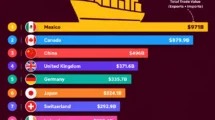





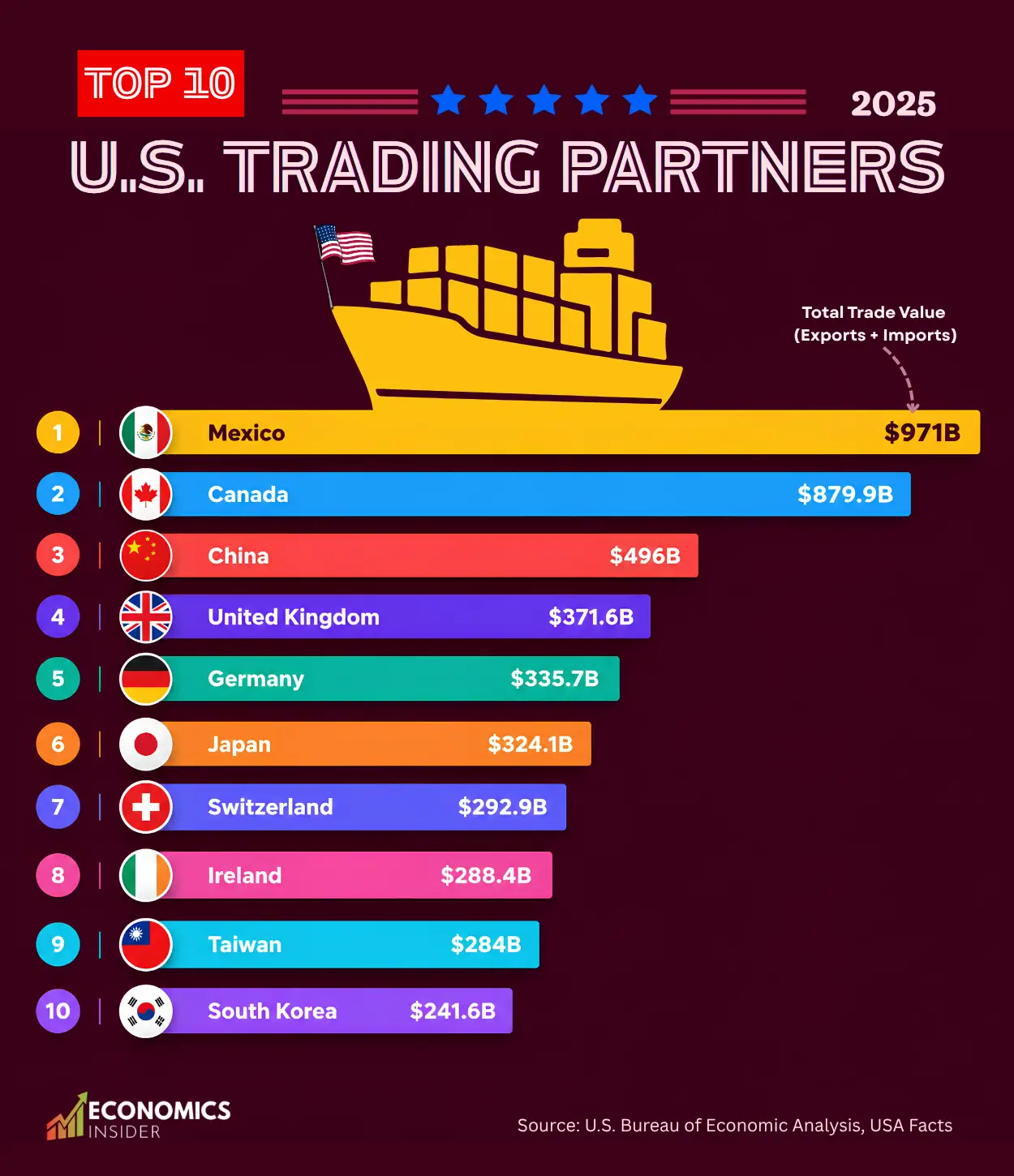
The U.S. does trade with more than 200 countries, but most of that trade is concentrated in a handful of relationships. In 2025, the U.S. traded the most with Mexico, Canada, and China. Mexico came out on top with $971 billion in total trade with the U.S. Canada was close behind at $879.9 billion, and China trailed the two North American neighbors at $496 billion.
Mexico and Canada matter so much because their economies are wired directly into America’s — through car plants, energy pipelines, farms, and supply chains.
China is still a massive trading partner of the United States, but tariffs and years of companies rethinking their supply chains have shrunk its share compared to a decade ago. Canada and the U.S. have been in an escalating tariff standoff through most of 2026, and China trade has kept sliding as businesses lean harder into Mexico and Southeast Asia.
Key Takeaways
- Mexico was America’s biggest trading partner in 2025, with $971 billion in total trade.
- Canada held onto second place at $879.9 billion, even as a tariff fight with the U.S. escalated through the second half of the year.
- China came in third at $496 billion — a sharp drop from where it stood a few years ago, as tariffs and shifting supply chains keep reshaping the relationship.
The 10 Largest U.S. Trading Partners in 2025
The table below shows the 10 countries with the highest total trade value with the United States in 2025. Total trade includes both imports and exports of goods. The data is sourced from the U.S. Bureau of Economic Analysis (BEA) and USA Facts.
| Rank | Country | Total Trade Value |
|---|---|---|
| 1 | 🇲🇽 Mexico | $971 billion |
| 2 | 🇨🇦 Canada | $879.9 billion |
| 3 | 🇨🇳 China | $496 billion |
| 4 | 🇬🇧 United Kingdom | $371.6 billion |
| 5 | 🇩🇪 Germany | $335.7 billion |
| 6 | 🇯🇵 Japan | $324.1 billion |
| 7 | 🇨🇭 Switzerland | $292.9 billion |
| 8 | 🇮🇪 Ireland | $288.4 billion |
| 9 | 🇹🇼 Taiwan | $284 billion |
| 10 | 🇰🇷 South Korea | $241.6 billion |
1. Mexico — $971 billion
Mexico held onto the top spot for the fifth year running, and it’s not close. Cars, auto parts, machinery, electronics, and produce move across the border constantly, often crossing back and forth several times before a finished product is ready to sell.
Some of that is just geography, but a lot of it is strategy. As companies try to move production out of China, Mexico has become the obvious landing spot. Mexico is cheaper than building in the U.S., and it still gets most of the benefits of USMCA. That “nearshoring” trend has only picked up steam.
2. Canada — $879.9 billion
Canada is America’s other deeply intertwined trading partner — but the relationship between the two countries has gone through a rough stretch. The country supplies the U.S. oil, natural gas, electricity, metals, and vehicles; the U.S. sends back machinery, food, and manufactured goods. Canadian crude in particular is a big deal for refineries in the Midwest, so anything that disrupts that flow can ripple into energy prices also.
The trade war between the United States and Canada has reached an unprecedented boiling point as of September 2026. Trade talks between the two countries broke down in August, and the U.S. followed through on a threat to slap 50% tariffs on roughly $20 billion worth of Canadian goods. Canada responded with its own dollar-for-dollar tariffs on a similar amount of U.S. imports — hitting sectors like dairy, steel, appliances, and electronics.
On top of that, existing U.S. tariffs on steel, aluminum, copper, autos, and lumber are still in place, and a separate 50% tariff aimed at the auto industry is scheduled to kick in on January 1, 2027.
Canada is still America’s second-largest trading partner, showing how much the two countries depend on each other. But if the trade conflict continues, the 2026 figures could look quite different from 2025.
3. China — $496 billion
China used to be the name at the top of this list. For years, American shelves were stocked with Chinese electronics, furniture, clothing, and machinery. That’s changed a lot.
Trade with China dropped sharply in 2025 — down about 25% from the year before — as tariffs stayed high and companies kept shifting orders to Vietnam, Mexico, and elsewhere.
Imports from China fell nearly 30% over the year, the steepest drop of any major U.S. trading partner. China still runs a trade surplus with the U.S., but a shrinking one, and its overall position in American trade is nowhere near what it was a decade ago. It’s still a major partner, but it’s playing a smaller and different role than it used to.
4. United Kingdom — $371.6 billion
The UK’s trade with the U.S. isn’t just about goods like aircraft, machinery, pharmaceuticals, and cars. A big chunk of the trade runs through finance, technology, and professional services. British firms operate extensively in the U.S. and vice versa, and that investment relationship helps the trade numbers stay large.
5. Germany — $335.7 billion
As Europe’s biggest economy, Germany sends the U.S. a steady stream of cars, machinery, chemicals, and industrial equipment. German automakers also build plenty of vehicles on American soil. This means trade is not just about finished products. Parts and machinery also move between the two countries to support production in those factories.
The rest of the top 10
Japan ($324.1 billion) trades heavily in vehicles, machinery, and electronics, and Japanese automakers have deep manufacturing roots in the U.S.
Switzerland ($292.9 billion) and Ireland ($288.4 billion) both lean on pharmaceuticals, chemicals, and medical products. Ireland’s numbers get a boost from the sheer number of multinational companies that base their European operations there.
Taiwan ($284 billion) is central to the electronics and semiconductor supply chain. Its trade relationship with the U.S. punches well above its size because of how critical chips have become.
South Korea ($241.6 billion) rounds out the list, driven by vehicles, electronics, and industrial machinery.
Which Countries Does the U.S. Have the Largest Trade Deficits With?
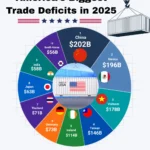
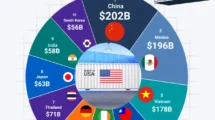
China is still the U.S.’s biggest deficit by far at $202.1 billion, but that’s actually down almost 32% from 2024’s $295.5 billion. This shows that tariffs and supply-chain shifts are catching up with the numbers.
Germany, Japan, South Korea, and Canada all saw their deficits shrink too. Everyone else went the other direction. Mexico’s deficit grew nearly 15% to $196.9 billion, putting it right on China’s heels.
Taiwan’s deficit nearly doubled (up 99%) to $146.8 billion, Vietnam jumped 44% to $178.2 billion, and Thailand climbed 58% to $71.9 billion. Ireland and India both grew by roughly a third as well.
Put together, it looks less like the U.S. is buying less from the world and more like it’s buying from different parts of it. As companies route around China, the deficit hasn’t disappeared — it’s just resurfaced in Vietnam, Taiwan, Thailand, and Mexico instead.
| Rank | Country | 2025 Deficit | 2024 Deficit | Change |
|---|---|---|---|---|
| 1 | 🇨🇳 China | $202.1B | $295.5B | -31.60% |
| 2 | 🇲🇽 Mexico | $196.9B | $171.5B | 14.80% |
| 3 | 🇻🇳 Vietnam | $178.2B | $123.5B | 44.30% |
| 4 | 🇹🇼 Taiwan | $146.8B | $73.7B | 99.10% |
| 5 | 🇮🇪 Ireland | $114.2B | $86.5B | 32.00% |
| 6 | 🇩🇪 Germany | $73.0B | $84.7B | -13.70% |
| 7 | 🇹🇭 Thailand | $71.9B | $45.5B | 58.00% |
| 8 | 🇯🇵 Japan | $63.9B | $69.4B | -7.90% |
| 9 | 🇮🇳 India | $58.2B | $45.8B | 27.10% |
| 10 | 🇰🇷 South Korea | $56.4B | $66.0B | -14.50% |
| 11 | 🇨🇦 Canada | $46.4B | $62.0B | -25.20% |
The Bottom Line
America’s biggest trade relationships are split between its own backyard (Mexico and Canada), its long-standing partners in Europe, and a cluster of manufacturing and tech powerhouses in Asia.
China’s slide down the rankings is probably the biggest story of the last few years. It is not because the U.S. stopped needing what China makes, but because tariffs and years of supply-chain rerouting have changed where things get made. Meanwhile, the Canada standoff shows that even the closest trade relationships aren’t immune to disruption.