



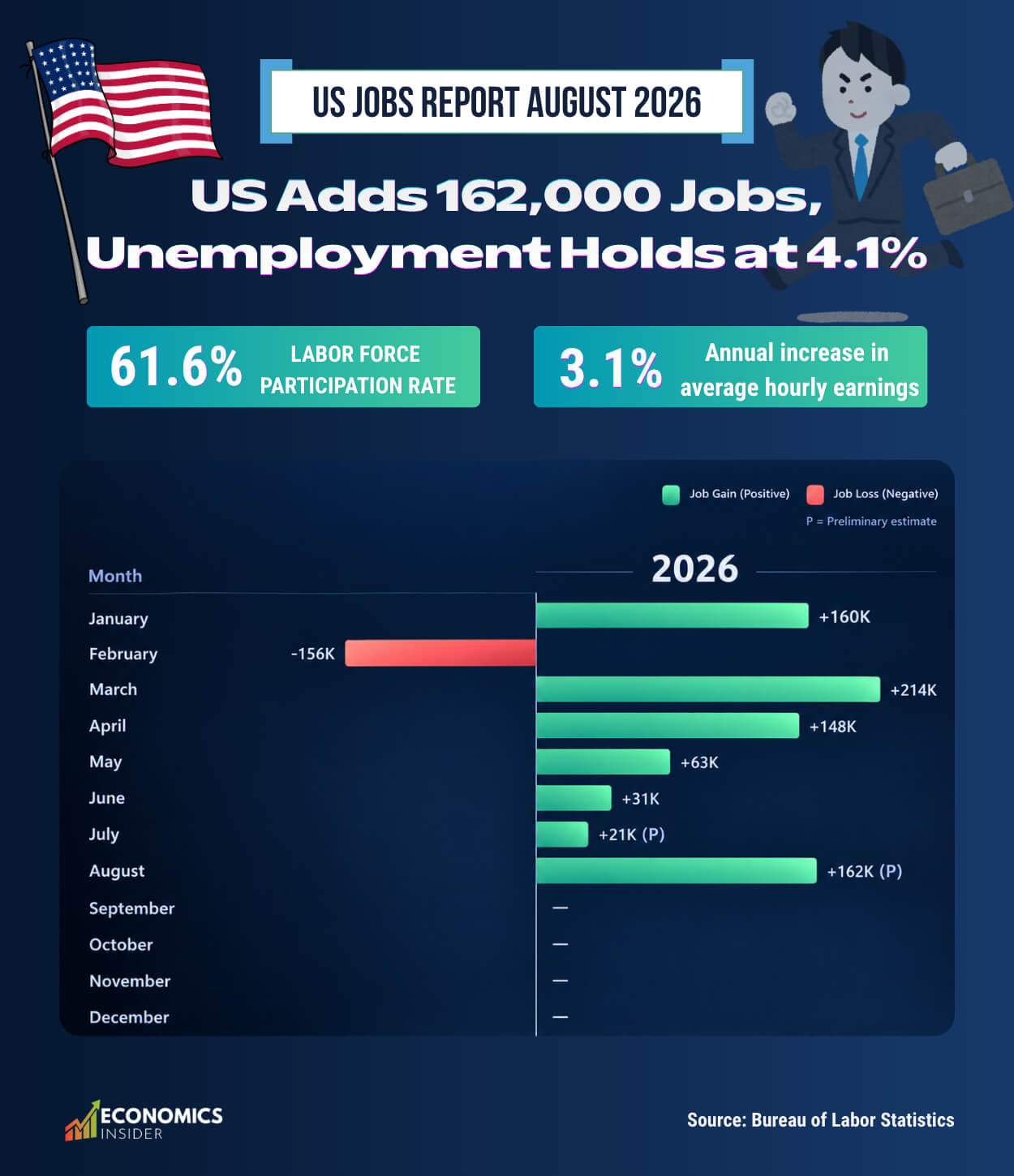
The US jobs report for August 2026 shows an important change from the weak job numbers seen earlier in the summer. American employers added 162,000 jobs in August, according to the latest report from the U.S. Bureau of Labor Statistics. The unemployment rate stayed at 4.1%, while the number of people in the labor force increased.
Key Takeaways
- The US economy added 162,000 jobs in August, three times more than what experts had predicted.
- The unemployment rate held steady at 4.1 percent, showing the job market did not weaken even with prices and interest rates still a concern.
- Almost all of the new jobs went to women, who made up about 98 percent of the total gain.
The August 2026 Jobs Report
The data in the table is taken from the U.S. Bureau of Labor Statistics (BLS) August 2026 Jobs Report.
| Measure | Aug-26 | What was expected |
|---|---|---|
| New jobs added | 162,000 | 53,000 |
| Unemployment rate | 4.10% | 4.10% |
| Average hourly pay | $37.75 (+0.3%) | — |
| Yearly pay growth | 3.10% | — |
| People working or looking for work | 61.60% | Higher than July |
| June + July jobs revised | Up 55,000 combined | — |
US Added 162,000 Jobs in August
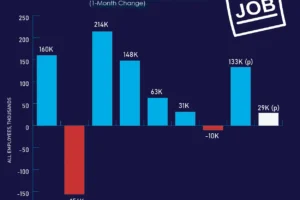
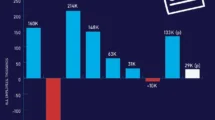
Nonfarm payroll employment increased by 162,000 jobs in August. Reuters reported that economists were anticipating for an increase of about 56,000 jobs. However, the August increase was the largest monthly gain since March .
| Month | 2025 Jobs Gain/Loss | 2026 Jobs Gain/Loss |
|---|---|---|
| January | -48K | +160K |
| February | +42K | -156K |
| March | +67K | +214K |
| April | +108K | +148K |
| May | +13K | +63K |
| June | -20K | +31K |
| July | +64K | +21K (P) |
| August | -70K | +162K (P) |
| September | +76K | — |
| October | -140K | — |
| November | +41K | — |
| December | -17K | — |
P = Preliminary.
The BLS also revised previous months’ figures higher. June’s job gain was revised from 20,000 to 31,000, while July changed from a reported loss of 23,000 jobs to a gain of 21,000. Together, the June and July revisions added 55,000 jobs to the previous estimates.
Restaurants and Local Education Led Job Growth
Much of August’s job growth came from a few industries. Food services and drinking places added 59,000 jobs, while leisure and hospitality added about 62,000 jobs. Local government education also added 42,000 jobs. These two areas accounted for a large part of the total increase.
Other industries also saw gains. Construction added jobs, manufacturing employment increased, and healthcare continued to grow. However, the gains were not spread evenly across the economy.
Some Industries Are Still Losing Jobs
The information industry continued to struggle. Employment in the information industry fell by 23,000 jobs in August, according to the BLS. Financial activities also lost jobs during the month.
This shows why looking only at the total number of jobs can be misleading. The US economy is still creating jobs, but some industries are expanding much faster than others.
U.S. Jobs Report July 2026: Economy Lost 23,000 Jobs as Hiring Weakens
Unemployment Stayed at 4.1%
The unemployment rate remained unchanged at 4.1% in August. About 7 million Americans were unemployed during the month. At the same time, the labor force grew by 683,000 people.
The labor force participation rate increased from 61.4% in July to 61.6% in August. This is a good sign for the U.S. economy because more people were either working or actively looking for work.
However, participation is still below the level seen at the start of the year. So while August brought an improvement, the labor market has not completely returned to its earlier strength.
Long-Term Unemployment Is Rising
One of the less positive parts of the August jobs report was long-term unemployment. The number of people unemployed for at least 27 weeks increased during the month. The median time unemployed also rose to 11.4 weeks.
This is important because a strong job market should not only create new jobs. Workers who lose their jobs should also be able to find new ones within a reasonable amount of time.
Wage Growth Remains Moderate
Wages continued to rise, but not at a fast pace. Average hourly earnings increased by 10 cents in August, reaching $37.75. Compared with a year earlier, average hourly earnings were up 3.1%. This is important for inflation.
When wages rise quickly, companies can face higher labor costs and may result in cost-push inflation. But with wage growth at around 3.1%, there is less evidence of a major wage-driven inflation problem.
Fewer Workers Were Forced Into Part-Time Jobs
Another positive detail was the decline in involuntary part-time employment. The number of people working part-time because they wanted a full-time job fell by about 414,000 in August. That means fewer workers were stuck with reduced hours or unable to find full-time employment.
What Does the August Jobs Report Mean for the US Economy?
The simplest way to describe the August report is this: The US labor market is weaker than it was during its strongest periods, but it is still far from collapsing.
The economy added 162,000 jobs, unemployment remained at 4.1%, and earlier job numbers were revised higher. The three-month average also improved compared with the previous period. Reuters reported that job growth averaged about 71,000 per month over the three months through August.
That is still a relatively slow pace of hiring. But compared with the very weak numbers reported earlier in the summer, August shows a clear improvement.
What Does the Jobs Report Mean for the Federal Reserve?
The report could make the Federal Reserve’s next interest-rate decision more difficult. A resilient labor market gives the Fed less reason to worry about rising unemployment.
At the same time, the Fed is still dealing with inflation. The robust August jobs report increased expectations that the Fed could raise interest rates at its September 15–16 meeting. Reuters reported that financial markets were pricing in roughly a 60% chance of a rate increase following the jobs report.
However, the jobs report will not be the only factor.
The Fed will also be watching the next inflation numbers closely. The August Consumer Price Index is scheduled for release on September 11, just days before the Fed’s meeting. If inflation remains high, the strong labor market could give the Fed more reason to keep interest rates high or raise them.
If inflation falls sharply, the Fed could take a different approach.
The Bottom Line
The August 2026 US jobs report was much better than expected. The US added 162,000 jobs, unemployment remained at 4.1%, and previous months were revised higher. Restaurants, local government education, construction and manufacturing were among the areas supporting job growth.
But the report is not entirely positive. Long-term unemployment increased, some industries continued to lose jobs, and overall hiring remains slower than it was during stronger periods.