


















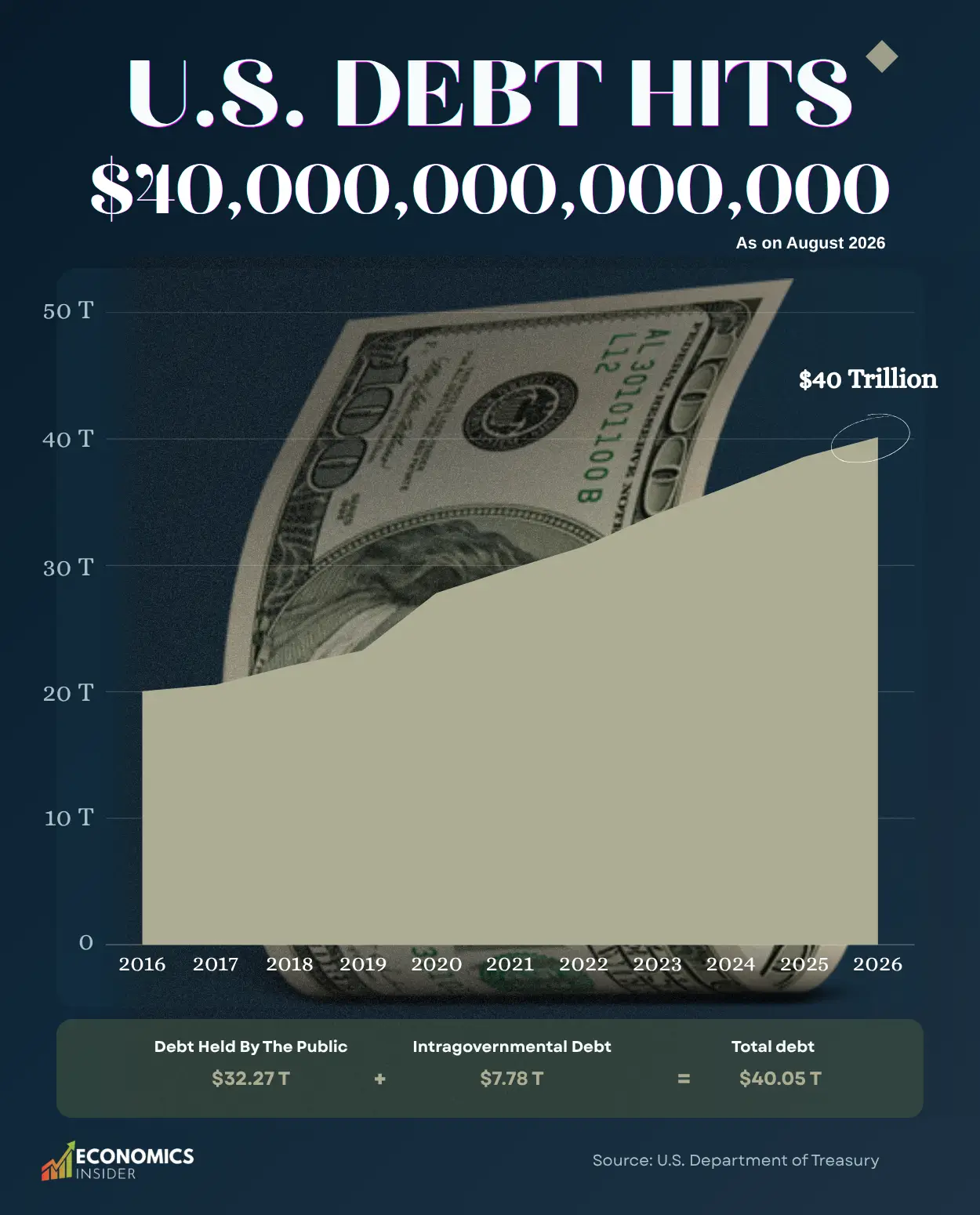
The U.S. national debt has crossed $40 trillion, a number that once seemed almost impossible to imagine. On August 18, 2026, the federal government’s gross debt reached approximately $40.047 trillion, according to the U.S. Treasury’s Debt to the Penny data. That was up from about $39.987 trillion just one day earlier.
America’s debt has more than doubled since 2017. At the same time, the government continues to run large annual deficits, while the cost of servicing the existing debt is becoming one of the fastest-growing items in the federal budget.
Key Takeaways
- U.S. gross national debt has surpassed $40 trillion, reaching about $40.047 trillion on August 18, 2026.
- The debt has more than doubled since 2017, when it was around $20 trillion.
- The government is still expected to run a $1.9 trillion budget deficit in 2026, according to the CBO.
- Net interest costs are projected to exceed $1 trillion in 2026 and reach about $2.1 trillion by 2036.
$40 Trillion: What Exactly Does That Number Mean?
The U.S. national debt is usually referred to gross federal debt. This includes two major components:
| Component | Approx. amount |
| Debt held by the public | $32.27 trillion |
| Intragovernmental debt | $7.78 trillion |
| Total gross federal debt | $40.05 trillion |
| Source: U.S. Department of the Treasury |
The $32.27 trillion owed to the public includes Treasury securities held by investors outside the federal government, including households, businesses, financial institutions, the Federal Reserve, and foreign investors.
The other $7.78 trillion represents debt the federal government owes to other federal government accounts, such as trust funds.
Together, they make up the $40.047 trillion gross debt recorded on August 18.
America’s Debt Has Doubled Since 2017
The simplest way to understand the scale of the increase is to look at the milestones.
| Year | U.S. Gross Federal Debt |
| 2017 | ~$20 trillion |
| 2020 | ~$27.7 trillion |
| 2022 | ~$30 trillion |
| 2025 | ~$38 trillion |
| March 2026 | ~$39 trillion |
| August 2026 | $40.047 trillion |
| Source:U.S. Department of the Treasury |
The exact debt balance changes every day as the Treasury collects revenue, makes payments, and issues new debt. But the broader trend is unmistakable. The national debt has roughly doubled in less than a decade. And the pace has accelerated during periods of crisis.
How Did the U.S. Accumulate $40 Trillion?
The national debt is not the result of one single event or one president. It is the accumulated result of decades in which the federal government has generally spent more money than it collects in taxes and other revenues.
That gap is the budget deficit. When the government runs a deficit, it has to borrow money to make up the difference.
In simple terms:
Government spending > Government revenue → Budget deficit → More borrowing → More debt
The United States has run persistent deficits for much of the past several decades. But several periods dramatically increased borrowing.
The Financial Crisis
Back in 2008, the financial crisis hit hard. The economy shrank, tax revenue dropped, and the government had to spend big just to keep things from falling apart.
The Pandemic
Then came COVID-19, and this time the spending was even bigger. The government sent money to households, propped up businesses, funded hospitals, and helped states stay.
Spending Never Really Went Back Down
Once the pandemic passed, spending didn’t shrink back to where it used to be. Programs like Social Security, Medicare, and Medicaid still eat up a massive chunk of the federal budget every single year.
Policy Choices Add Up Too
On top of that, tax cuts, defense budgets, and other spending decisions all play a role in how big the yearly deficit gets. Put it all together, and the government keeps borrowing — even when the economy is doing fine.
America Is Still Running Large Deficits
Reaching $40 trillion would be less concerning if the government were now running large surpluses and paying the debt down. Instead, it continues to spend more than it collects in revenue, forcing the government to borrow even more each year.
The CBO projects a $1.9 trillion federal budget deficit in fiscal year 2026. It expects the deficit to grow to about $3.1 trillion by 2036. That means the government is not simply carrying a $40 trillion balance. It is continuing to add to it.
CBO estimates that deficits will average roughly $2.4 trillion per year from 2027 through 2036, producing a cumulative deficit of about $24.4 trillion over that period under its baseline projections.
Why Interest Is Becoming the Real Problem
Borrowing money creates another expense: interest. The federal government has to pay interest to the investors and institutions that hold Treasury securities. And as the amount of debt increases, the government has more debt on which it must pay interest. Higher interest rates make the problem even more expensive.
The CBO estimates that federal net interest costs will exceed $1 trillion in 2026, up from about $970 billion in 2025. It projects those costs will reach approximately $2.1 trillion by 2036.
| Fiscal year | Net interest |
| 2025 | ~$970 billion |
| 2026 | >$1 trillion |
| 2036 | ~$2.1 trillion |
CBO projects net interest will rise from 3.3% of GDP in 2026 to 4.6% in 2036. And this creates a difficult feedback loop.
More debt → more interest → larger deficits → more borrowing → even more debt
That is why the $40 trillion debt milestone matters more than the headline number itself.
Why Interest Rates Matter So Much
The government does not pay the same interest rate on every dollar of debt. Treasury securities have different maturities and interest rates. Some debt was issued years ago at relatively low rates.
But as those securities mature, the Treasury has to refinance them. If new borrowing costs more than the old debt, the government’s interest bill gradually rises.
CBO estimates that the average interest rate on debt held by the public will be around 3.4% in 2026 and rise to about 3.9% in the later years of its projection period. This is why today’s interest rates can affect government finances for years.
The Treasury doesn’t need to refinance the entire $40 trillion at today’s rates. But as old securities mature and new debt is issued, the cost of borrowing gradually reflects the new interest-rate environment.
$40 Trillion Compared With the U.S. Economy
The raw debt number is enormous, but economists usually look at debt relative to the size of the economy. This is the debt-to-GDP ratio. It helps answer a more useful question:
How large is the government’s debt compared with the economy that generates the income and tax revenue used to support it?
As of August 2026, the U.S. gross federal debt is roughly 124% of U.S. nominal GDP, based on $40 trillion in debt and $32.38 trillion in nominal GDP.
This is different from the debt-to-GDP measure commonly used by the CBO, which focuses on debt held by the public and is projected at 101% of GDP in 2026. Under its baseline, that figure rises to 120% of GDP by 2036. That would put debt held by the public well above the previous post-World War II record of 106% of GDP.
Top Foreign Holders of U.S. national debt?
As of June 2026, foreign countries together hold roughly $9.3 trillion of U.S. debt. Japan is the single biggest foreign lender, holding just over $1.2 trillion, followed by the United Kingdom at around $940 billion. China comes in third these days, at roughly $633 billion — well below where it stood a decade ago, as Beijing has been quietly stepping back from Treasury bonds for years.
Even added all together, foreign countries only hold about a quarter of America’s debt. The rest is owed to Americans themselves: U.S. banks, pension funds, mutual funds, individual investors, and government trust funds. So, the U.S. mostly owes this money to its own people and institutions, not to foreign governments.
So Does That Mean Every American Owes $40 Trillion?
No — and this is worth clearing up. The government doesn’t owe this money to its own citizens directly, and it definitely doesn’t need to pay the whole thing back tomorrow.
Think of the debt as a running total of everything the government has borrowed over time, through bonds that come due at different points. The government handles it the same way it always has: collecting taxes, paying off old bonds as they come due, and issuing new ones to cover the gap.
The bigger the debt gets, the more of the government’s yearly income has to go toward just paying interest on it. And if borrowing keeps climbing, that interest bill eats up more and more money that could’ve gone toward other things.
What Happens If Debt Keeps Growing?
A growing debt burden does not automatically mean an economic crisis is about to happen. The United States has some important advantages.
It has the world’s largest economy, strong financial market, and the dollar remains the dominant international reserve currency. Treasury securities are also widely regarded as among the world’s most important financial assets.
But those advantages do not make borrowing costless. Persistent large deficits can place upward pressure on interest rates, particularly when investors require greater compensation to lend to the government.
Higher rates can then affect the private economy.
For example:
Higher Treasury yields → higher borrowing costs → more expensive mortgages and business loans → potentially less private investment
CBO explicitly notes that increased federal borrowing can raise interest rates and crowd out private investment.
What the CBO Forecast Says About the Next Decade
The CBO’s projections offers a useful view of where current policies could lead the U.S. economy and federal finances.
| Measure | 2026 | 2036 |
| Federal deficit | $1.9T | $3.1T |
| Debt held by public / GDP | 101% | 120% |
| Net interest / GDP | 3.3% | 4.6% |
| Net interest | >$1.0T | ~$2.1T |
| Federal outlays / GDP | 23.3% | 24.4% |
| Federal revenues / GDP | 17.5% | 17.8% |
| Source: Congressional Budget Office |
These are projections, not predictions of exactly what will happen. They are CBO’s baseline based on laws and policies included in its February 2026 outlook. Changes in taxes, spending, economic growth and interest rates could materially change the numbers.
The Bottom Line
The United States has now crossed a historic threshold. $40 trillion in national debt. But the most important number isn’t $40 trillion itself. It is what comes next.
The government is still running large deficits. Interest costs are already above $1 trillion a year. And the Congressional Budget Office expects debt held by the public to rise from 101% of GDP in 2026 to 120% by 2036.
The United States can continue borrowing for a long time. The dollar’s global role, the size of the U.S. economy and the depth of the Treasury market give Washington considerable financial advantages.
But borrowing is not free. Every new dollar of debt adds to the amount that must eventually be serviced. And when interest payments themselves become large enough, the government can find itself borrowing not only to finance today’s spending—but increasingly to cover the cost of yesterday’s borrowing.