









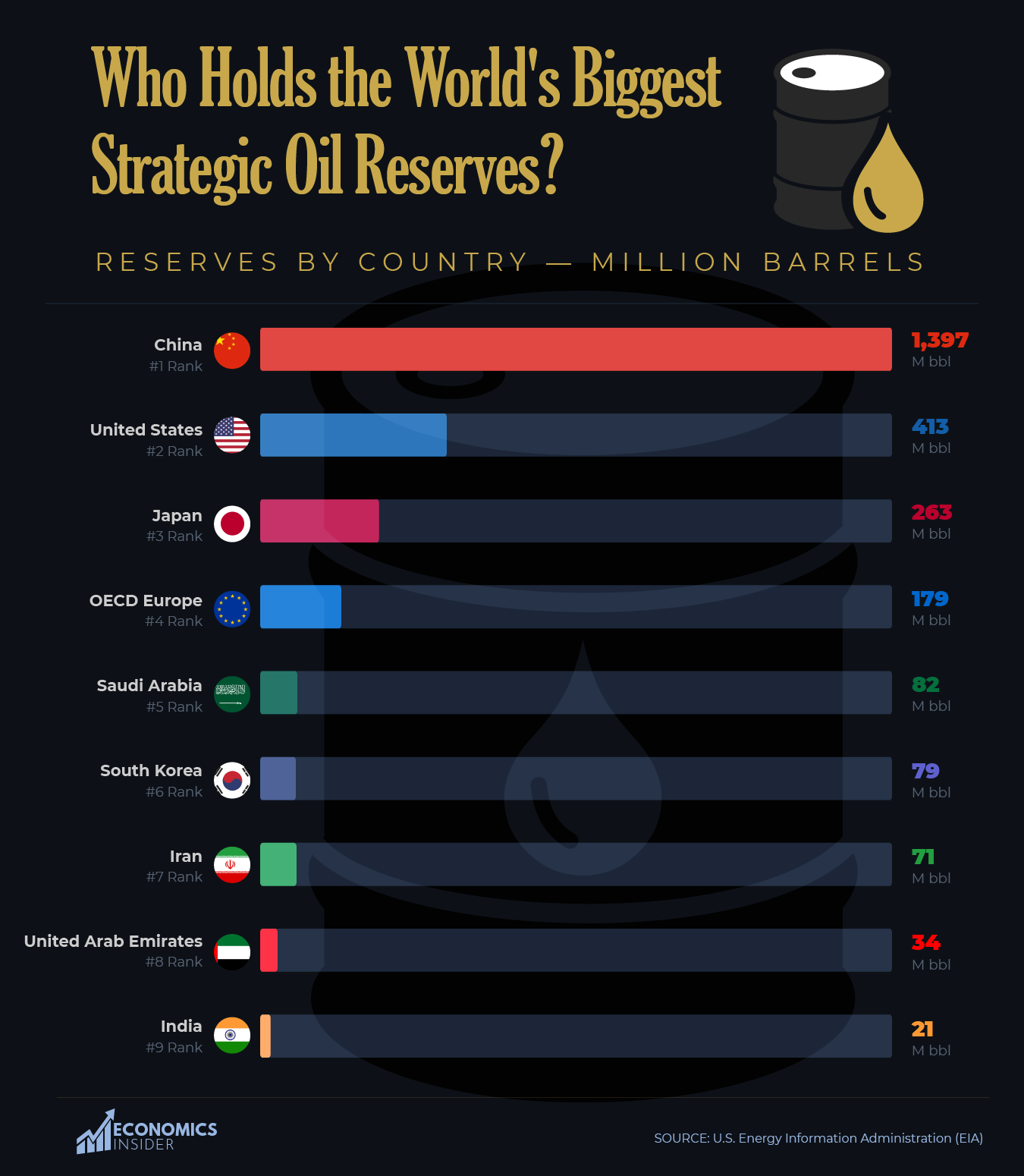
According to data from the U.S. Energy Information Administration (EIA), China, the United States, and Japan held the world’s largest strategic crude oil inventories in 2025. China leads by a massive margin with nearly 1.4 billion barrels of strategic oil reserves. The United States comes second with 413 million barrels, while Japan ranks third with 263 million barrels. Together, these three countries hold more than two-thirds of all the strategic oil reserves.
What are strategic oil inventories?
Strategic oil inventories are stockpiles of oil that governments set aside specifically for emergencies. Think of them as a national savings account, but for fuel. If a war breaks out, a natural disaster hits oil-producing regions, or a major supply disruption happens, these reserves can be released to keep the country running. They are not meant for everyday use — they are a backup for when things go wrong.
Key Takeaways
- China’s reserves are so large they dwarf every other country — its 1,397 million barrels account for nearly half of all the strategic oil reserves held by major countries and orgnizations.
- The United States still maintains one of the world’s largest emergency oil reserves despite years of reserve releases.
- Even big oil-producing nations like Saudi Arabia and the UAE hold surprisingly modest reserves compared to major importing countries like China and Japan.
Strategic oil inventories by country
The table below shows estimated strategic crude oil inventories in selected countries as of December 2025. The data is sourced from the U.S. Energy Information Administration (EIA).
| Rank | Country / Region | Stored Reserves |
|---|---|---|
| 1 | 🇨🇳 China | 1,397M bbl |
| 2 | 🇺🇸 United States | 413M bbl |
| 3 | 🇯🇵 Japan | 263M bbl |
| 4 | 🇪🇺 OECD Europe | 179M bbl |
| 5 | 🇸🇦 Saudi Arabia | 82M bbl |
| 6 | 🇰🇷 South Korea | 79M bbl |
| 7 | 🇮🇷 Iran | 71M bbl |
| 8 | 🇦🇪 United Arab Emirates | 34M bbl |
| 9 | 🇮🇳 India | 21M bbl |
🇨🇳 China
China has built the world’s largest strategic oil inventory as part of its long-term energy security strategy. Over the past two decades, China has gone from having almost no strategic reserves to building the largest stockpile in the world. This did not happen by accident.
China knows that its economy runs on oil, and that it imports enormous amounts of it from countries far away. Because of this dependence, Beijing has spent years expanding storage facilities and filling reserves whenever oil prices were relatively low.
🇺🇸 United States
The United States operates one of the most famous emergency oil systems in the world through the Strategic Petroleum Reserve (SPR). The reserve was created after the oil crisis of the 1970s, when energy shortages caused major economic problems across Western countries.
Although the U.S. reserve has declined from earlier peak levels, it still remains the second-largest strategic oil inventory globally. Washington has used parts of the reserve in recent years to stabilize fuel markets and respond to supply disruptions.
Top 10 Countries With Largest Oil Reserves in the World (2026)
🇯🇵 Japan
Japan has almost no oil of its own, yet it maintains the third-largest strategic reserve in the world at 263 million barrels. The reason behind this ranking is that the country depends heavily on imported crude oil.
Japan’s reserves are managed both by the government and by private oil companies, which are required by law to maintain a certain level of stock. Such oil reserves assist in providing a constant supply of fuel when unexpected situations arise.
Other Countries
OECD Europe sits at number four with 179 million barrels, but this figure covers an entire group of countries rather than a single nation. Saudi Arabia, at 82 million barrels, and South Korea, at 79 million barrels, are close together in fifth and sixth place. Iran follows with 71 million barrels. What is interesting here is that Saudi Arabia — the world’s most famous oil producer — keeps a relatively modest strategic reserve.
At the bottom of the list, the United Arab Emirates holds 34 million barrels, and India holds just 21 million barrels. India has been working to expand its strategic reserves in recent years.
Conclusion
Strategic oil reserves continue to be an essential tool in ensuring energy security in today’s world. In light of geopolitical conflicts, wars, and supply shortages that continue to threaten energy markets across the world, strategic oil reserves have taken on more importance than ever before.
China, America, and Japan are taking the lead in this trend. The sheer size of their oil reserves underscores the importance of energy security in the contemporary world.