






















The United States is the largest economy in the world. It produces trillions of dollars in goods and services every year, leads global financial markets, and issues the world’s most trusted currency. But behind this economic strength lies a growing concern — the country’s national debt.
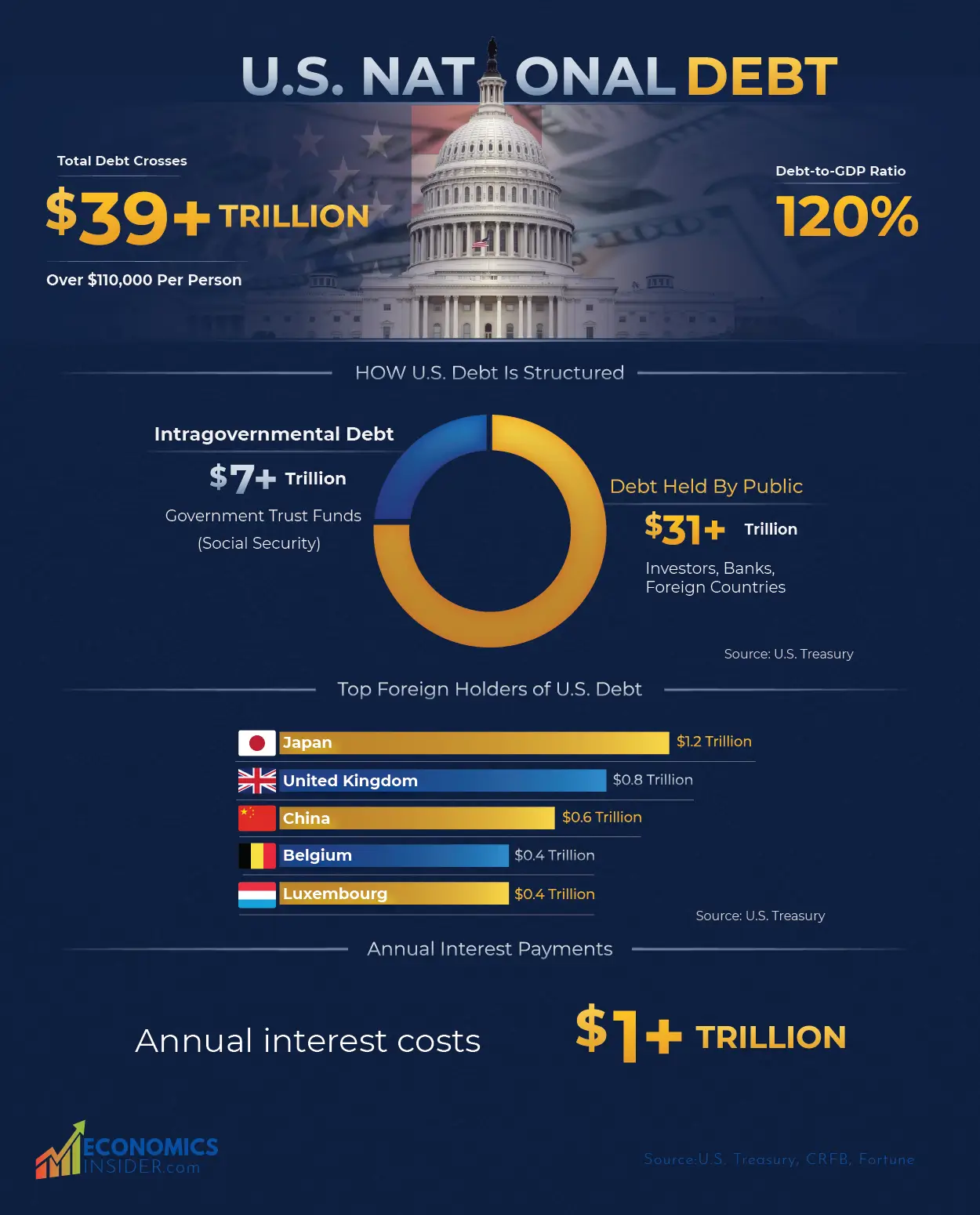
As of 2026, the U.S. national debt has crossed $39 trillion, according to the U.S. Department of the Treasury. Out of this massive total, debt held by the public stands at around $31.4 trillion, and Intragovernmental holdings — money the government owes to itself — are about $7.6 trillion.
This number is so large that it becomes almost impossible to imagine. It is larger than the entire annual economic output of many countries combined. At the same time, this debt continues to grow rapidly. In recent years, the U.S. has been adding trillions of dollars in debt within just a few years, especially after the COVID-19 pandemic and continued budget deficits.
In this guide, we will break down the U.S. national debt in simple and clear language, so anyone can understand one of the most important economic issues in the world today.
📊What Is U.S. National Debt?
U.S. national debt is the total amount of money that the federal government has borrowed over time. Every government spends money on things like defense, healthcare, infrastructure, education, and social programs. To fund these expenses, the government collects taxes.
But for many years, the government has spent more than it earns. When that happens, it needs to borrow money to cover the gap. This borrowing is what creates national debt. The official data is tracked by the U.S. Treasury, which records how much the government owes at any given time.
To understand this better, imagine a simple example.
If the government collects $4 trillion in taxes but spends $6 trillion, it creates a gap of $2 trillion. That $2 trillion is borrowed from investors, banks, and institutions. Over time, these yearly borrowings add up. After decades of deficits, the total becomes trillions of dollars. This is why the U.S. debt has reached such a massive level today.
Global Debt Hits $348 Trillion: Is the World Economy at Risk?
💡Debt vs Deficit: A Critical Difference
One of the most common misunderstandings in economics is the difference between debt and deficit. These two terms are related, but they are not the same.
A budget deficit refers to the amount the government borrows in a single year. It is the yearly shortfall between spending and revenue. On the other hand, national debt is the total accumulation of all past deficits.
You can think of it like personal finance. If you spend more than your income in one month, that is your deficit. If you keep doing that every month, your total unpaid balance becomes your debt.
The United States has been running deficits almost every year. According to projections, the country is expected to run deficits of around $1.8 to $2 trillion annually in the coming years. Because of this, the total debt keeps increasing.
📈How Did U.S. National Debt Grow So Fast?
The United States did not always have such a high level of debt. In fact, in 1980, total federal debt was less than $1 trillion. The rise to over $38 trillion happened over several decades, driven by key economic and political events.
In the 1980s, tax cuts combined with higher government spending increased deficits. This was one of the first major periods where debt began to grow quickly.
In 2008, the global financial crisis forced the government to spend heavily to stabilize banks and support the economy. This led to another surge in government borrowing.
But the biggest jump came during the COVID-19 pandemic. The government introduced massive stimulus programs to support households and businesses. And to fund these programs, trillions of dollars were spent in a short period. This pushed the debt above $30 trillion within just a few years.
Experts now estimate that the U.S. is adding debt at a historically fast pace, sometimes approaching $1 trillion every few months due to persistent deficits and rising spending.
📊Breaking Down the U.S. Debt
U.S. national debt is not a single uniform number. It is divided into two main categories.
The first is debt held by the public. This includes money borrowed from investors, banks, pension funds, and foreign governments. This is the largest portion of the debt and is actively traded in financial markets. As of 2026, debt held by the public stands at around $31.4 trillion, making up the majority of the United States’ total national debt.
The second is intragovernmental debt. This is money the government owes to itself. For example, programs like Social Security collect more money than they spend in some years. The surplus is invested in government bonds, which creates internal debt. As of 2026, intragovernmental debt stands at around $7.6 trillion, which represents the portion the government owes within its own accounts.
Both of these together make up the total national debt.
🌍Who Owns U.S. Debt?
A common belief is that foreign countries like China own most of the U.S. debt. However, this is not true.
The majority of U.S. debt is actually owned domestically. American institutions such as pension funds, mutual funds, and banks hold a large share of government bonds. These institutions invest in U.S. Treasury securities because they are considered safe and reliable.
Top 15 Largest US Treasury Holders in 2025: Who Owns America’s Debt?
Another major holder is the Federal Reserve, which buys government bonds as part of its monetary policy operations.
Foreign countries do own a portion of the debt. Nations like Japan, the United Kingdom, and China are among the largest foreign holders of U.S. Treasury bonds. However, their share is much smaller compared to domestic ownership. This structure is important because it means the U.S. is not heavily dependent on foreign creditors alone.
📊Understanding Debt-to-GDP Ratio
To understand whether debt is sustainable, economists use a measure called the debt-to-GDP ratio. This compares total debt to the size of the economy. If a country has high debt but also a large economy, it may still be manageable. But if debt grows faster than the economy, it becomes a concern.
Currently, U.S. debt is around 120% of GDP, meaning the country owes more than its entire annual economic output. Historically, this level is very high. The last time the U.S. reached similar levels was after World War II. Projections suggest that debt could continue rising and exceed previous historical records within the next decade.
💰The Real Problem: Interest Payments
While the total debt number is important, the real issue lies in the cost of managing that debt. Every year, the government must pay interest to those who lend it money. And this cost is rising rapidly.
In recent data, the U.S. government has already paid hundreds of billions in interest within just a few months, and annual interest costs are now exceeding $1 trillion per year.
Projections show that interest payments could reach $2 trillion annually by 2036, making it one of the largest government expenses.
This means the government may soon spend more on interest than on major programs like defense or healthcare.
📉Why Interest Costs Are Rising So Fast
Interest costs are increasing due to two main reasons.
First, interest rates have risen. When borrowing becomes more expensive, the cost of servicing existing debt also increases.
Second, the total debt itself is larger. Even small interest rates on a very large debt can result in massive payments.
For example, if you have $1 trillion in debt, even a small increase in interest rates can add billions in additional costs. This creates a cycle where rising debt leads to higher interest payments, which then require more borrowing.
🏛The Debt Ceiling and Political Risk
The United States has a unique system known as the debt ceiling. This is a legal limit on how much the government can borrow. It is set by the U.S. Congress. When the government reaches this limit, it cannot borrow more unless Congress raises the ceiling.
This often leads to political conflicts and uncertainty in financial markets. If the debt ceiling is not raised in time, the government could face a situation where it cannot meet its financial obligations.
⚠️What Happens If the U.S. Defaults?
A default occurs when a country fails to pay its debt. The United States has never defaulted on its obligations in modern history. However, even the possibility of default can create serious risks.
If the U.S. were to default, global financial markets would be severely disrupted. Investors would lose confidence in U.S. government bonds, which are considered one of the safest assets in the world.
Interest rates would rise sharply, borrowing would become more expensive, and the value of the dollar could fall. Because of these risks, policymakers usually take action to avoid default.
📉Does High Debt Cause Inflation?
The relationship between debt and inflation is complex. Debt itself does not automatically cause inflation. However, if the government spends excessively and finances that spending through borrowing or money creation, it can lead to inflationary pressure.
During the COVID-19 period, large stimulus spending combined with low interest rates contributed to a surge in inflation. The Federal Reserve plays a key role in controlling inflation through monetary policy measures by adjusting interest rates.
💵Could Rising Debt Weaken the Dollar?
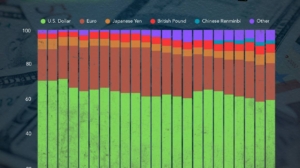
The U.S. dollar is the world’s primary reserve currency. It is widely used in global trade and finance. However, rising debt raises long-term concerns.
Share of Global Foreign Exchange Reserves by Currency And the US Dollar Dominance
If investors begin to question the sustainability of U.S. debt, they may reduce their reliance on the dollar. Some countries are already exploring alternatives and diversification strategies. Despite this, the dollar remains dominant due to the size and strength of the U.S. economy.
🌍Is the Current Debt Path Sustainable?
Many economists are now debating whether the current path of U.S. debt is sustainable.
According to projections, deficits are expected to remain high for years, and debt will continue to rise as a share of the economy.
Some forecasts suggest that federal debt held by the public will rise 120% of GDP by 2036 and continue increasing beyond that.
At the same time, economic growth is expected to slow, averaging around 1.7% annually over the long term, which makes managing debt more difficult (same source). This combination of rising debt and slower growth raises concerns about long-term sustainability.
👨👩👧Debt Per Person: A Simple Perspective
One way to understand the scale of U.S. debt is to divide it by the total population. On average, each American effectively carries a share of over $110,000 in national debt.
While individuals are not directly responsible for paying this amount, it highlights the scale of the government’s borrowing.
🇯🇵Comparing the U.S. with Japan
Japan has the largest debt-to-GDP ratio in the world, exceeding 250%. However, Japan’s total debt is much smaller than that of the United States due to its smaller economy relative to the U.S. Also, most of its debt is owned domestically, and interest rates have remained very low for years.
This shows that high debt alone does not automatically lead to a crisis. What matters is who owns the debt and how expensive it is to manage.
📊Can the U.S. Ever Pay Off Its Debt?
Unlike individuals, governments do not need to fully repay their debt. Instead, they manage it by continuously borrowing and refinancing. This means old debt is replaced with new debt, and the system continues as long as investors are willing to lend.
The key is not to eliminate debt, but to keep it at a manageable level relative to the economy.
🔮Future Outlook: What Lies Ahead
Looking ahead, the future of U.S. debt will depend on several key factors.
Economic growth will play a major role. A strong economy can support higher levels of debt. Interest rates will also be critical. Higher rates increase borrowing costs and make debt more difficult to manage. Additionally, government policy decisions, including spending and taxation, will shape the long-term trajectory.
If current trends continue, debt and interest payments are expected to rise significantly in the coming decades.
🧠 Final Thoughts
U.S. national debt is one of the most important economic issues in the world today. It is massive, growing rapidly, and becoming increasingly expensive to manage.
However, it is not an immediate crisis. The United States still has strong economic fundamentals, global financial influence, and the ability to borrow at scale.
The real concern is not the size of the debt, but the direction in which it is heading. If debt continues to grow faster than the economy and interest costs keep rising, it could become a serious challenge in the future.
📌Summary
U.S. national debt has reached over $38 trillion and continues to grow due to persistent budget deficits. Most of the debt is held domestically, and the key risk comes from rising interest payments rather than the debt itself. While the system remains stable for now, long-term sustainability depends on economic growth, interest rates, and government policy decisions.