








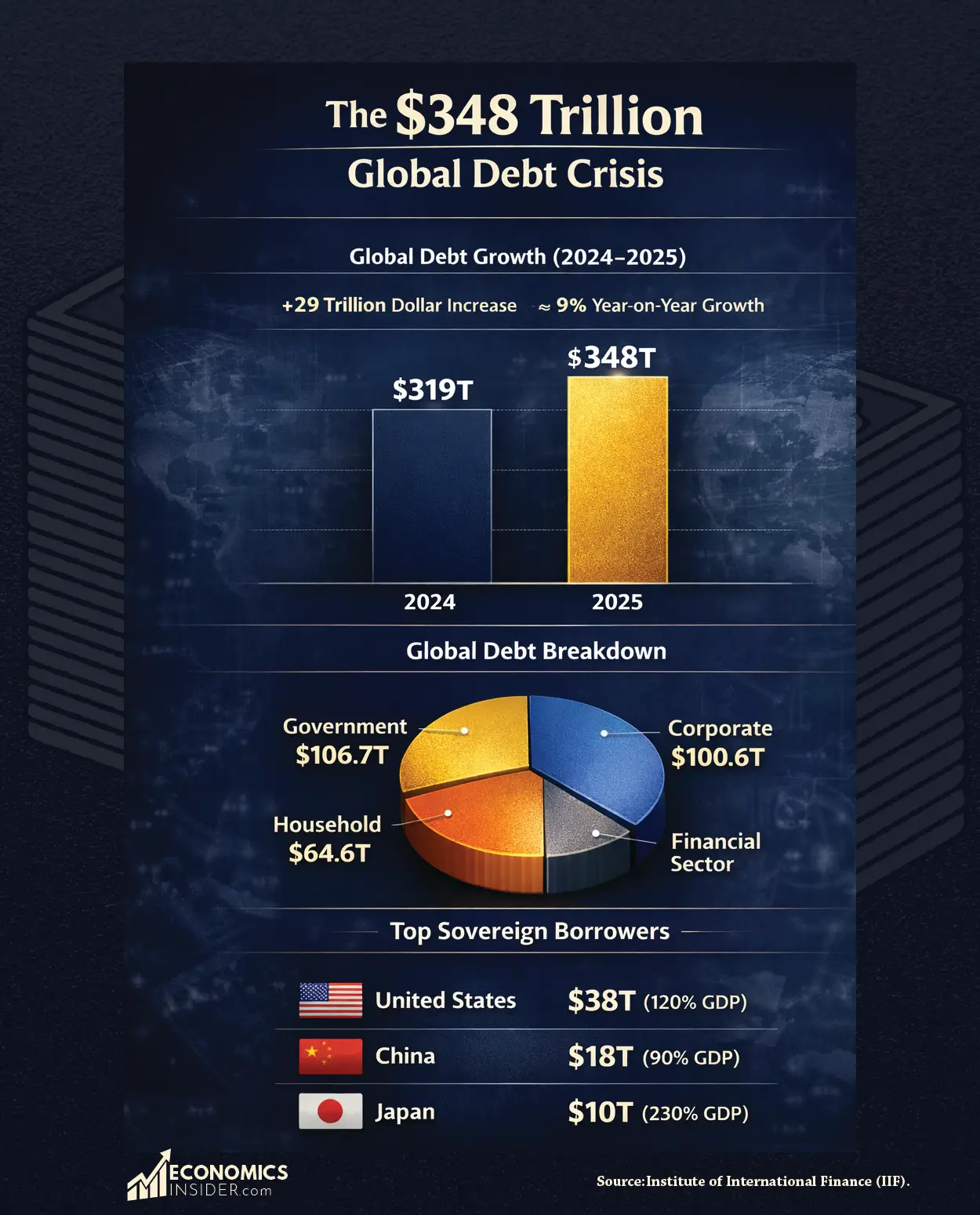
At the end of 2025, the global economy crossed yet another historic threshold. Total global debt surged to $348 trillion. In just one year, nearly $29 trillion was added — the fastest annual increase since the pandemic-era surge. These figures come from the latest Global Debt Monitor report by the Institute of International Finance (IIF).
$348 trillion represents roughly 308% of global GDP. In simple terms, the world owes more than three times what it produces in a year.
Who Owes What?
Out of the total 348 trillion dollars in global debt, governments owe about 106.7 trillion dollars. Non-financial companies owe around 100.6 trillion dollars, while household debt stands at about 64.6 trillion dollars. The rest belongs to the financial sector, including banks and other financial institutions. This clearly shows an important shift in the global economy.
Governments are now the largest borrowers and have become the main force behind the rise in global debt.
Why Are Governments Borrowing So Much?
More than 10 trillion dollars of the 2025 increase came from government borrowing alone. Nearly 75 percent of that rise was driven by three major economies: the United States, China, and the European Union.
These are the world’s largest economies. Their fiscal decisions influence global liquidity, bond markets, and interest rates.
The United States remains the world’s largest debtor in absolute terms. Its national debt has surpassed 38 trillion dollars. That means the U.S. alone accounts for roughly 11 percent of total global debt. Its debt-to-GDP ratio stands near 120 percent, meaning the country owes more than it produces in a year.
China is the second-largest debtor in absolute terms, with government debt estimated at around 18 trillion dollars. Its debt-to-GDP ratio is about 90 percent, lower than that of the United States. However, China’s total debt burden becomes much larger when corporate and local government borrowing are included. Its growth model relies heavily on credit and investment.
Japan is also among the largest debtor nations, with government debt close to 10 trillion dollars. What makes Japan unique is its very high debt-to-GDP ratio, which exceeds 230 percent — the highest in the world. However, most of Japan’s debt is owned domestically. This reduces the risk of sudden pressure from foreign investors.
Strong Demand for U.S. Treasury Bonds
There has been a lot of discussion about weak U.S. fiscal balances and rising deficits. Some believe foreign investors are moving away from the United States due to diversification and de-dollarization efforts.
However, according to the report, demand for U.S. debt securities remains strong. The safe-haven status of U.S. Treasury bonds continues. Foreign investors are still buying U.S. assets, including Treasuries, stocks, and corporate bonds. This strong demand is supported by relatively solid U.S. economic performance.
This contrasts with the recent narrative that foreign capital is leaving the United States. So far, global investors still view U.S. financial markets as stable and reliable compared to many alternatives.
Government Debt vs Private Debt
After the pandemic, private sector debt has slowed down somewhat. But government debt keeps rising.
There is a simple reason for this difference. Private companies usually borrow to invest and earn profits. If their investments fail, they cut back borrowing. Governments, on the other hand, borrow to fund public spending, defense, infrastructure, social programs, and political commitments. Political pressures can sometimes push borrowing higher, even when fiscal discipline weakens.
Persistent budget deficits, rising defense spending, infrastructure projects, and subsidies have all contributed to the steady rise in government debt.
Debt vs Growth: A Growing Imbalance
The biggest concern is not just rising debt. It is the gap between debt growth and economic growth.
According to projections from the International Monetary Fund, global growth in 2026 is expected to be around 3.1 percent. Advanced economies may grow by about 1.6 percent, while emerging markets could expand by about 4 percent.
Now compare that with debt growth. If debt rises at 8 to 10 percent per year while economies grow at only 3 to 4 percent, the burden increases. Debt compounds faster than income.
This is why emerging market debt-to-GDP ratios have climbed above 235 percent, reaching record highs.
In 2026, emerging markets will need to refinance more than 9 trillion dollars in debt. Developed countries must refinance over 20 trillion dollars. Refinancing means taking out new loans to repay old ones.
If global interest rates rise or the U.S. dollar strengthens, refinancing becomes more expensive. Local currencies may weaken. Foreign debt costs could increase. Investors might pull out funds. Bond markets could face stress. This type of pressure has often triggered financial crises in the past.
Corporate Borrowing and the AI Supercycle
After governments, non-financial corporations are the second-largest borrowers. Their debt now exceeds 100 trillion dollars.
A major driver behind this borrowing is a new wave of investment linked to artificial intelligence, data centers, semiconductor manufacturing, green energy, and supply chain restructuring.
The report describes this as the beginning of a new global capital expenditure supercycle. A supercycle is a long period of strong and sustained investment. It is driven by structural changes, not just short-term economic growth.
Several forces are pushing this cycle forward:
- The global race for artificial intelligence
- The shift toward clean energy
- Rising geopolitical tensions
- The push for national and economic security
Many countries are trying to reduce dependence on foreign suppliers. They are bringing production back home or shifting it to trusted partner countries. This is known as reshoring or friend-shoring.
The AI race, in particular, is reshaping capital markets. Large technology and industrial firms are borrowing heavily from bond markets to finance expansion.
Conclusion
The world is now at a critical point. Governments have become the largest borrowers. Emerging markets face record refinancing pressure. Corporate borrowing is rising due to the AI investment wave. At the same time, economic growth remains moderate. If growth stays weak while debt continues to rise, the risk of financial instability could increase in the coming years.