




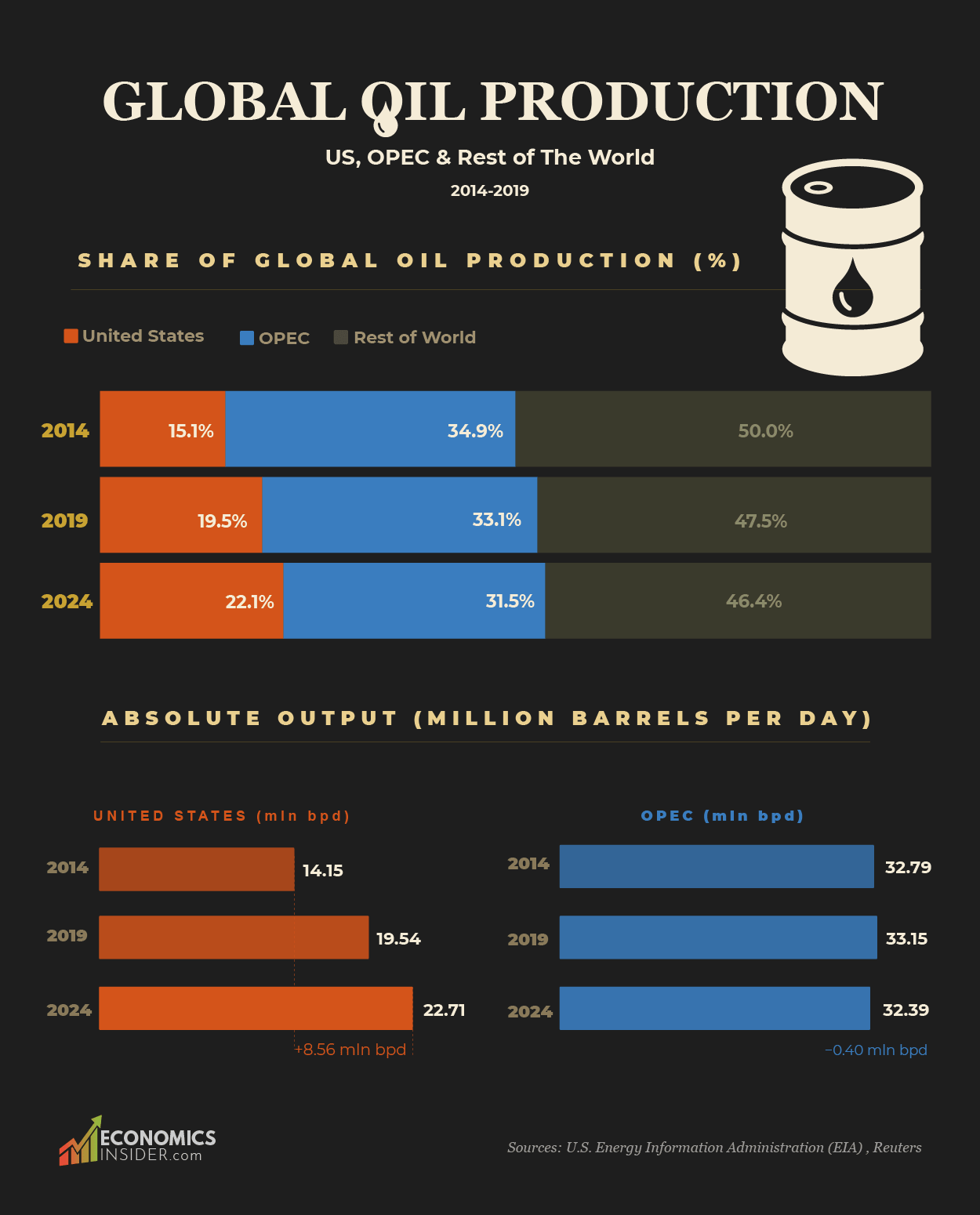
The United States and OPEC together account for a large share of the world’s oil supply. But the balance of power between them has been quietly shifting. Back in 2014, OPEC was the undisputed king of oil. The group of major producing nations was pumping 32.79 million barrels per day, while the US was producing 14.15 million. The gap was enormous. By 2024, that gap had nearly closed. The US now produces 22.71 million barrels per day — a 60% jump in just ten years — while OPEC’s output has actually slipped to 32.39 million.
Meanwhile, global oil demand has kept marching upward, from 93 million barrels per day in 2014 to approximately 103 million in 2025.
Key Takeaways
- American oil production has grown by more than 8.5 million barrels per day since 2014. The US is now the world’s single largest oil producer, a title it first claimed in 2018 and has held every year since.
- OPEC’s total output in 2024 was actually lower than in 2014. The group has spent much of the past few years deliberately cutting production to keep oil prices from falling too far.
- Countries outside the US and OPEC, like Canada, Brazil, Norway, and Guyana, have also added production over this period.
Global Oil Production by Source (2014–2024)
The table shows total petroleum and other liquids production worldwide, measured in million barrels per day. The data is based on figures from the U.S. Energy Information Administration and Reuters.
| Year | US (mln bpd) | OPEC (mln bpd) | Rest of the world (mln bpd) | Total (mln bpd) |
|---|---|---|---|---|
| 2014 | 14.15 | 32.79 | 46.95 | 93.89 |
| 2019 | 19.54 | 33.15 | 47.6 | 100.29 |
| 2024 | 22.71 | 32.39 | 47.65 | 102.75 |
America’s Oil Boom
From most of the 20th century until very recently, the United States’ output of crude oil was declining, and its dependence on foreign sources of oil was increasing. Now, the U.S. has become a major oil exporter in the world. Crude oil exports hit a record average of over 4.1 million barrels per day in 2024, with Europe and India being the biggest buyers.
The US went from producing 14.15 million barrels per day in 2014 to 22.71 million in 2024. Its share of global production climbed from 15.1% to 22.1%. According to the US Energy Information Administration (EIA), American crude oil production averaged 13.2 million barrels per day in 2024 on a crude-only basis. This was a new annual record, surpassing the previous high set in 2023.
OPEC’s Cutting Production to Hold Prices
OPEC was founded in 1960 to give major oil-producing nations control over their own resources and revenue. For decades, it worked remarkably well. But today, the group faces a dilemma it never quite anticipated: the more it cuts production to prop up prices, the more market share it hands to rivals like the United States.
OPEC’s production actually fell from 32.79 million barrels per day in 2014 to 32.39 million in 2024 — a drop that reflects years of deliberate output cuts.
Even with OPEC+ cutting production, oil prices stayed stubbornly below where many member countries need them to balance their national budgets. The reason is that every barrel OPEC+ took off the market was quickly replaced by American shale, Canadian oil sands, Brazilian deepwater, and Guyanese offshore production.
Top 10 Countries With Largest Oil Reserves in the World (2026)
What Else Is Moving in the Oil World
The US and OPEC grab most of the headlines, but there is a lot happening elsewhere in global oil markets that is worth paying attention to. Countries like Canada, Brazil, Norway, and Guyana have all been quietly growing their oil output. Guyana, in particular, has gone from being an oil unknown to one of the fastest-growing producers in the world in under a decade.
Wrapping Up
American production has grown by over 8.5 million barrels per day since 2014, a feat that has fundamentally changed the energy map. OPEC, meanwhile, has pulled back output in an effort to hold prices steady, but in doing so, it has given up the ground it is now struggling to reclaim.
OPEC can no longer simply set a production target and expect the market to follow. And the US, once a reluctant participant in global oil geopolitics, is now right at the center of it. OPEC still produces roughly 32 million barrels per day and holds most of the world’s easy-to-access reserves.