











The average American household spent about $78,535 per year, according to the latest data from the Consumer Expenditure Survey 2024. This amount is 1.8% up from 2023, indicating that while spending remains up, it is not rising at a fast pace. The majority of spending is concentrated in a few essential areas. The biggest proportion of the expenditure is taken by housing, followed by transportation and food.
American Consumer Expenditures Survey – 2024
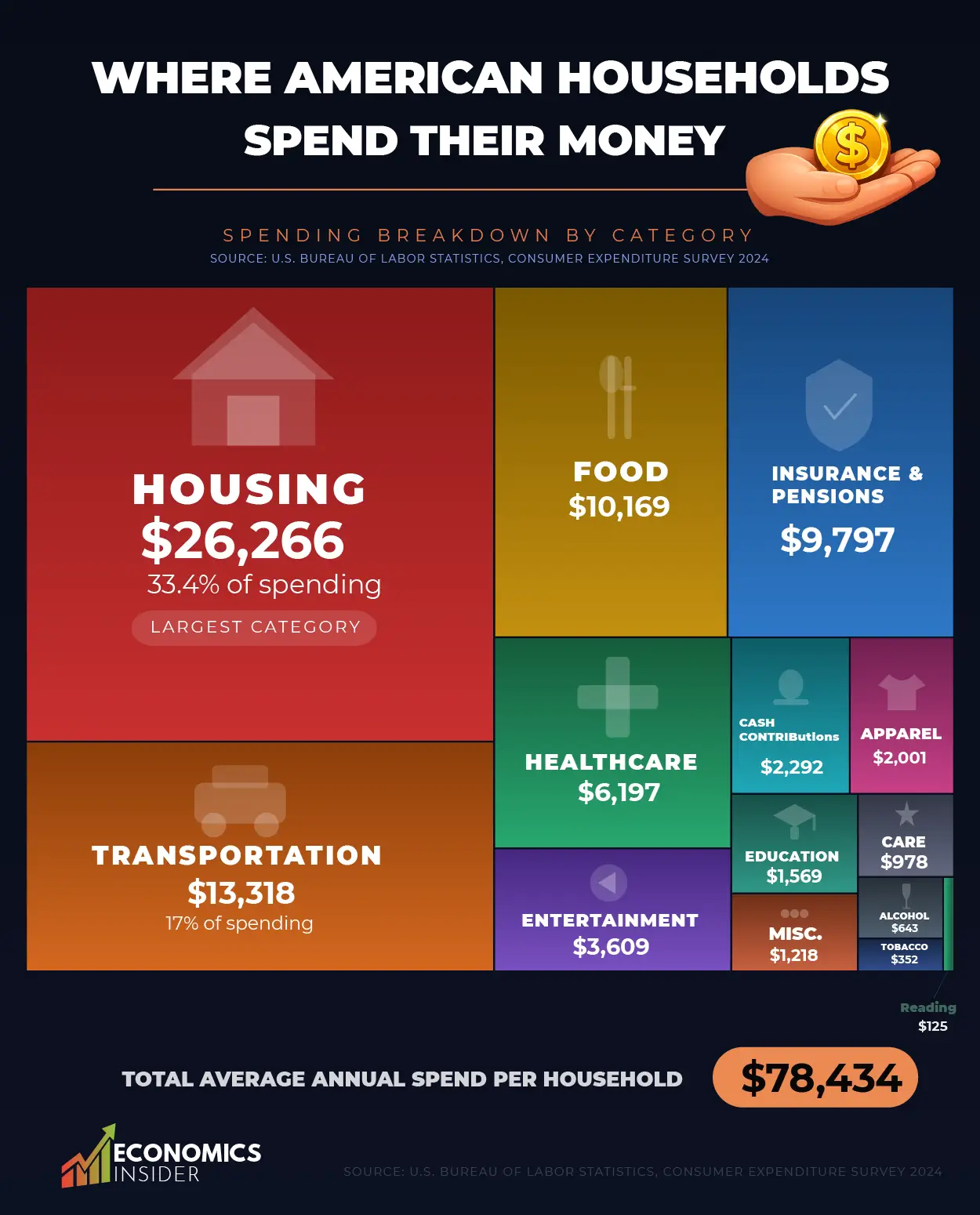
The table below shows average annual spending per household across 14 categories, along with each category’s share of total spending. Data is taken from the 2024 Consumer Expenditure Survey, published by the U.S. Bureau of Labor Statistics.
| # | Category | Annual Expenditures ($) | Share |
|---|---|---|---|
| 1 | Housing | 26,266 | 33.40% |
| 2 | Transportation | 13,318 | 17% |
| 3 | Food | 10,169 | 12.90% |
| 4 | Personal insurance & pensions | 9,797 | 12.50% |
| 5 | Healthcare | 6,197 | 7.90% |
| 6 | Entertainment | 3,609 | 4.60% |
| 7 | Cash contributions | 2,292 | 2.90% |
| 8 | Apparel & services | 2,001 | 2.50% |
| 9 | Education | 1,569 | 2% |
| 10 | Miscellaneous | 1,218 | 1.60% |
| 11 | Personal care | 978 | 1.20% |
| 12 | Alcoholic beverages | 643 | 0.80% |
| 13 | Tobacco | 352 | 0.40% |
| 14 | Reading | 125 | 0.20% |
| Total | 78,534 | 100% |
Housing — $26,266 (33.4%)
At $26,266 annually, housing takes up one-third of all households’ spending. It involves rent or mortgage payments, property taxes, insurance premiums, maintenance, and utility bills such as electricity, natural gas, and water.
The cost of housing continues to rise at a steady rate. Although its growth rate has slowed somewhat, it continues to affect household budgets. The cost of housing rose by 3.3 percent in 2024, following an increase of 4.7 percent in 2023.
This is mainly driven by high mortgage rates that stayed high throughout the year and rental prices in cities that refused to come down. For millions of Americans — especially younger people trying to buy their first home — housing remains the single hardest financial challenge of their lives. This is the single biggest reason why many Americans feel financially stressed.
How Many Years It Takes to Buy a Home in Each U.S. State
Transportation — $13,318 (17.0%)
Transportation cost is the second biggest expense for most families, at $13,318 per year. These include payments towards cars, fuel costs, insurance, repairs, and public transport. The price of transportation only rose by 1.1% for 2024, compared to the 7.1% surge seen in 2023.
Food — $10,169 (12.9%)
On average, Americans have been spending $10,169 on their food expenses in 2024. The food expense went up by 1.8% in 2024, and that was well below the previous year’s 6.9% increase. This is the total cost incurred for purchasing food from the store and food from restaurants.
Personal Insurance & Pensions — $9,797 (12.5%)
Personal Insurance & Pensions make up a big part of the household’s budget—about $9,797 per year. This Spending category increased by 2.5% in 2024, which is slower than the 9.3% growth in 2023. It covers Social Security payments, retirement contributions, and life insurance — all the money Americans put aside to protect their future selves.
Healthcare — $6,197 (7.9%)
Households allocated $6,197 on health insurance premiums, medications, visits to doctors, dentists, and medical devices. Healthcare Spending rose only 0.6% in 2024, while last year’s increase was 5.2%.
Expenditures on items such as entertainment ($3,609), clothing ($2,001), and educational needs ($1,569) are minimal compared to other categories. In most cases, these expenses were lower or showed insignificant growth in 2024. For instance, entertainment expenses declined slightly (-0.7%), and spending on clothing dropped (-2.0%). The data indicate that when prices go up, consumers reduce purchases of non-essential products.
Among the lowest categories of expenditures are personal care, beverages and tobacco products, and reading, all contributing less than 1–2% to the total amount.
Who Owns U.S. Debt? A Simple Breakdown of America’s $39 Trillion Debt
Conclusion
More of Americans’ income is now going towards basic needs, including housing, transportation, food, and health care services. Together, these four items account for roughly two-thirds of the total household expenditure, leaving very little to spend on other expenditures. Housing alone takes the largest share at over one-third of the budget, followed by transportation and food as the second and third largest items, respectively.