


















The U.S. budget deficit has become one of the most important economic challenges today. It affects everything from debt to interest rates and future growth.
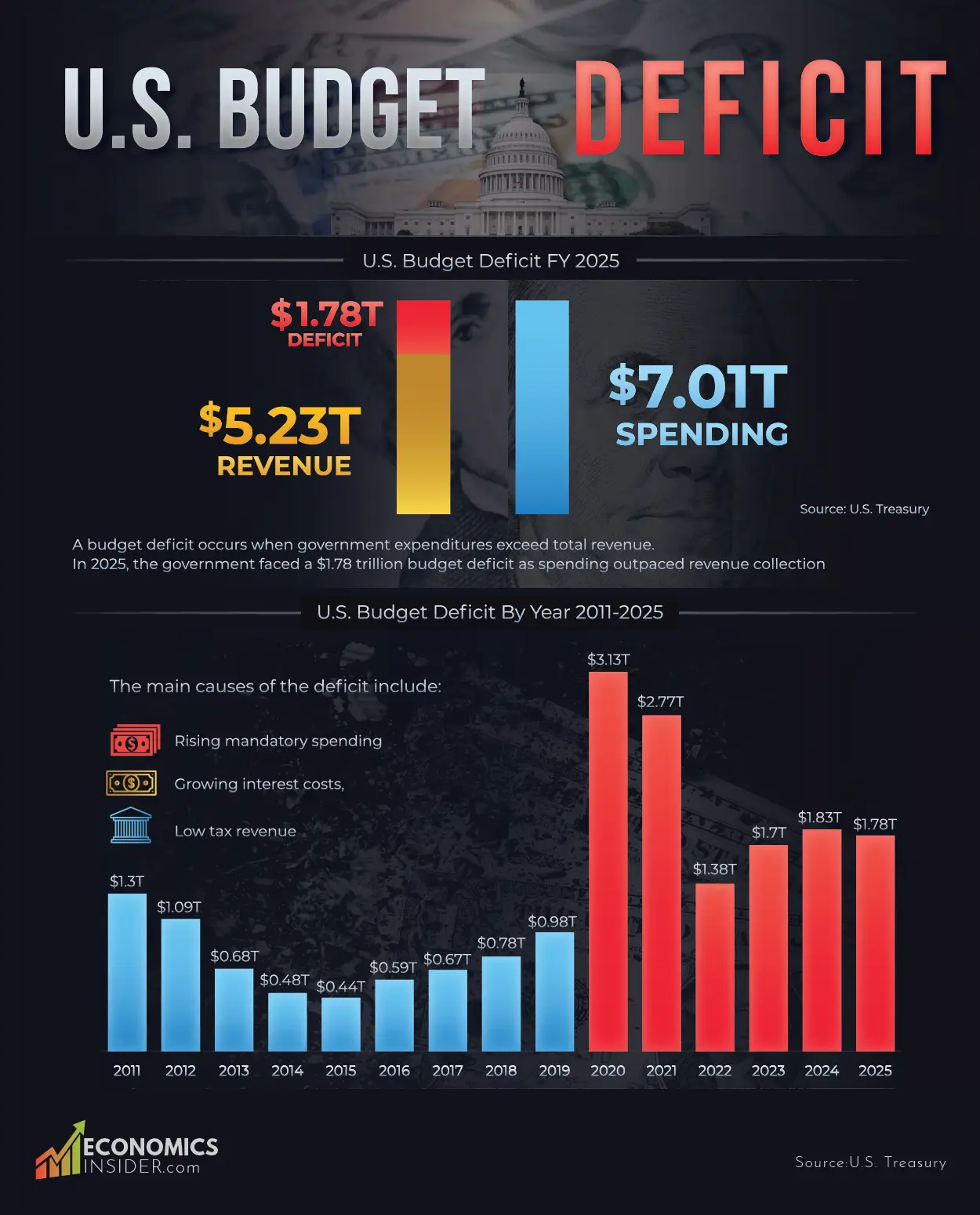
According to the U.S. Treasury, the U.S. government ran a $1.78 trillion deficit in 2025. This is not an isolated case. Over the past 25 years, fiscal deficits have remained high, with sharp spikes during crises and elevated levels even in normal years.
A budget deficit happens when the government spends more money than it collects in revenue. While deficits are common, the size and persistence of recent deficits are what make the current situation different.
The U.S. budget deficit is no longer a temporary phenomenon. It has become a structural part of the U.S. economy. The continued deficits every year are responsible for rising debt, higher interest costs, and increasing pressure on future government budgets.
Key Takeaways
- In 2025, the U.S. budget deficit stood at $1.78 trillion, showing that large deficits are still a major part of government finances.
- A deficit appears when the government spends more money than it collects in taxes and revenue during a year.
- The main causes of the deficit include rising mandatory spending, growing interest costs, and a gap between revenue and total spending.
Understanding the Federal Budget
Before going deeper, it is important to understand a few basic terms.
A budget is a financial plan that shows how much money the government expects to earn and how much it plans to spend in a year. In simple terms, it is the difference between money going out and money coming in.
A budget deficit happens when government spending is higher than its revenue. This means the government needs to borrow money to cover the gap. In 2025, the U.S. government spent much more than it collected. The extra $1.78 trillion had to be borrowed. This is known as deficit spending.
A budget surplus is the opposite situation. It occurs when the government collects more money than it spends. This extra money can be used to reduce debt or saved for the future. However, this is very rare in the United States. The country has only recorded a few surpluses in the past 50 years, with the last one in 2001.
A balanced budget happens when government spending and revenue are equal. In this case, there is no deficit and no surplus.
In reality, the United States mostly runs deficits rather than surpluses.
U.S. Deficit Hits to $1.78 Trillion in Fiscal Year 2025
In fiscal year 2025, the U.S. government’s finances show a massive gap between income and spending. The government collected about $5.23 trillion in revenue, but total spending reached $7.01 trillion. This resulted in a budget deficit of $1.78 trillion.
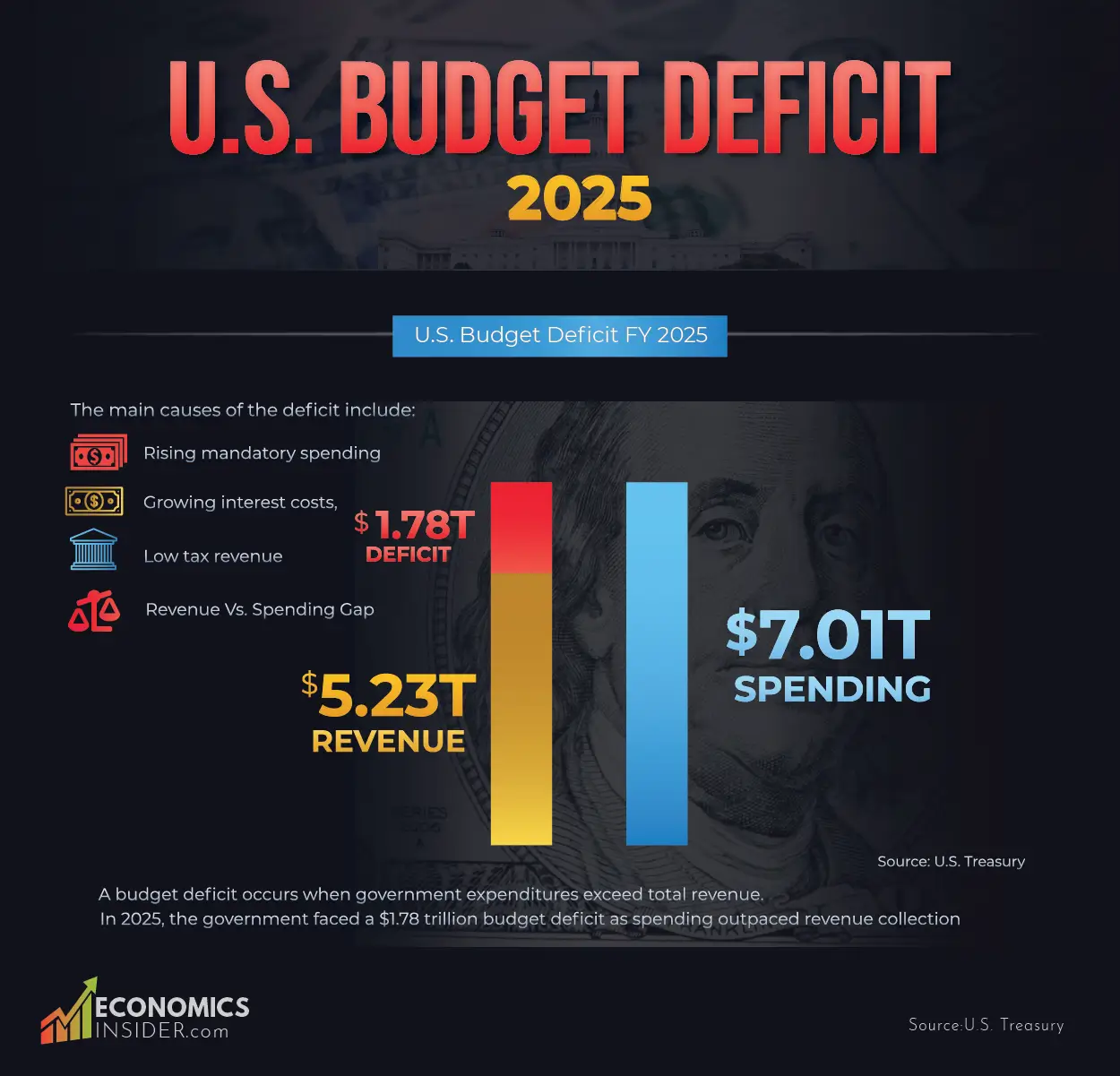
In fiscal year 2025, the large deficit was mainly driven by a few key factors.
One of the primary reasons is the rising mandatory spending, particularly on programs such as Social Security and Medicare. These programs continue to grow as more people retire and healthcare costs continue to rise.
Another major factor is soaring interest costs. Interest payments on the national debt exceeded $1.2 trillion in FY 2025, making it one of the largest government expenses. This is about $100 billion higher than the previous year.
At the same time, a large portion of government debt is being refinanced at higher interest rates, which increases borrowing costs even further.
Although government revenue increased by around 6% in 2025, it was still not enough to match spending. Overall, the government spent about $1.34 for every $1 it earned, creating a large gap.
This combination of rising spending and high interest costs is the main reason why the deficit remains elevated.
U.S. Deficit By Year (2011-2025)
The table below shows the U.S. deficit by year, based on official data from the U.S. Treasury.
| Year | Total Deficit |
| 2011 | $1.3 trillion |
| 2012 | $1.09 trillion |
| 2013 | $680 billion |
| 2014 | $480 billion |
| 2015 | $440 billion |
| 2016 | $590 billion |
| 2017 | $670 billion |
| 2018 | $780 billion |
| 2019 | $980 billion |
| 2020 | $3.13 trillion |
| 2021 | $2.77 trillion |
| 2022 | $1.38 trillion |
| 2023 | $1.7 trillion |
| 2024 | $1.83 trillion |
| 2025 | $1.78 trillion |
Source: U.S. Treasury
Looking at the past 15 years, the data shows three clear phases.
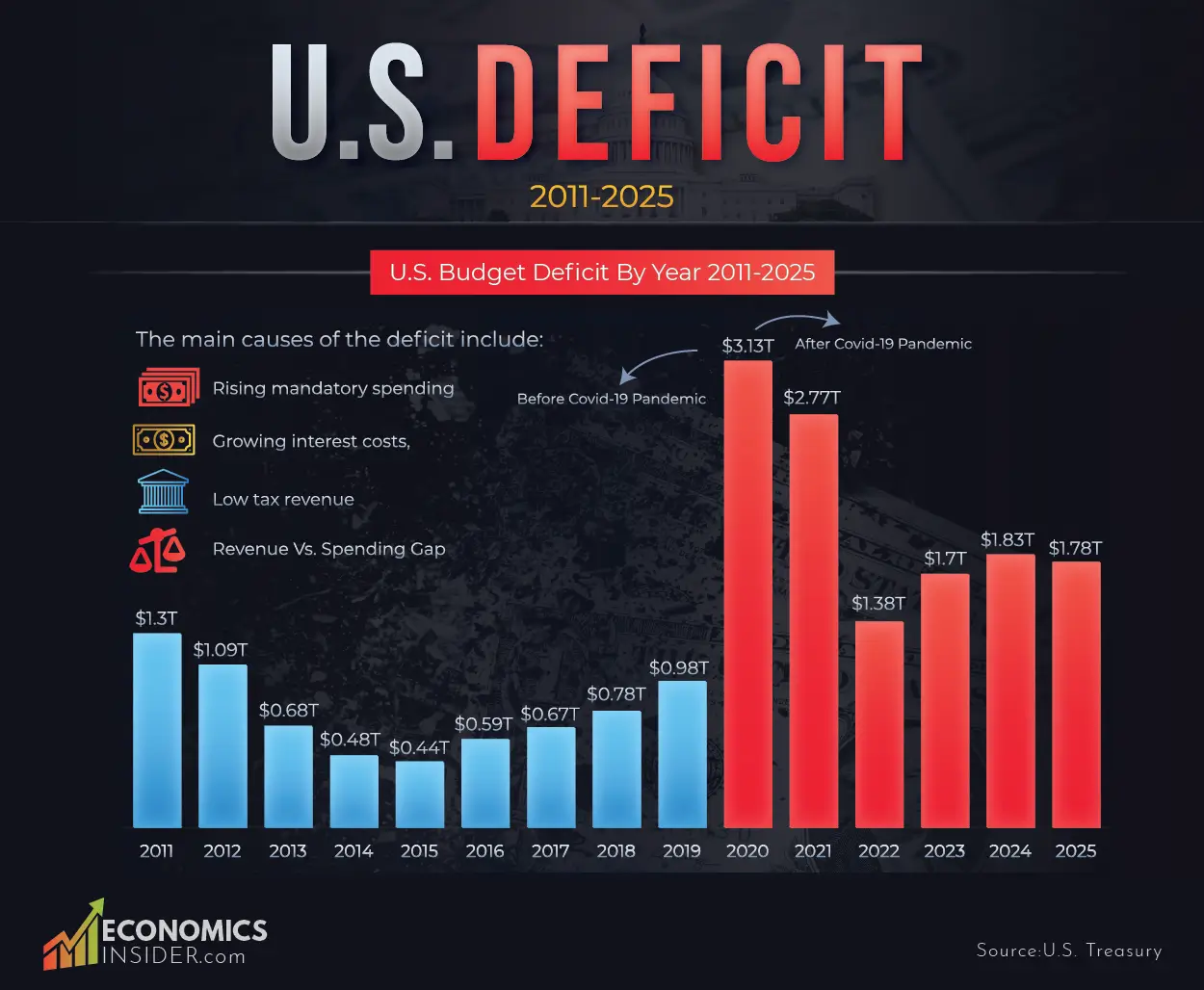
From 2011 to 2015, the deficit was gradually declining. After the 2008 financial crisis, the government reduced emergency spending, and the deficit fell to around $440 billion by 2015.
From 2016 to 2019, the deficit started rising again. Government spending increased while tax revenues did not keep up. By 2019, the deficit had reached nearly $1 trillion.
In 2020 and 2021, the deficit surged sharply due to the COVID-19 pandemic. Massive government spending on stimulus programs pushed the deficit to $3.13 trillion in 2020, the highest level in modern history.
After the pandemic, the deficit declined but remained high. From 2022 to 2025, it stayed above $1 trillion every year, showing that the problem is no longer temporary.
This consistent pattern in the US deficit by year clearly shows that high deficits have become a long-term structural issue rather than a short-term crisis.
Why The Revenue Gap Matters
The gap between spending and revenue is not just a number. It reflects deeper economic challenges the U.S. economy is going through. When the government runs a deficit, it must borrow money to cover the shortfall. If this happens occasionally, it is manageable. But when deficits continue every year, the borrowing keeps increasing. Over time, this leads to rising national debt and higher financial pressure on the government.
The U.S. national debt has now reached around $39 trillion, making it the largest in the world. The nation’s debt-to-GDP ratio has climbed above 120%, which shows how large the debt is compared to the overall economy.
Another concern is the speed at which debt is growing. The government is now adding about $1 trillion in new debt in a much shorter period of time than before.
U.S. National Debt: History, Causes, Risks, and Future (2026)
The Difference Between the Budget Deficit and the National Debt
The terms budget deficit and national debt are often confused, but they are not the same.
A budget deficit is the shortfall in a single year. It shows how much extra money the government needs to borrow during that year.
The national debt is the total amount of money the government has borrowed over time. It includes all past deficits plus interest owed to investors.
To finance a deficit, the government borrows money by selling Treasury bonds and other securities. Investors, including individuals, banks, and foreign governments, buy these securities.
As deficits continue year after year, the borrowed money adds up. This causes the national debt to grow.
There is also an important additional cost. The government must pay interest on this debt. As the debt becomes larger, interest payments increase. These interest payments are now becoming one of the fastest-growing parts of government spending. This adds more pressure on the budget and contributes to future deficits.
In simple terms, deficits increase debt, and growing debt makes future deficits larger.
How Deficits Turn Into Debt Over Time
Each year’s deficit is added to the total national debt. If the government spends more than it earns this year, it borrows money. If it does the same next year, it borrows even more. Over time, these repeated deficits accumulate into a large and growing debt.
This creates a cycle.
- The government runs a deficit and borrows money.
- The total debt increases.
- Interest payments rise.
- Higher interest increases spending.
- And higher spending leads to even larger deficits.
This cycle is one of the key reasons why the deficit problem continues to grow.
Major Causes of the Growing U.S. Budget Deficit
The U.S. budget deficit is not caused by a single factor. It is the result of several long-term forces.
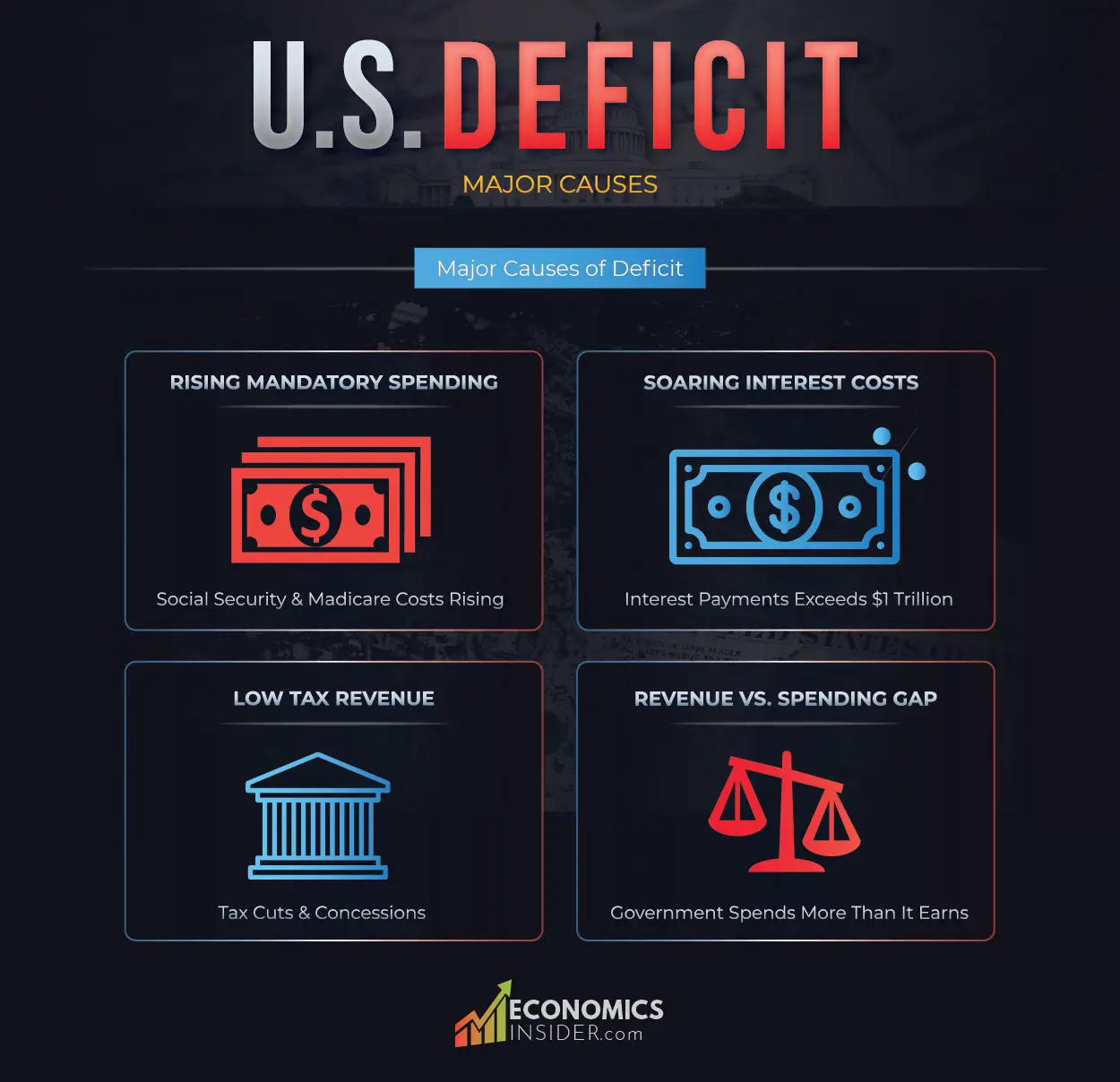
One of the biggest reasons is rising government spending. Programs like Social Security and Medicare automatically increase as the population ages. More people are retiring and receiving benefits, which raises total spending.
Healthcare costs are also rising faster than inflation. This puts additional pressure on government budgets.
Another major factor is interest payments on the national debt. As debt grows and interest rates rise, the government must spend more just to service its existing debt. This adds billions of dollars in extra costs every year. For example, interest payments exceeded $1.2 trillion in FY 2025, making it one of the largest government expenses, and about $100 billion higher than the previous year.
Tax revenue is another part of the problem. While the U.S. economy has grown over time, government revenue has not increased enough to match spending. Tax cuts, economic slowdowns, and changing corporate profits all affect how much revenue the government collects.
Economic crises also play a role in deficits. Events like the financial crisis and the pandemic lead to large increases in government spending and sharp declines in revenue. Even after these crises end, deficits often remain elevated. For example, during the COVID-19 pandemic in 2020, the U.S. recorded one of the highest budget deficits in its history, exceeding $3 trillion due to massive emergency spending and falling revenues.
Finally, political challenges make it difficult to reduce deficits. Cutting spending or raising taxes are both difficult decisions. As a result, long-term solutions are often delayed.
Conclusion
The U.S. budget deficit has evolved from a short-term issue into a long-term structural challenge. The last 25 years of data show that while deficits may fall temporarily, they tend to rise again and remain at high levels. The sharp increase during the pandemic only made an existing problem more visible.
Today, the combination of rising spending, growing interest payments, and limited revenue growth continues to push the deficit higher. If current trends continue, the U.S. will likely face persistent deficits in the years ahead. This will lead to higher national debt, increasing interest costs, and reduced flexibility to respond to future economic challenges.