






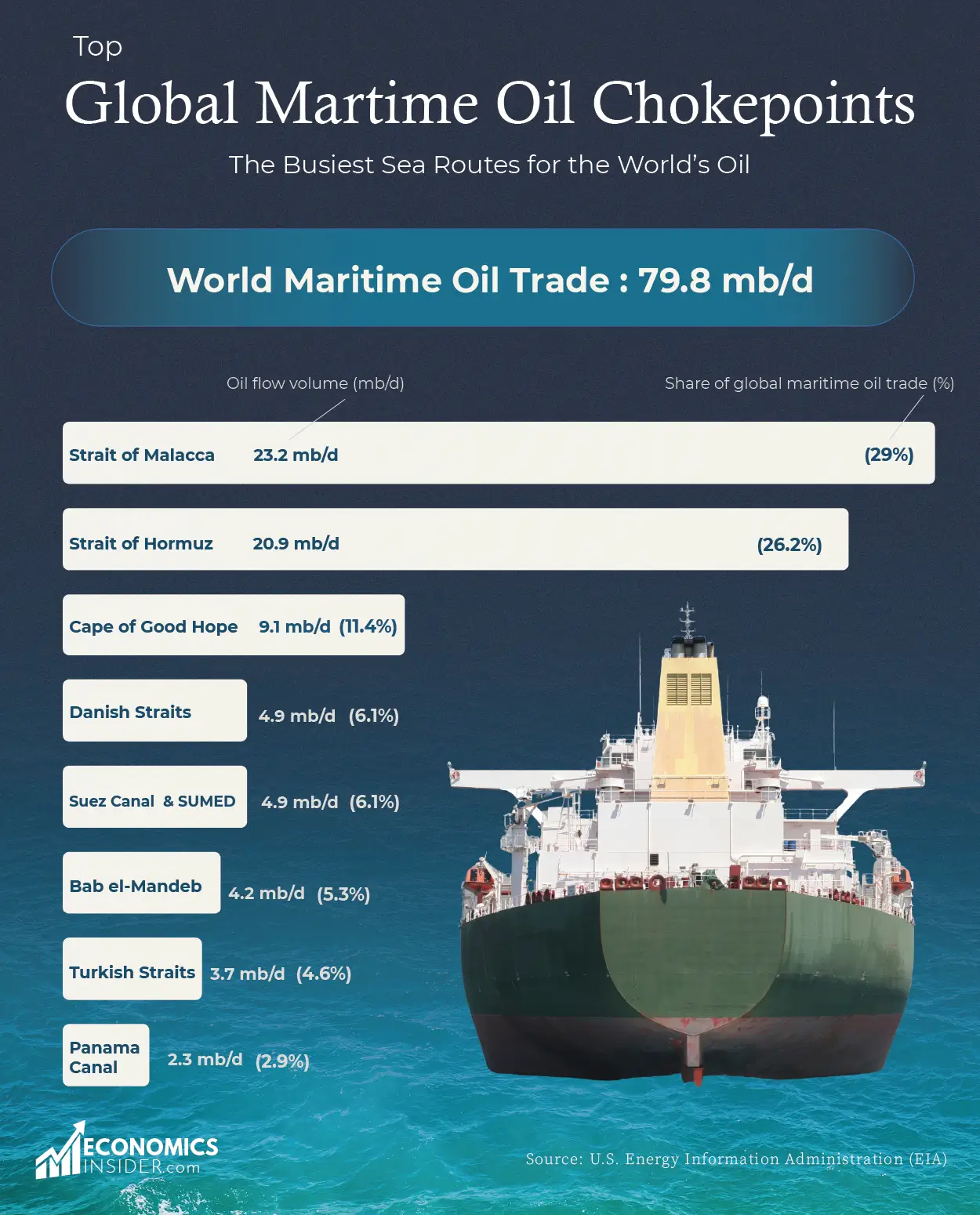
Every day, millions of barrels of oil move across oceans on large tankers. These shipments travel through a few narrow sea routes called maritime chokepoints. According to data from the U.S. Energy Information Administration (EIA), around 80 million barrels of oil per day move through maritime shipping routes worldwide. Most of this oil passes through just a handful of strategic chokepoints. The world’s total oil supply stands at about 104 million barrels per day. These routes connect oil producers in the Middle East, Africa, and the Americas with major energy consumers in Asia, Europe, and North America.
Key Takeaways
- The Strait of Malacca and the Strait of Hormuz are the largest maritime oil chokepoints, collectively handling around 44 million barrels of oil per day.
- Global maritime oil trade moves around 80 million barrels per day, compared with the total world oil supply of about 104 million barrels per day.
Global Maritime Oil Trade Through Key Chokepoints
The table below shows the amount of oil moving through the world’s major maritime chokepoints between 2020 and the first half of 2025. The data is sourced from the U.S. Energy Information Administration (EIA).
| Location | 2020 | 2021 | 2022 | 2023 | 2024 | 1H25 | % of Total (1H25) |
|---|---|---|---|---|---|---|---|
| Strait of Malacca | 22.8 | 22.1 | 23 | 24 | 22.5 | 23.2 | 29.10% |
| Strait of Hormuz | 19.2 | 19.7 | 21.9 | 21.8 | 20.7 | 20.9 | 26.20% |
| Suez Canal & SUMED Pipeline | 5.4 | 5.2 | 7.3 | 8.8 | 4.8 | 4.9 | 6.10% |
| Bab el-Mandeb | 5.7 | 6 | 8 | 9.3 | 4.1 | 4.2 | 5.30% |
| Danish Straits | 3.1 | 3.1 | 4.2 | 5 | 4.9 | 4.9 | 6.10% |
| Turkish Straits (Dardanelles) | 3.2 | 3.3 | 3.2 | 3.5 | 3.6 | 3.7 | 4.60% |
| Panama Canal | 1.7 | 1.8 | 2.2 | 2.2 | 2 | 2.3 | 2.90% |
| Cape of Good Hope | 7.9 | 7.2 | 6.1 | 6.2 | 9.3 | 9.1 | 11.40% |
| World Maritime Oil Trade | 74.1 | 75.9 | 78.6 | 80.2 | 79.7 | 79.8 | 100% |
| World Total Oil Supply | 94.1 | 95.8 | 100.6 | 102.6 | 103.3 | 104.4 | – |
Data Source: U.S. Energy Information Administration (EIA).
The Strait of Malacca: The World’s Busiest Oil Route
The Strait of Malacca, located between Malaysia and Indonesia, is the busiest oil chokepoint in the world. More than 23 million barrels of oil per day pass through this route. It connects the Indian Ocean with the Pacific Ocean, which makes it the shortest sea route between Middle Eastern oil exporters and Asian markets.
Several major Asian economies, including China, Japan, South Korea, and Singapore, rely heavily on this route for their energy supplies. These countries import large amounts of oil from the Middle East to power their industries, transportation, and electricity needs.
The Strait of Hormuz: The Most Strategic Oil Passage
The Strait of Hormuz is located between Iran and Oman. It connects the Persian Gulf with the Arabian Sea.
This narrow passage is one of the most important energy routes in the world. Around 20 million barrels of oil pass through it every day, which is roughly one-fifth of global oil consumption. Major oil-exporting countries such as Saudi Arabia, Iraq, Kuwait, the United Arab Emirates, and Qatar use this route to ship their oil to international markets.
Any conflict, political tension, or disruption in this area can quickly affect oil supplies and push global energy prices higher. In early 2026, rising conflict in the Middle East created serious disruptions to shipping in the Strait of Hormuz.
Top 10 Countries With Largest Oil Reserves in the World
The Red Sea Corridor: Suez Canal and Bab el-Mandeb
The Bab el Mandeb Strait is a narrow strait of water situated between Yemen and the Horn of Africa. It is considered the southern entrance to the Red Sea, and it is an important route for oil transportation, especially those moving towards Europe via the Middle East. In recent years, oil flows through this passage have increased steadily.
According to the data, shipments rose from about 5.7 million barrels per day in 2020 to 9.3 million barrels per day in 2023. However, this trend changed sharply afterward. In 2024, the volume dropped to about 4.1 million barrels per day, and in the first half of 2025, it remained close to 4.2 million barrels per day. This reduction was due to escalating security concerns, as well as attacks on ships in this region. Therefore, many ships avoided this route and opted to take longer routes around Africa.
The Suez Canal and SUMED pipeline connect another important route for oil transportation, linking the Red Sea to the Mediterranean Sea. Over the past few years, flows through this route also increased before falling sharply. Oil shipments rose from about 5.4 million barrels per day in 2020 to 8.8 million barrels per day in 2023. However, as disruptions in the Red Sea intensified, the volume dropped to around 4.8 million barrels per day in 2024 and stayed close to 4.9 million barrels per day in the first half of 2025.
Cape of Good Hope: The Long Alternative Route
When ships avoid the Red Sea, they often take a longer route around the southern tip of Africa through the Cape of Good Hope. This route links the Indian Ocean with the Atlantic Ocean and may be used as an alternative route in case of disruptions in the Red Sea route.
Although the journey is much longer, shipping companies prefer it when security risks increase in the Red Sea region. The data shows how traffic shifted to this route in recent years. Oil shipments around the Cape were about 6.2 million barrels per day in 2023, but they rose sharply to around 9.1 million barrels per day in 2025.
Other Important Oil Routes
Several other maritime chokepoints also play important roles in global oil trade. The Danish Straits connect the Baltic Sea with the North Sea and are used to export oil from Russia and Northern Europe. The Turkish Straits, including the Bosporus and Dardanelles, allow oil from the Black Sea region to reach international markets. The Panama Canal links the Atlantic and Pacific oceans and it helps move oil between the Americas and Asia.
Global Oil Trade Continues to Grow
Despite geopolitical tensions and occasional disruptions in important shipping routes, the global oil transport has continued to grow. The data indicates that the global maritime oil trade has grown from about 74 million barrels per day in 2020 to nearly 80 million barrels per day in recent years. At the same time, total global oil supply also expanded, rising from around 94 million barrels per day to more than 104 million barrels per day.
Why Maritime Chokepoints Matter
Maritime chokepoints are narrow sea passages that connect major shipping routes. Because these passages are narrow and busy, they are vulnerable to disruption.
If ships cannot pass through a chokepoint, oil must take longer routes. This increases shipping costs and delays deliveries. Even short disruptions can push oil prices higher and affect global energy markets.
Conclusion
Global oil trade depends on just a few key maritime chokepoints. The Strait of Malacca and the Strait of Hormuz carry the largest volumes of oil, while the Suez Canal and Bab el-Mandeb serve as important passages for transporting Middle Eastern oil to Europe. These narrow routes are essential for keeping energy flowing around the world, and any disruption can have significant effects on global markets.