
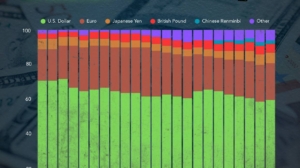

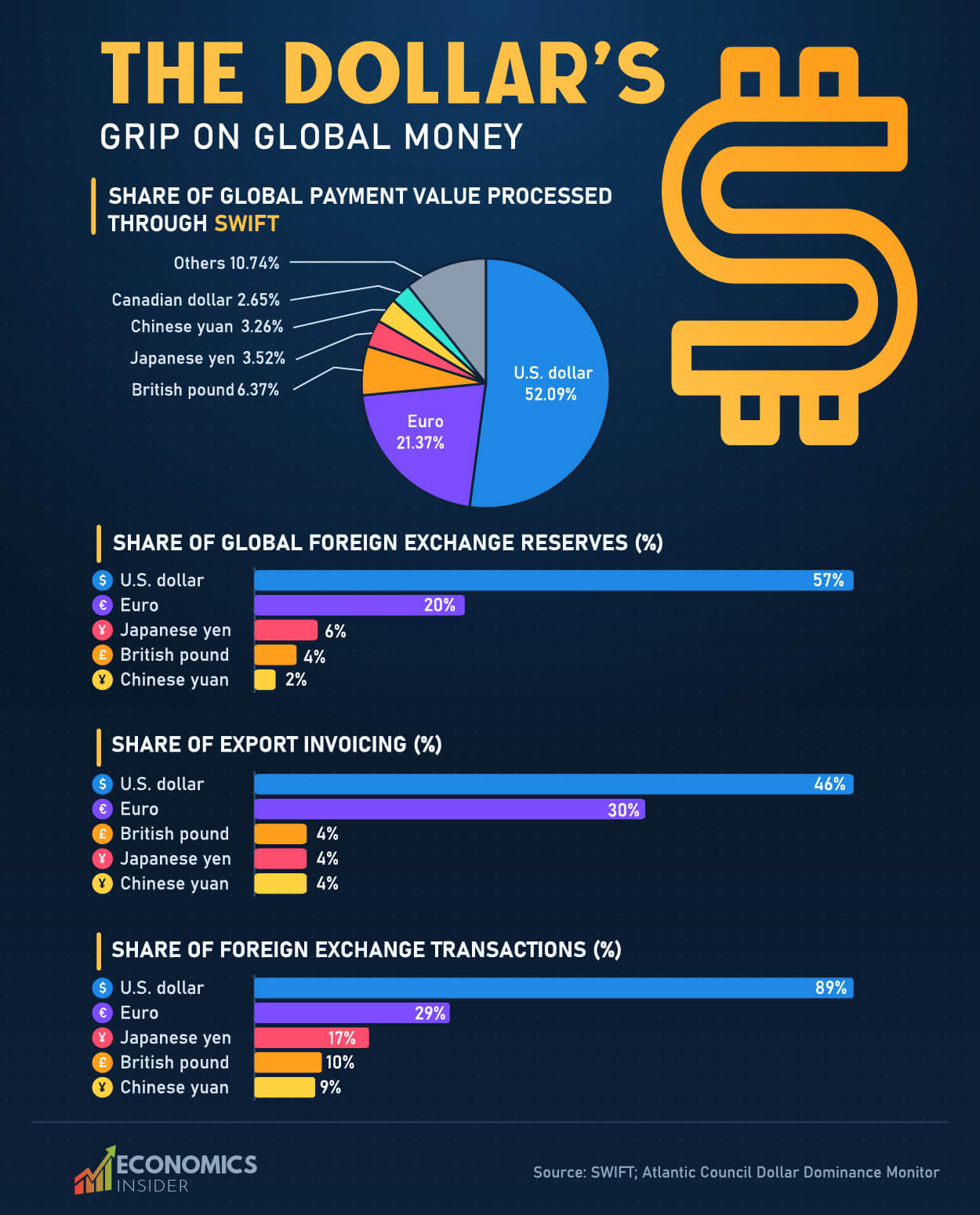
Every day, banks around the world send money across borders. Most of that money moves through a messaging network called SWIFT. The U.S. dollar handles approximately 50% of all the payments sent through SWIFT. The euro comes in second, but its share is much lower than the dollar at about 21%. Together, they cover nearly three-quarters of the total payments sent through SWIFT. Every other currency in the world is fighting over the rest.
But the dollar’s position goes far beyond international payments. It is also the world’s leading currency held by central banks and widely used to price international trade. The dollar is also heavily involved in foreign exchange transactions.
Share of Global SWIFT Payment Value
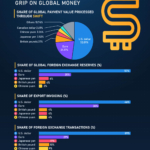
The table below shows the share of global payment value processed through SWIFT for each major currency.
| Currency | Share of global SWIFT payment value |
|---|---|
| 🇺🇸 U.S. dollar | 52.09% |
| 🇪🇺 Euro | 21.37% |
| 🇬🇧 British pound | 6.37% |
| 🇯🇵 Japanese yen | 3.52% |
| 🇨🇳 Chinese yuan | 3.26% |
| 🇨🇦 Canadian dollar | 2.65% |
| Other currencies | 10.74% |
The following table shows the same currencies compare on three other measures, using data from the Atlantic Council’s Dollar Dominance Monitor:
| Currency | Share of global reserves | Share of export invoicing | Share of foreign exchange transactions |
|---|---|---|---|
| 🇺🇸 U.S. dollar | 57% | 46% | 89% |
| 🇪🇺 Euro | 20% | 30% | 29% |
| 🇬🇧 British pound | 4% | 4% | 10% |
| 🇯🇵 Japanese yen | 6% | 4% | 17% |
| 🇨🇳 Chinese yuan | 2% | 4% | 9% |
One note on the last column: every currency trade involves two currencies, so the shares add up to 200%, not 100%. That is why the dollar can show 89% and still leave room for everyone else.
The U.S. Dollar: The King of Money
The dollar’s rise to the top began in the 20th century. Before World War I, the British pound was the main currency used in global trade. But two world wars drained Europe, while the United States came out the biggest economy with most of the world’s gold reserves.
In 1944, leaders from 44 countries built a new money system around the dollar. The dollar was tied to gold, and other currencies were tied to the dollar. In 1971, President Nixon ended the link between the dollar and gold. It was thought the dollar would lose its special place in global finance. It didn’t. In the 1970s, major oil producers, led by Saudi Arabia, agreed to price oil in dollars. That kept demand for dollars high everywhere.
Today the dollar handles 52.09% of SWIFT payments, the largest share of any currency. Additionally, it makes up about 57% of global foreign exchange reserves, which means that out of every $100 central banks keep in their savings, roughly $57 is in dollars. The dollar is used in about 46% of export invoicing and is involved in 89% of foreign exchange transactions. That means, he dollar is involved in roughly nine out of every ten foreign exchange transactions.
The Euro: The Strong Number Two
The euro is the second-most-used currency in the SWIFT payment figures, with a share of 21.37%. It is the official currency of 21 European Union countries and is used by hundreds of millions of people in their daily lives.
The euro is much younger than the dollar. The euro launched in 1999 as an electronic currency, and notes and coins arrived in 2002. It replaced older national currencies like the German mark, the French franc and the Italian lira. Today about twenty European countries use it, and the European Central Bank in Frankfurt runs its policy.
The euro makes up about 20% of global reserves. It is used in about 30% of export invoicing, and involved in nearly around 29% of foreign exchange transactions.
Why is it strong? A big reason is geography. Europe is one of the world’s largest trading areas, and countries inside the eurozone do a huge amount of business with each other. Many of their neighbors in Eastern Europe, Africa and the Middle East also trade with them in euros.
However, the euro’s payment share is still less than half the dollar’s. The euro area also lacks a single government issuing debt on the same scale as the U.S. federal government, which limits the supply of one common asset that global investors can buy across the entire currency area. The debt crisis of 2010 to 2012, when investors worried some countries could not pay their bills, also hurt trust. That is part of why the euro still sits far behind the dollar.
The British Pound: A Former Champion
The British pound accounts for 6.37% of global payment value processed through SWIFT. It is the third-largest SWIFT currency, ahead of the Japanese yen and Chinese yuan.
The pound has the longest history of any currency. In the 1800s, Britain ran the largest empire in the world, and London was the center of global finance. The pound was widely used to settle international business and was an important reserve currency.
However, the two world wars weakened Britain’s economic position. Britain spent heavily on wars, lost much of its empire and lost its place at the top. After World War II, the pound handed its crown to the dollar, and it was cut loose from its old role in 1971 when Britain moved to a decimal system and floated its currency.
Still, the pound is not finished. It holds 6.37% of SWIFT payments, the third highest. It makes up about 4% of global reserves and 4% of export invoicing. Also, the pound is involved in roughly one out of every ten foreign exchange transactions, which is equal to 10%.
The reason of high pound’s share in global finance is London. It is still one of the biggest places in the world for trading currencies. Banks and hedge funds that move enormous amounts of money every day, and a lot of it passes through pounds. So, the pound’s influence today comes less from British trade and more from the strength of London’s financial industry.
The Japanese Yen: Cheap, Safe and Widely Traded
The Japanese yen accounts for 3.52% of global payment value processed through SWIFT. Japan rebuilt itself after World War II into one of the biggest economies in the world. As its companies sold cars and electronics across the globe, the yen grew in importance. It became a freely traded currency in the early 1970s.
The yen holds 3.52% of SWIFT payments. Its share of global reserves is about 6%, which is higher than the pound’s. Its share of export invoicing is only about 4%, because most countries don’t price their trade in yen. But its trading share is large, at about 17% of all currency transactions.
Why do traders love the yen? The reason is that for decades, Japan has kept its interest rates extremely low. That made the yen a cheap currency to borrow. Investors would borrow yen, swap it into higher-paying currencies such as dollar, and pocket the difference. This is known as the “Yen carry trade.” The yen is also seen as a safe place to park money during rough times in global markets. So it is traded heavily even if it is not used as much to pay for things.
The Chinese Yuan: Big Economy, Small Currency Role
The Chinese yuan, also known as the renminbi, accounts for 3.26% of global payment value processed through SWIFT. China is the world’s second-largest economy and a major trading nation. The yuan holds 3.26% of SWIFT payments, about 2% of global reserves, about 4% of export invoicing and about 9% of Foreign exchange transactions.
The reason is control. China limits how freely money can move in and out of its borders and the yuan is not as freely convertible as the dollar. Therefore, most countries are not comfortable holding large amounts of a currency that the government can restrict.
China is trying to change this. It built its own payment network, called CIPS, in 2015 to cut its reliance on the Western banking system. In 2016, the International Monetary Fund added the yuan to its special basket of currencies. China has also signed deals with many countries to trade in yuan. The currency is growing, but slowly. For now, the yuan is a regional player, not a global one.
Why Is the Dollar So Dominant?
The simple answer is trust, and the biggest pillar of that trust is the U.S. Treasury market.
When the U.S. government needs to borrow money, it sells bonds called Treasuries. These are promises to pay back the money with interest. Because the United States has never missed a payment on its debt, they are seen as one of the safest investments in the world.
Japan, China and the United Kingdom are among the largest foreign holders of U.S. treasury securities worth trillions of dollar.
Also, the U.S. has the world’s largest economy with strong financial markets. Therefore, Confidence and established financial markets keep the dollar in demand. The dollar is also easy to buy, sell, and exchange.
But this system has risks. U.S. debt crossed $40 trillion, and interest costs are rising. Some countries are also uncomfortable depending so much on one currency, especially after U.S. sanctions on Russia, Iran and other countries. This is one reason many central banks have been buying more gold and looking at alternative payment system. So far, though, no alternative has the size, safety and ease of use to really replace the dollar.
The Bottom Line
The dollar and the euro handle nearly three-quarters of the value in global payments, but the dollar is in a league of its own. The euro is a strong second currency behind the SWIFT, especially in trade. The pound and the yen punch above their weight in trading, thanks to London and Japan’s low interest rates. The yuan, despite China’s size, still has a long road ahead. For now, only the dollar is the dominant global currency. Other currencies are slowly growing, but the dollar’s lead is still very large.