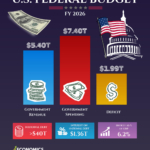












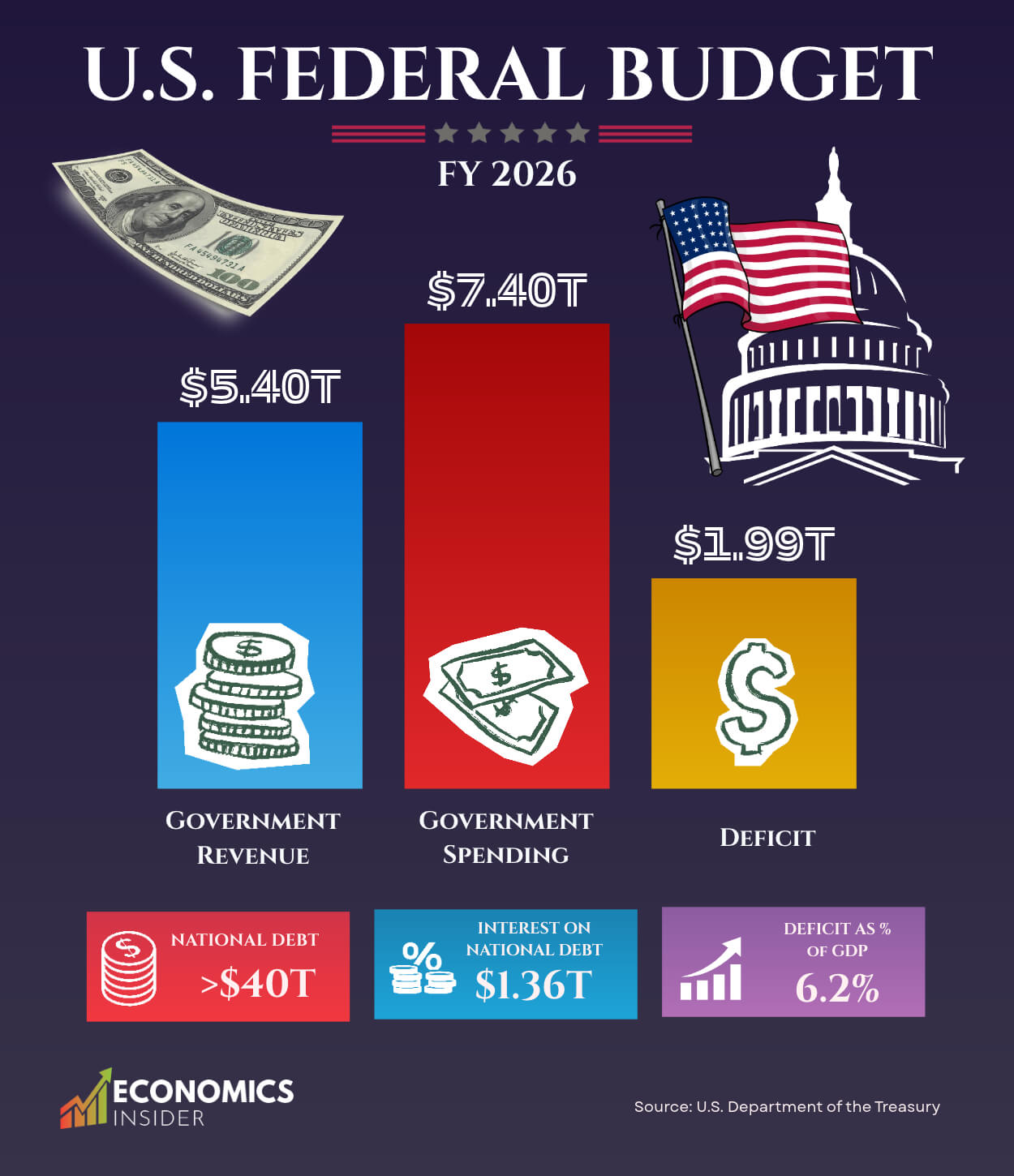
In fiscal year 2026 the U.S. government budget deficit reached the massive $2 trillion. The Treasury Department issued figures show that the federal budget deficit for the fiscal year 2026 was $1.99 trillion, which is an increase from $1.78 trillion in the previous fiscal year.
The government raised a revenue of $5.40 trillion but its spending was about $7.40 trillion. Since spending increased more rapidly than revenue, a bigger budget gap was left in Washington. At the same time, the national debt has now exceeded $40 trillion and interest payments on the national debt hit a record $1.36 trillion.
Since spending on the major benefit programs and on interest payments is still increasing, the difference between the government spending and revenue will continue to increase.
Key Takeaways
- The federal government ran a $1.99 trillion deficit, around $217 billion more than the $1.78 trillion shortfall recorded in fiscal year 2025.
- U.S. Gross interest costs reached $1.36 trillion, while the national debt exceeded $40 trillion.
U.S. Federal Budget: Revenue, Spending and Deficit
The federal budget indicates the amount of money that the government collects, the amount that it spends, and the amount that it has to borrow in order to make up the difference.
In 2026 the government collected higher amount of money than in any previous fiscal year, but its spending also set a record. Therefore, the rise in revenue was not sufficient to meet the extra costs and US faced a huge budget deficit of approximately $2 trillion.
The following data are sourced from the U.S. Department of the Treasury.
| Budget Measure | FY2025 | FY2026 |
|---|---|---|
| Total Revenue | $5.24 trillion | $5.40 trillion |
| Total Spending | $7.01 trillion | $7.40 trillion |
| Budget Deficit | $1.78 trillion | $1.99 trillion |
| Gross Interest Costs | Approximately $1.2 trillion | $1.36 trillion |
| Deficit as a Share of GDP | 5.9% | 6.2% |
The comparison shows that since revenue rose by about $169 billion over the two fiscal years but spending increased by around $386 billion.
That is to say, the amount of extra money that the government spent was more than twice the amount of extra revenue that it earned. As a result, the annual deficit was increased by about $210 billion.
The deficit also rose in relation to the size of the economy, increasing from 5.9% of GDP in the fiscal year 2025 to an estimated 6.2% in 2026.
Where Does the U.S. Government Spend Its Money?
Each year the federal government spends trillions of dollars on retirement benefits, healthcare, national defence, interest payments, and many other programmes.
It is difficult to cut back on some of these expenses since millions of Americans rely on Social Security and Medicare. The interest payments result from money which the government has already borrowed.
The table below shows the main areas in which federal spending took place in fiscal year 2026.
| Spending Category | FY2026 Amount |
|---|---|
| Social Security | Approximately $1.6 trillion |
| Medicare and Medicaid | Approximately $1.9 trillion combined |
| National Defense | $917 billion |
| Gross Interest on Debt | $1.36 trillion |
| Other Federal Spending | Remaining expenditures |
Social Security and Healthcare
Social Security is one of the biggest entries in the federal budget and it pays out retirement, disability, and survivor benefits to millions of Americans.
Healthcare schemes, especially Medicare and Medicaid, also make up a large portion of federal expenditure. Since the population is getting older and healthcare costs are changing, these schemes are placing increasing pressure on the government’s long-term financial position.
National Defense
In fiscal year 2026 defence spending amounted to around $917 billion, which was an increase of about 6 percent on the previous year.
Interest on the National Debt
The payments on interest are one of the most worrying elements of the federal budget. In fiscal year 2026, gross interest costs hit a record high of $1.36 trillion; this amount represents the money paid to holders of government debt. The more debt accumulates and the older the existing securities become, the more the government will have to finance its obligations.
Where Does the U.S. Government Get Its Revenue?
Most of the federal government’s revenue comes from taxes, such as individual income tax and payroll tax. Other income from corporate taxes, customs duties, and so on brings in extra revenue.
In the fiscal year 2026, total federal revenue hit a record high of $5.40 trillion, which was an increase from the $5.24 trillion recorded in 2025.
| Revenue Source | Role in the Federal Budget |
|---|---|
| Individual Income Taxes | Taxes paid on personal income |
| Payroll Taxes | Taxes that help fund Social Security and Medicare |
| Corporate Income Taxes | Taxes collected from businesses |
| Customs Duties | Revenue collected on imported goods |
| Other Revenue | Other taxes, fees, and government receipts |
| Total Revenue | $5.40 trillion |
The bottom Line
In the federal budget 2026, the US deficit came in at nearly $2 trillion. A budget deficit simply means the government spent more than it took in. To cover the gap, the Treasury borrows, mostly by selling government bonds and other securities. A deficit isn’t automatically a sign of trouble. Governments borrow during recessions, wars and emergencies, and that borrowing can keep an economy on its feet when times are hard.
What really matters is how big the gap is, and how long it lasts. The United States has been running very large deficits lately, even without pandemic-sized emergency spending. In fiscal year 2026, the shortfall came in at nearly $2 trillion.