






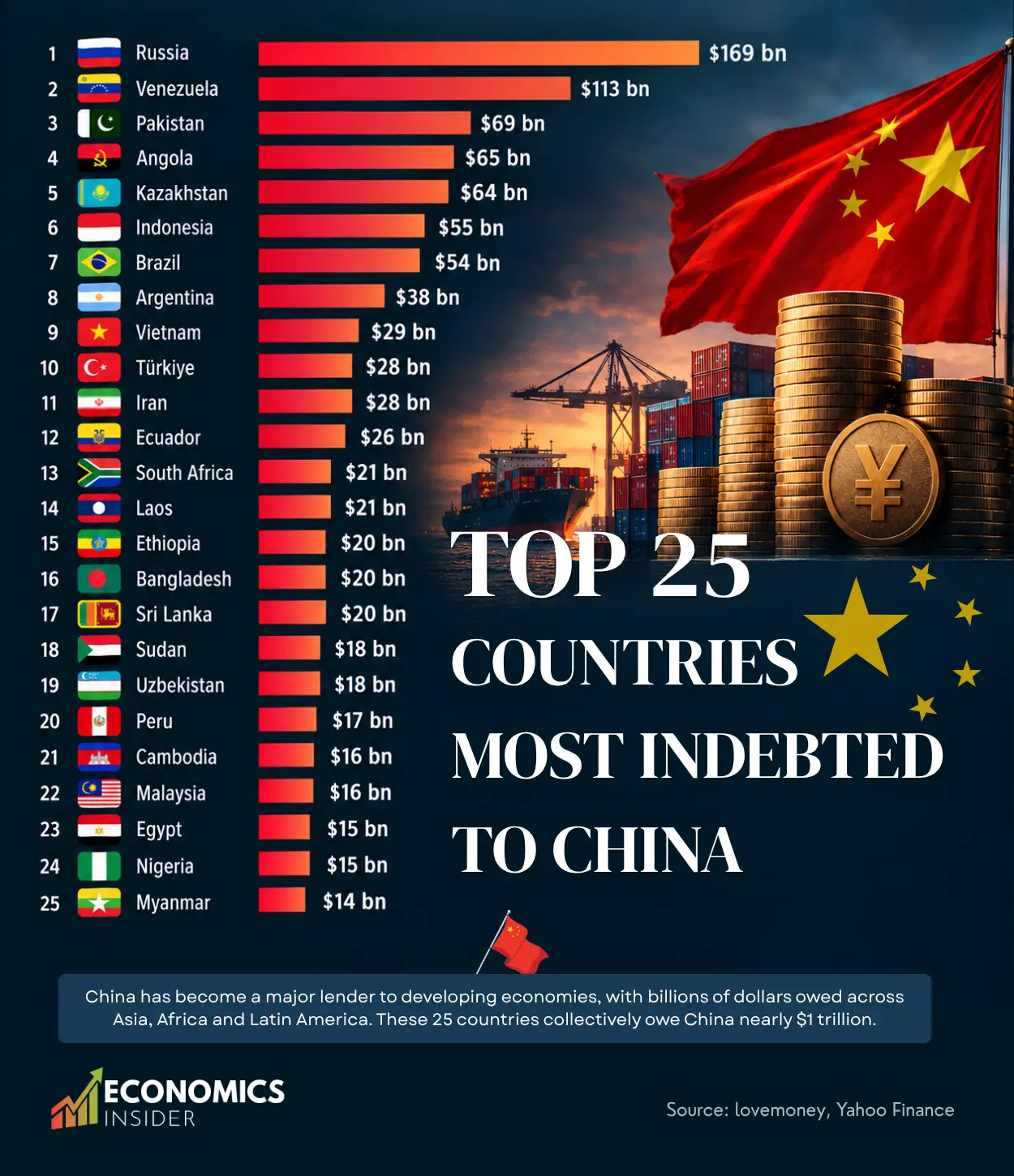
China has become a major lender to countries across Asia, Africa, Latin America and Europe. Over the years, Chinese state-backed lenders have financed roads, railways, power plants, ports and other large projects around the world. AidData’s latest research shows that China’s overseas lending and grant portfolio reached about $2.2 trillion across 217 countries and territories between 2000 and 2023.
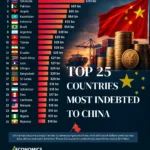
Russia has the largest amount of debt to China at $169 billion, followed by Venezuela at $113 billion and Pakistan at $69 billion. Angola and Kazakhstan are next, with about $65 billion and $64 billion respectively. Together, the top 25 countries in the dataset owe about $1 trillion to China.
Key Takeaways
- Russia has the largest Chinese debt, at $169 billion, followed by Venezuela and Pakistan.
- Asia and Africa account for many of the countries near the top, including Pakistan, Kazakhstan, Indonesia, Bangladesh, Sri Lanka and several African economies.
- China’s lending is much broader than infrastructure projects alone. Recent AidData research shows that Chinese state-backed financing now covers a wide range of countries and projects around the world.
Top 25 Countries With the Most Debt to China
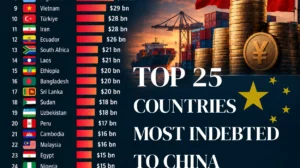
The table below ranks the 25 countries by the amount of debt owed to China. The data is compiled from Yahoo Finance and Love Money, and the figures are approximate.
| Rank | Country | Debt to China |
|---|---|---|
| 1 | 🇷🇺 Russia | $169 bn |
| 2 | 🇻🇪 Venezuela | $113 bn |
| 3 | 🇵🇰 Pakistan | $69 bn |
| 4 | 🇦🇴 Angola | $65 bn |
| 5 | 🇰🇿 Kazakhstan | $64 bn |
| 6 | 🇮🇩 Indonesia | $55 bn |
| 7 | 🇧🇷 Brazil | $54 bn |
| 8 | 🇦🇷 Argentina | $38 bn |
| 9 | 🇻🇳 Vietnam | $29 bn |
| 10 | 🇹🇷 Türkiye | $28 bn |
| 11 | 🇮🇷 Iran | $28 bn |
| 12 | 🇪🇨 Ecuador | $26 bn |
| 13 | 🇿🇦 South Africa | $21 bn |
| 14 | 🇱🇦 Laos | $21 bn |
| 15 | 🇪🇹 Ethiopia | $20 bn |
| 16 | 🇧🇩 Bangladesh | $20 bn |
| 17 | 🇱🇰 Sri Lanka | $20 bn |
| 18 | 🇸🇩 Sudan | $18 bn |
| 19 | 🇺🇿 Uzbekistan | $18 bn |
| 20 | 🇵🇪 Peru | $17 bn |
| 21 | 🇰🇭 Cambodia | $16 bn |
| 22 | 🇲🇾 Malaysia | $16 bn |
| 23 | 🇪🇬 Egypt | $15 bn |
| 24 | 🇳🇬 Nigeria | $15 bn |
| 25 | 🇲🇲 Myanmar | $14 bn |
Russia Has the Largest Chinese Debt
Russia stands at the top of the list with $169 billion in debt to China. The size of the figure is important, but it should not be confused with Russia’s total government debt. The number in this table only represents the debt attributed to China.
China and Russia have developed strong economic ties over the years, including trade, energy and large financial relationships. Research on Chinese lending shows that Russia has been one of the largest recipients of Chinese loans.
Venezuela Has $113 Billion in Chinese Debt
Venezuela ranks second, with $113 billion. Much of China’s financial relationship with Venezuela has been linked to the country’s energy sector and its large oil reserves.
Research shows that Russia and Venezuela stood out among the largest borrowers from China in earlier periods of Chinese overseas lending. For Venezuela, access to Chinese financing has been particularly important because the country has faced severe financial and economic pressures.
Pakistan Is China’s Third-Largest Debtor
Pakistan comes third which owes China $69 billion. China has helped pay for big projects in Pakistan, like roads and power plants. The two countries are also tied together through the China-Pakistan Economic Corridor.
But Chinese debt is only one slice of Pakistan’s total foreign debt. The country also owes money to other governments, international lenders and banks.
Angola and Kazakhstan Are Close Behind
Angola owes China $65 billion. Kazakhstan owes $64 billion. Both countries are rich in natural resources, which makes them important partners for China. In some cases, the loans are linked to those resources and to the money the countries will earn from selling them later.
Indonesia and Brazil Both Owe More Than $50 Billion
Indonesia ranks sixth, owing China $55 billion, followed by Brazil, which owes China $54 billion. These are two of the largest economies in the developing world. China has become an important source of finance and investment for both countries.
AidData’s research on Indonesia, for example, identifies nearly $70 billion in Chinese state-backed finance and foreign investment, showing how large the overall financial relationship can be beyond debt alone.
Argentina Has $38 Billion in Chinese Debt
Argentina ranks eighth, with $38 billion in debt owed to China. China has become an important economic partner for Argentina through trade, investment and financing. The country has also used Chinese financial arrangements to support its foreign-currency position.
Vietnam, Türkiye and Iran
Vietnam has $29 billion, while Türkiye and Iran each have $28 billion in debt to China. These three countries have very different economies and relationships with China, but all have developed significant trade and financial links with Beijing.
Vietnam has become an important manufacturing and trade partner for China. Türkiye sits between Europe and Asia and has growing trade links with China. Iran, meanwhile, has a major energy relationship with China.
Latin America Also Has Large Chinese Debt
Brazil owes $54 billion to China, followed by Argentina with $38 billion, Ecuador with $26 billion, and Peru with $17 billion. China’s lending in Latin America has been particularly important in countries rich in natural resources. Over the years, Chinese banks have provided financing for energy, transport and other major projects. The region therefore shows that China’s lending reach extends well beyond Asia and Africa.
Africa Has a Large Share of the Top 25
Africa is also heavily indebted to China. Angola owes $65 billion to China, followed by South Africa at $21 billion and Ethiopia at $20 billion. Sudan owes China $18 billion, while Egypt and Nigeria each owe China around $15 billion.
Chinese financing in Africa has supported roads, railways, power generation and other large projects. Some loans have also been connected to natural resources.
Recent AidData research found that Chinese state-backed creditors have provided financing across a very large number of countries, making China one of the world’s most important official lenders.
Why Does China Lend So Much?
China lends abroad for a few reasons. First, it helps pay for big projects that boost trade and create business. Chinese companies often get the contracts to build them. Second, it strengthens ties with countries that matter to China for trade, energy and raw materials.
Many people think all of this is the Belt and Road Initiative, but that’s not true. According to AidData, Belt and Road infrastructure projects made up only about 20% of China’s total lending and grants to developing countries between 2000 and 2023. China’s financial reach is much wider than that label suggests.
What Do Countries Use the Loans For?
The debt money has gone into many things: roads, railways, power plants, ports, mines and phone networks. For some countries, these loans made projects possible that they could not have afforded otherwise. But every big project also comes with a big bill that has to be paid back over many years.
AidData found more than 30,000 Chinese-funded projects across 217 countries and territories between 2000 and 2023.
Does Chinese Debt Always Mean a Crisis?
No. A large debt does not automatically mean a country is in trouble. What matters is how big the debt is compared with the country’s economy and its government income, and whether it can keep up with payments.
Take $20 billion. For a large economy, that may be manageable. For a small one, it could be crushing. The interest rate, the repayment schedule, the currency and what the money was used for all make a difference.
Some Loans Are Backed by Guarantees
Some Chinese loans are protected by future income or by money set aside in special accounts. A 2025 AidData study found that almost half of China’s lending to developing-country governments was effectively secured. That covers about $420 billion across 57 countries. In some cases, repayment is backed by future earnings from commodities, or by cash held in accounts.
The Bottom Line
The top 25 countries in this dataset owe a combined about $1 trillion to China. Russia and Venezuela account for a particularly large share, while Pakistan, Angola, Kazakhstan, Indonesia and Brazil also have substantial amounts.
But the numbers tell only part of the story. China’s role in global finance is much larger than the debt owed by these 25 countries. Its state-backed lenders have financed tens of thousands of projects across the world, while the terms of individual loans can vary significantly.