





Every year, the BRICS countries get together to talk about trade, money, and their place in the world. This year, the meeting happened in New Delhi, India, on September 12 and 13, 2026. It was the 18th summit since the group started, and it brought together leaders from eleven countries, including Russia’s Vladimir Putin, China’s Xi Jinping, and India’s Narendra Modi as host.
The expanded BRICS group now represents about half of the world’s population and roughly 40% of global GDP by purchasing power. The summit was about much more than the dollar. Leaders focused heavily on trade, tariffs, development, technology, supply chains, energy, food security and the role of developing countries in the global economy. In fact, the summit avoided the idea of creating a common BRICS currency and placed greater emphasis on practical economic cooperation.
Key Takeaways
- BRICS did not create a common currency to replace the dollar.
- The real move was a plan to make trade payments between members faster and less dependent on Western banking systems.
- The group criticized unfair tariffs without ever saying the word “America,” even though everyone knew who they meant.
BRICS Summit 2026
These following points highlights some of the key economic topics at the summit meeting. They included the U.S. dollar, trade, investments, tariffs and financial coordination.
1. BRICS pushed harder for trade in local currencies
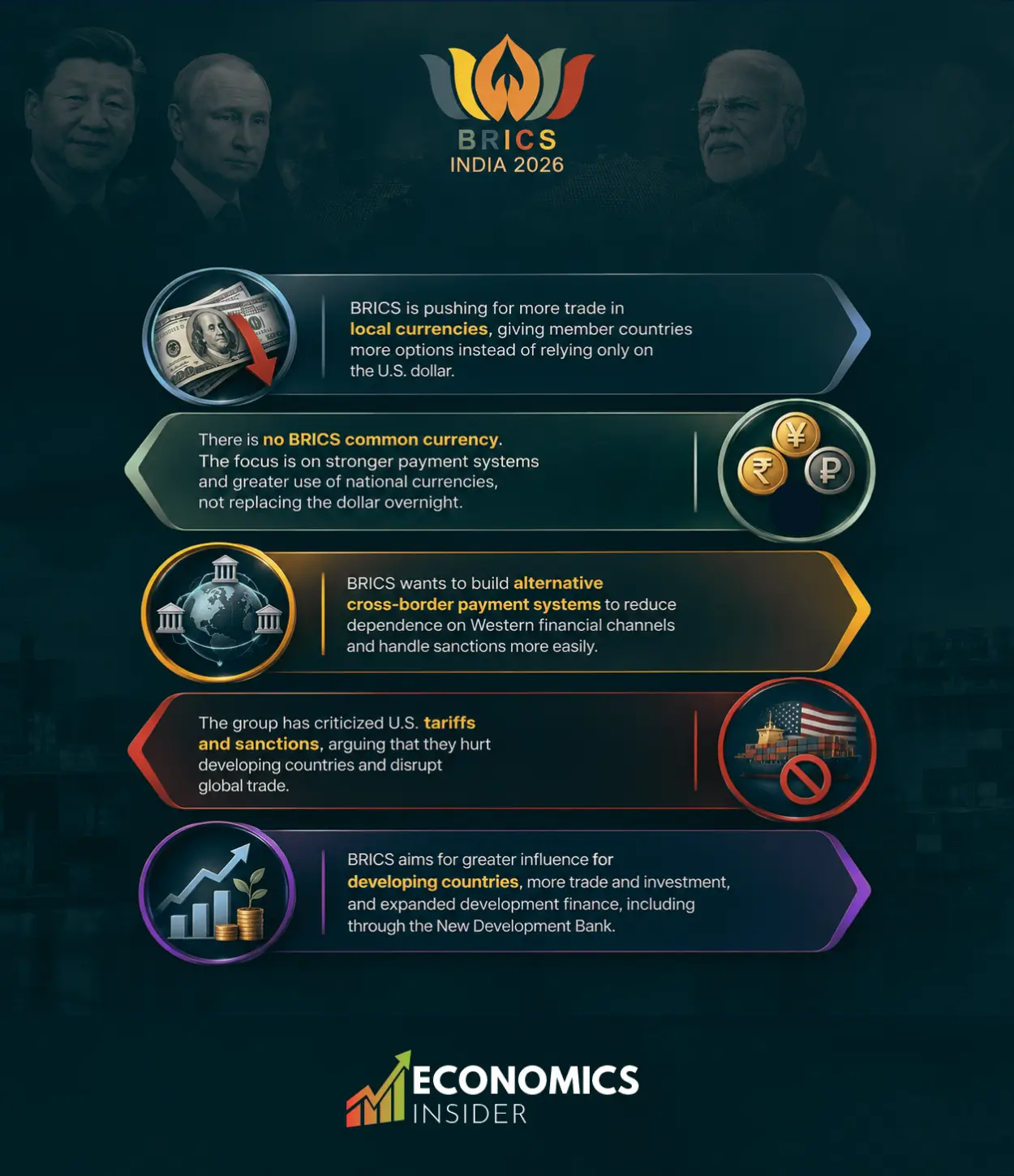
The Summit desired to make it easier for BRICS countries to trade using their own currencies. The idea is simple. If an Indian company buys goods from China, the payment does not necessarily have to move through the dollar. The two countries could increasingly use the rupee and yuan, depending on the arrangement. The declaration supported greater use of local currencies and stronger cross-border payment arrangements.
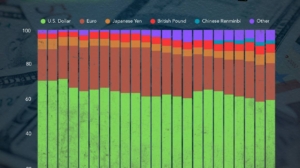
This does not mean BRICS has stopped using the dollar. The dollar remains deeply embedded in global trade and finance.
2. BRICS did not create a new common currency
There had been considerable speculation about a possible BRICS currency. The 2026 summit did not announce a common BRICS currency. Instead, the group focused on practical steps such as using national currencies and improving payment systems between member countries.
3. BRICS continued working on alternatives to Western payment systems
BRICS also continued its effort to make cross-border payments easier between member countries. The broader goal is to reduce the difficulties countries can face when they depend heavily on financial systems controlled or influenced by Western countries.
4. The dollar was challenged, but not replaced
The summit clearly showed that some BRICS countries want to reduce their dependence on the U.S. dollar. But there is an important difference between reducing dollar dependence and replacing the dollar.
BRICS still has no single currency, no unified financial system and no fully developed alternative that can match the global role of the dollar.
5. Pushback on Tariffs & Sanctions
The declaration raised concerns over unilateral tariffs, non-tariff barriers and secondary sanctions, arguing they distort trade and conflict with WTO rules, and opposed carbon border measures used as protectionism.
6. BRICS wants a bigger role for developing countries
Another major theme was the argument that countries outside the traditional Western economic powers should have a larger voice in global institutions. BRICS called for changes to international institutions, including greater representation for developing countries.
7. The economic weight of BRICS is getting larger
The expanded BRICS group now represents roughly half of the world’s population and around 40% of global GDP when measured by purchasing power. That gives the group considerable economic weight.
But size alone does not make BRICS a unified economic power. China and India, for example, have their own interests and serious differences.
8. BRICS focused on trade, investment and development
Members discussed expanding trade and investment, improving supply chains, food and energy security, critical minerals, agriculture and development financing.
The New Development Bank is also becoming an important part of this effort.
9. Health, Energy & Food Security
Leaders expanded cooperation on digital healthcare, energy storage and smart grids, and food security, framing resilient supply chains as a shared priority for the group’s 11 members.
10. Support for Small Businesses
The declaration backed easier finance access for MSMEs and welcomed progress on an invoice-discounting mechanism to help smaller businesses unlock working capital across member economies.
11. Critical minerals became an important economic issue
The BRICS nations also paid more attention to critical minerals. These are minerals that are required for battery production, electric vehicles, and electronics.
Was De-dollarization the Main Goal?
For years, people have talked about BRICS building its own currency to compete with the dollar. That didn’t happen here, and it likely won’t happen anytime soon. Instead, the group agreed to something more practical: making it easier for members to pay each other directly in their own currencies, and linking up their banking systems so payments don’t have to pass through Western channels.
The Bottom Line
The 2026 BRICS Summit was not a “dollar collapse” summit. It was more accurately a “reduce dependence on the dollar” summit. BRICS is trying to create more ways for its members to trade, lend and make payments without automatically using the U.S. dollar or Western financial channels. That could gradually reduce the dollar’s role in some areas of international trade.
But the dollar remains the world’s dominant international currency, and BRICS still has a long way to go before it can offer a complete replacement.