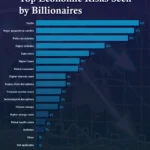





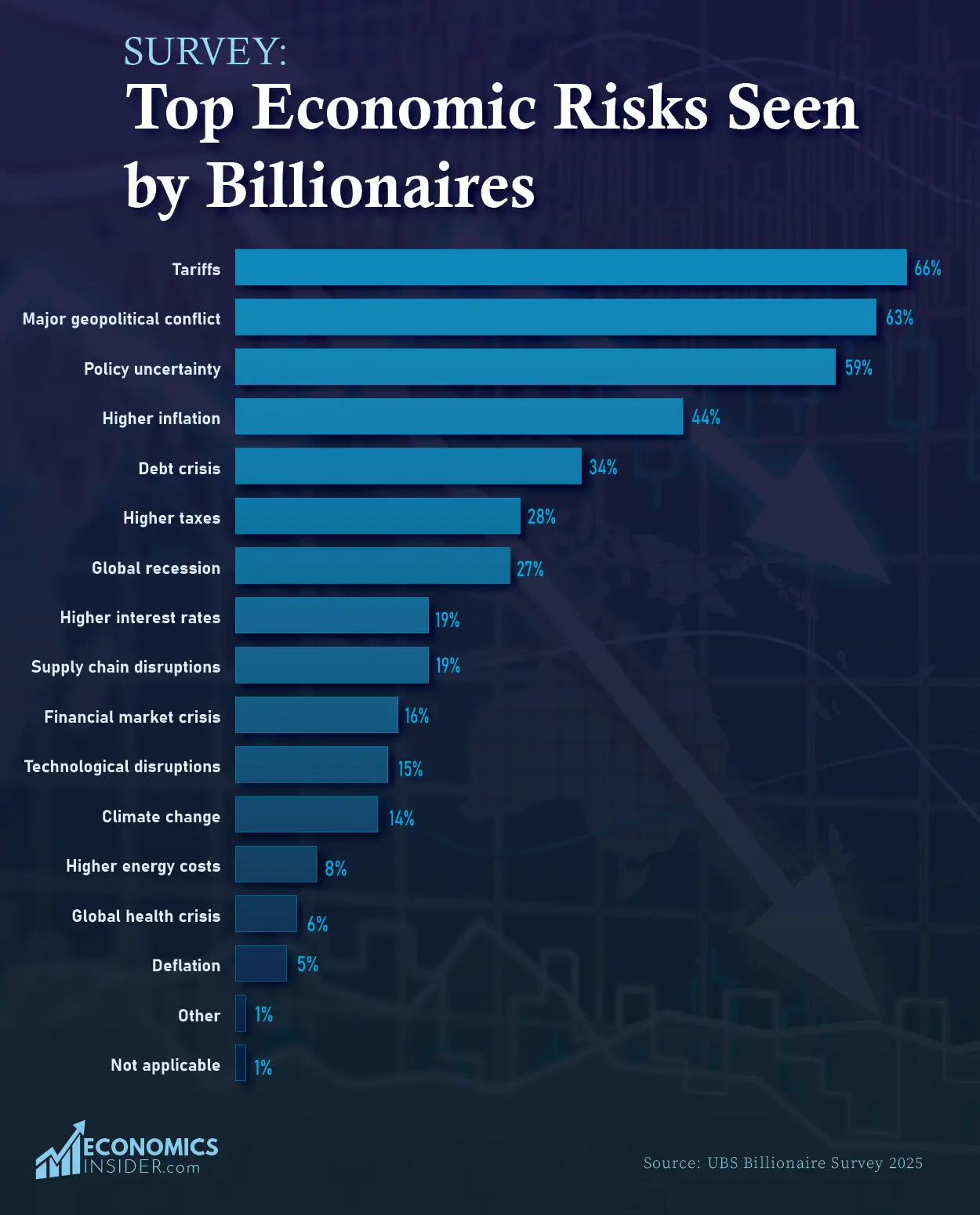
In the latest UBS Billionaire Survey 2025, global wealthy investors have picked the factors they think might have the most negative impact on the market. At the top of the list are tariffs (66%), geopolitical conflict (63%), and policy uncertainty (59%), , all of which indicate a deep concern about a volatile and unpredictable global economy. Among these, tariffs stand out as the most cited risk. These tariffs, including high reciprocal tariffs imposed in April 2025, were intended to raise funds and rebalance the global trade system in favor of the United States.
Key Takeaways
- According to the UBS Billionaire Ambitions Report, tariffs are one of the biggest risks for markets because trade barriers directly raise costs, disrupt supply chains, and create uncertainty.
- Geopolitical conflicts are also surveyed as a serious risk because political tensions or wars can suddenly disrupt global trade, energy supplies, and investor confidence.
The Factors Most Likely to Negatively Impact the Market
According to the latest UBS Billionaire Survey 2025, the table shows the factors most likely to negatively impact the market over the next 12 months.
| Rank | Factor | Percentage |
|---|---|---|
| 1 | Tariffs | 66% |
| 2 | Major geopolitical conflict | 63% |
| 3 | Policy uncertainty | 59% |
| 4 | Higher inflation | 44% |
| 5 | Debt crisis | 34% |
| 6 | Higher taxes | 28% |
| 7 | Global recession | 27% |
| 8 | Higher interest rates | 19% |
| 9 | Supply chain disruptions | 19% |
| 10 | Financial market crisis | 16% |
| 11 | Technological disruptions | 15% |
| 12 | Climate change | 14% |
| 13 | Higher energy costs | 8% |
| 14 | Global health crisis | 6% |
| 15 | Deflation | 5% |
| 16 | Other | 1% |
| 17 | Not applicable – I am not worried about any economic, market, or policy factors negatively impacting the market environment over the next 12 months | 1% |
Source: UBS Billionaire Survey 2025
Tariffs (66% Concerned)
According to the latest UBS Billionaire Survey 2025, tariffs were the number one concern for international investors. The Trump administration announced a comprehensive set of tariffs – commonly referred to as the “Liberation Day” tariffs – that applied to all imports to the United States. These tariffs included a base tariff of 10% and “reciprocal” tariffs, which were higher and applied to imports from countries with large trade surpluses with the U.S., such as China.
In February 2026, the Supreme Court upheld that the emergency powers on which the administration relied did not apply to the type of tariffs that the administration had put in place.
In a 6-3 decision, the justices explained that the law the administration used, the International Emergency Economic Powers Act (IEEPA), “does not give the president the authority to impose import tariffs in this way without Congress’s approval.”
Major Geopolitical Conflict
Geopolitical conflict, whether over trade, territory, or military hotspots, is always among the top risks for Billionaires. Current geopolitical conflicts can interfere with supply chains and reduce investment, which can have a shockwave effect on financial markets. Trade wars, such as those between the U.S. and China or the U.S. and Brazil, introduce an additional element of uncertainty to the global economy.
Higher Inflation and Debt Crises
Inflation remains a concern in many markets despite efforts by central banks to control price increases. Increased debt in the world’s largest economies also poses potential problems if growth slows or interest rates unexpectedly rise.
Other issues, such as taxation, the global recession, and rising interest rates, continue to raise concerns about slower growth and higher capital costs.
Lower-Ranked Risks
The survey also showed that risks like supply chain disruptions (19%), technological disruptions (15%), climate change (14%), and energy costs (8%) are viewed as less urgent in the next year.
This does not imply these factors are unimportant – they remain significant. Supply chain disruptions are still a concern for manufacturers and logistics firms, while technological advances can radically change industries. Climate change and energy markets pose long-term challenges to corporate planning and investment.
Nonetheless, compared to tariffs, political instability, and policy uncertainties, these risks are seen as more manageable or less immediate for most billionaires.
Conclusion
The biggest worries for markets at the moment are tariffs, geopolitical instability, and debt risk. Tariffs are the top concern because they have a direct impact on business and consumers. When governments increase trade barriers, it becomes more expensive for companies, and supply chains become more complicated. However, some risks are considered less pressing in the short term. Deflation, global health crises, and higher energy prices were among the least pressing concerns, according to the survey.