





Artificial intelligence has turned into one of the biggest rivalries between the United States and China. Both want to lead the next wave of technology, and both are pouring money into AI companies, data centers, chips and research.
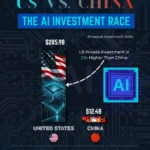
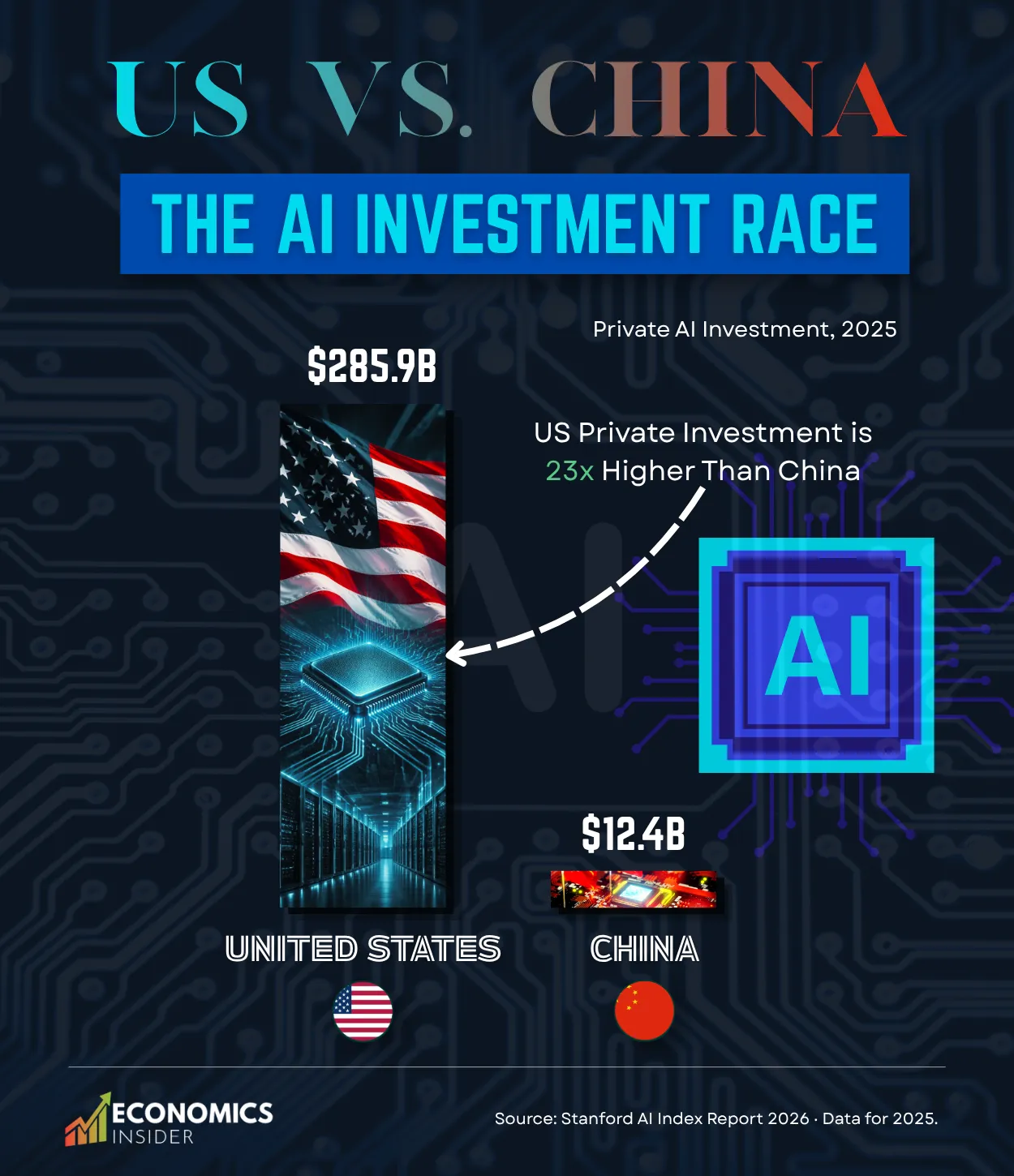
In 2025, private AI investment in the US reached roughly $285.9 billion. China’s total was just $12.4 billion. Put simply, American companies and investors put in more than 23 times as much as their Chinese counterparts.
Still, those numbers don’t tell the whole story. China provides substantial support to its tech industry through government-backed investment funds, while the US relies far more on private capital. The two countries are playing the same game by very different rules.
So who is really spending more on AI? Where is the money going? And can China keep up despite the gap? Let’s look at investment, infrastructure, government support and the wider AI industry.
Key Takeaways
- The US attracted $285.9 billion in private AI investment in 2025, compared with $12.4 billion in China.
- In the fourth quarter of 2025, the US made up 77% of global AI infrastructure spending. China’s share was 9.4%.
- The US has a much bigger private investment market, but China is still a serious rival in research, manufacturing and AI development.
1. US vs. China: AI Investment Comparison
When it comes to private AI investment, the US is far out in front. American tech giants, venture capital firms and other investors are putting large amounts of money into AI businesses.
Stanford University’s 2026 AI Index Report puts US private AI investment at about $285.9 billion for 2025. China pulled in around $12.4 billion. That makes the American figure roughly 23.1 times larger.
The gap also appears in the number of newly funded AI companies. The US had 1,953 newly funded AI companies in 2025. China had 161.
US vs China: AI Investment
Compare private AI investment and newly funded AI companies in 2025.
In other words, the American market attracts more money, and far more companies are getting funded to build AI products and services.
But private investment is only one piece of the puzzle. China’s government has a much bigger hand in steering money toward industries it considers strategic, and AI is one of them.
2. How Has Private AI Investment Changed Over Time?
The investment gap between the United States and China did not appear overnight. Both countries have drawn private money into AI for years, but the US has steadily built a much larger market.
It became especially obvious once generative AI took off. New AI tools grabbed public attention, and tech companies and venture capital firms rushed to put more money behind the technology.
By 2025, US private AI investment had jumped to $285.9 billion, while China’s reached $12.4 billion.
Looking at the numbers year by year gives a clearer sense of how the gap grew, and whether China is catching up or falling further behind.
Historical AI Investment: US vs China
Explore how private AI investment in the two countries has changed from 2013 to 2025.
| Year | United States | China |
|---|---|---|
| 2013 | $3.6B | $0.6B |
| 2014 | $7.0B | $0.7B |
| 2015 | $9.3B | $2.1B |
| 2016 | $10.2B | $4.5B |
| 2017 | $14.1B | $6.6B |
| 2018 | $21.1B | $14.0B |
| 2019 | $32.1B | $14.1B |
| 2020 | $44.2B | $17.1B |
| 2021 | $86.9B | $25.9B |
| 2022 | $61.2B | $15.1B |
| 2023 | $72.4B | $9.5B |
| 2024 | $109.5B | $9.4B |
| 2025 | $285.9B | $12.4B |
3. How Much Are the Two Countries Spending on AI Infrastructure?
Developing artificial intelligence requires much more than software and skilled engineers. You need powerful computers, advanced chips, giant data centers and a huge supply of electricity. All of that is expensive, and both countries are spending heavily on it.
According to IDC, global spending on AI infrastructure hit $89.9 billion in the fourth quarter of 2025 alone. The US accounted for $69.2 billion of that, or 77% of the total. China came in at $8.4 billion, or 9.4%.
US vs China: AI Infrastructure
Compare AI infrastructure investment, global spending share and data-center capacity.
That means US spending was more than eight times China’s in the quarter. It reflects how much American tech companies are putting into data centers, computing hardware and networking systems to run advanced AI services.
China is expanding its computing capacity too. But limits on its access to some advanced semiconductor technology make that harder.
One thing to keep in mind: these figures cover the fourth quarter of 2025, not the whole year. For the full year, IDC reported that worldwide AI infrastructure spending came to $318 billion.
Top 20 Cities Leading the World in AI Investment
4. Government Investment: How China and the US Support AI
Private companies matter to the AI industry, but governments play a big role as well. They fund research, encourage domestic manufacturing and back businesses in strategic industries. The US and China just go about it differently.
China’s Government-Backed Investment
China treats technological development as a national priority. The government supports research, homegrown manufacturing and companies in industries it sees as vital to the country’s future.
One of its main tools is the government guidance fund. These funds combine public money with private capital to back businesses in priority sectors.
Stanford’s AI Index estimates that about $184 billion went to AI companies through Chinese government guidance funds between 2000 and 2023. That’s a big deal for understanding China’s AI investment, because private funding figures alone leave out a lot of the financial support behind its AI industry.
China is also spending heavily on research and development across its economy. According to the country’s National Bureau of Statistics, total national R&D spending reached about 3.93 trillion yuan in 2025, up 8.2% from the year before.
That’s a large number, but it is important to understand that it covers R&D across everything from manufacturing and medicine to engineering. It is not an AI-only figure.
The United States’ Approach
The US has a huge private tech sector. Microsoft, Google, Amazon and Meta are all spending big on AI development and infrastructure, and venture capital firms are backing startups that build AI models, apps and related tools.
The federal government plays a supporting role through research funding, defense technology programs and semiconductor incentives. The CHIPS and Science Act is a good example. It was designed to boost chip manufacturing and research in the US, which matters because advanced chips are essential for building and running powerful AI systems.
So the two countries take different routes. The US leans on a very large private investment market, while China mixes private money with strong government direction and support.
5. Why Are Data Centers and AI Chips So Important?
A big chunk of AI investment doesn’t go into software at all. It goes into the physical infrastructure that keeps AI running.
Data centers sit at the heart of that. They house thousands of computers and specialized chips that process data and run AI models. Training an advanced model takes enormous computing power, and so does serving millions of people using AI tools at the same time. That’s why tech companies are spending billions on new data centers and equipment.
The US has a clear edge here. It’s home to some of the world’s biggest cloud providers and AI developers, and they’re building out capacity to support their growth.
Boston Consulting Group estimates that the US had more than 50 gigawatts of total data-center capacity at the end of 2025, compared with 31 gigawatts in China. A quick caveat: those numbers cover all data centers, not just AI-focused ones. BCG uses overall capacity because comparable public figures for AI-specific capacity aren’t available.
China is expanding its own data-center network too, aiming to boost computing power and rely less on foreign technology.
Chips remain the sticking point. Building powerful AI systems requires advanced semiconductors, especially graphics processing units (GPUs), which handle the huge number of calculations AI needs. American companies, particularly Nvidia, are strong in AI chip design and related technology. China is working to build up its own semiconductor industry and find alternatives to restricted foreign products.
It matters because access to computing power and advanced chips can decide how fast companies build and run more capable AI systems.
6. Can China Catch Up With the United States?
The numbers say the US has a big financial lead. But spending more doesn’t automatically mean winning the AI race, and China has real strengths.
First, it has a large technology and manufacturing base, which gives Chinese companies access to engineers, factories and supply chains.
Second, it’s investing in homegrown technology. Its companies are trying to develop their own chips, computing systems and AI models instead of depending entirely on foreign suppliers.
Third, it has a massive domestic market, with plenty of room to apply AI in manufacturing, transportation, finance and other industries.
China has also produced AI models that drew attention around the world.
Research and Innovation Also Matter
Money is only one way to measure where a country stands in AI. Research papers, notable AI models and patents all help show how its tech industry is really doing.
The Stanford AI Index shows China performing strongly in several areas of AI research and innovation, while the US still produces more notable AI models. It’s a reminder to look beyond investment totals when comparing the two.
AI Research and Innovation: US vs China
Compare research output, notable AI model development and AI patent activity. Select an indicator to explore the differences.
These figures are the number of papers from each country represented in the top 100 most-cited AI publications. A paper with authors from both countries can be counted for both.
Stanford HAI, 2026 AI Index Report.
Publications: OpenAlex data, 2024.
Notable AI models: Epoch AI data, 2025.
AI patents: EPO PATSTAT Global data, 2024.
Even so, the US keeps some major advantages. It attracts enormous private AI investment, has leading AI companies and benefits from strength in chip design and cloud computing. It also has a deep network of universities, research institutions and tech businesses working on AI.
7. US vs. China: Who Is Leading the AI Race?
On private investment and infrastructure spending, the US is clearly ahead. Its private AI investment was more than 23 times China’s in 2025, and it accounted for 77% of global AI infrastructure spending in the fourth quarter of that year. It also has a strong position in private tech funding, advanced computing and AI businesses.
China is taking another path. It’s using government-backed funds, national research spending and domestic manufacturing to build up its AI industry.
There’s also a difference between having more money and building better technology. Investment helps companies hire talent, buy computing equipment and develop products, but it doesn’t guarantee that every bet will pay off.
China has shown it can compete in AI even with a much smaller private investment market. At the same time, the US can’t assume its financial lead will protect its position forever.
How this plays out will depend on access to advanced chips, the cost of computing, research quality, skilled workers and how well companies turn AI into products people actually use.
Conclusion
Both countries are spending on AI because they see it as central to future economic growth and global competition. The US has a clear lead over China in AI investment and infrastructure spending, and the gap is widest when you look at private money. But you can’t judge China’s AI industry by private investment alone. Its government backs the sector through investment funds and national technology programs, and its broader research and manufacturing base feeds into AI development too.