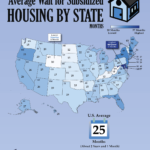









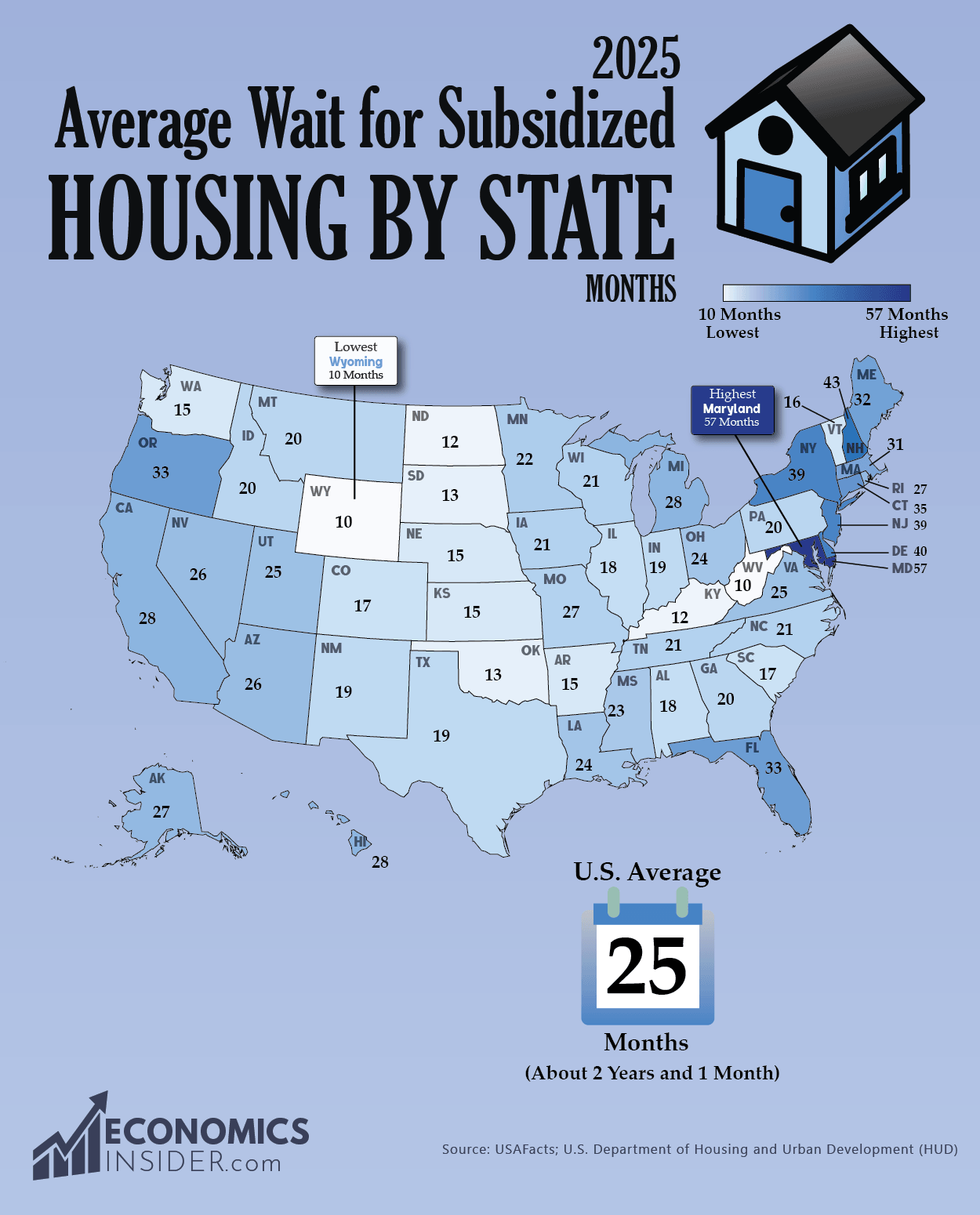
Wait times for Subsidized Housing in the US can depends on where you live, the type of help you need, and how many affordable homes are available. In some places, people may wait for several years. In 2025, people who received subsidized housing waited an average of 25 months, or about two years and one month. That was down from about 27 months in 2024.
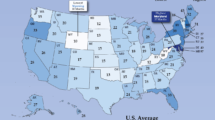
People in Maryland waited the longest, with an average wait of 57 months, or nearly five years. On the other hand, people in Wyoming and West Virginia waited the least, with an average wait of 10 months.
Key Takeaways
- The average wait for people who received subsidized housing in the United States was 25 months in 2025.
- Wait times varied widely by state, from 10 months in Wyoming and West Virginia to 57 months in Maryland.
- The long waits show that the country does not have enough affordable housing for everyone who needs it.
Average Wait Times for Subsidized Housing by US States in 2025
The table below shows the average wait time for subsidized housing in each state in 2025. The data comes from USAFacts and the U.S. Department of Housing and Urban Development (HUD).
| Rank | State or Area | Average Wait |
|---|---|---|
| 1 | Maryland | 57 months |
| 2 | New Hampshire | 43 months |
| 3 | Delaware | 40 months |
| 4 | New Jersey | 39 months |
| 5 | New York | 39 months |
| 6 | Connecticut | 35 months |
| 7 | Florida | 33 months |
| 8 | Oregon | 33 months |
| 9 | Maine | 32 months |
| 10 | Massachusetts | 31 months |
| 11 | California | 28 months |
| 12 | Hawaii | 28 months |
| 13 | Michigan | 28 months |
| 14 | Alaska | 27 months |
| 15 | Missouri | 27 months |
| 16 | Rhode Island | 27 months |
| 17 | Arizona | 26 months |
| 18 | Nevada | 26 months |
| 19 | Utah | 25 months |
| 20 | Virginia | 25 months |
| 21 | Louisiana | 24 months |
| 22 | Ohio | 24 months |
| 23 | Mississippi | 23 months |
| 24 | Minnesota | 22 months |
| 25 | Iowa | 21 months |
| 26 | North Carolina | 21 months |
| 27 | Tennessee | 21 months |
| 28 | Wisconsin | 21 months |
| 29 | Georgia | 20 months |
| 30 | Idaho | 20 months |
| 31 | Montana | 20 months |
| 32 | Pennsylvania | 20 months |
| 33 | Indiana | 19 months |
| 34 | New Mexico | 19 months |
| 35 | Texas | 19 months |
| 36 | Alabama | 18 months |
| 37 | Illinois | 18 months |
| 38 | Colorado | 17 months |
| 39 | South Carolina | 17 months |
| 40 | Vermont | 16 months |
| 41 | Arkansas | 15 months |
| 42 | Kansas | 15 months |
| 43 | Nebraska | 15 months |
| 44 | Washington state | 15 months |
| 45 | Washington, DC | 14 months |
| 46 | Oklahoma | 13 months |
| 47 | South Dakota | 13 months |
| 48 | Kentucky | 12 months |
| 49 | North Dakota | 12 months |
| 50 | Puerto Rico | 12 months |
| 51 | West Virginia | 10 months |
| 52 | Wyoming | 10 months |
Average Wait Time for Subsidized Housing in 2024 and 2025
According to HUD-based data, households that received subsidized housing in 2025 waited an average of 25 months before receiving help. This means that a household entering the system may wait more than two years before moving into subsidized housing.
| Year | Average Wait |
| 2024 | 27 months |
| 2025 | 25 months |
The 2025 average was about 7.4% lower than the 2024 average. Even so, the wait was still longer than two years.
This number only includes households that eventually received assistance. It does not include people who remain on waiting lists or people who cannot apply because a local list is closed.
Maryland had the longest average wait in the list, at 57 months. That is nearly four years and nine months. New Hampshire followed at 43 months, while Delaware had an average wait of 40 months.
The shortest waits were reported in Wyoming and West Virginia, at 10 months each. These figures show why a national average can be misleading. A person’s wait may depend heavily on the state and local housing authority handling the application.
What Is Subsidized Housing?
Subsidized housing is a general term for housing help that lowers rent for low-income households. One of the largest programs is the Housing Choice Voucher program, often called Section 8. A voucher usually helps an eligible household pay rent to a private landlord.
Another major program is public housing. In this program, local housing authorities manage rental homes for eligible households.
There are also other federal programs that support affordable housing. These programs have limited funding and a limited number of homes. Because of this, being eligible does not mean that a household will receive help right away.
States With the Longest Wait Times for Subsidized Housing
Some states have much longer waits for subsidized housing than the national average of 25 months.
Maryland had the longest wait in the table, at 57 months. That is almost five years. New Hampshire followed with an average wait of 43 months, while Delaware had a wait of 40 months.
Other states with long waits included New Jersey and New York, both at 39 months. Connecticut had an average wait of 35 months, while Florida and Oregon were both at 33 months.
These states show how long people may have to wait in areas where the demand for affordable housing is high.
States With the Shortest Wait Times for Subsidized Housing
The shortest waits were found in Wyoming and West Virginia, where the average wait was 10 months.
Other states also had waits of around one year or slightly more. Kentucky and North Dakota both had average waits of 12 months, while Oklahoma and South Dakota were at 13 months.
Washington, DC had an average wait of 14 months, while Arkansas, Kansas, Nebraska, and Washington state each had waits of 15 months.
These numbers show that some households receive housing assistance much sooner than the national average.
Wait Time For the Most Populous States?
The wait times in some of the country’s largest states also varied widely.
California had an average wait of 28 months, which was longer than the national average. Florida had one of the longer waits at 33 months, while Texas was much lower at 19 months.
New York had a wait of 39 months, making it one of the states with the longest waits for subsidized housing. Illinois had an average wait of 18 months, while Pennsylvania was at 20 months.
Why Does It Take So Long?
The main reason is simple: There are not enough subsidized homes and vouchers for everyone who needs help. HUD’s 2025 Worst Case Housing Needs report found that in 2023 there were only 59 affordable homes for every 100 very low-income renter households.
The shortage was even worse for extremely low-income renters. There were only 38 affordable homes for every 100 households in that group. When many people need help but only a limited number of homes and vouchers become available, applicants remain on waiting lists for a long time.
Where You Live Matters
Housing assistance is funded by the federal government, but much of the work is handled by local housing authorities. That makes location very important.
A household in one county may face a short wait, while a household with a similar income in another county may wait several years. Large cities often face strong demand because rents are high and affordable homes are limited.
HUD research has also found that people may face another wait after receiving a voucher. In one HUD study, the middle search time for new voucher holders was 60 days. Only about 61% had rented a home within 180 days.
This means that receiving a voucher does not always lead to an immediate move. The household may still need to find a landlord, locate an eligible home, and complete the required checks.
The Bottom Line
The long wait for subsidized housing is not only a paperwork problem. It is mainly a shortage problem. Millions of households need affordable homes, but the number of subsidized homes and vouchers is limited. As a result, assistance can be very helpful once a household receives it, but difficult to obtain quickly.
In 2025, the average household that received subsidized housing waited 25 months. For some people, the wait was much longer. Maryland had an average wait of 57 months, while New Hampshire had an average wait of 43 months. In Wyoming and West Virginia, the average wait was 10 months. These differences show that local housing conditions matter greatly.