



The European Union’s economy is one of the biggest in the world, worth about €18.8 trillion in 2025. However, the economic weight of this bloc is unevenly distributed among its 27 members. The few largest economies in Europe contribute a large proportion of the total output of the EU.
Of the 27 EU members, Germany is the largest economy, followed by France, Italy, and Spain. Add up these four countries alone, and they account for 61 percent of everything the EU produces, based on the 2025 numbers. In simple terms, more than three out of every five euros made in the EU comes from just these four countries.
Key Takeaways
- Germany is Europe’s largest economy, accounting for 24.1% of total EU GDP in 2025.
- Germany, France, Italy and Spain together make up 61% of the EU economy.
- Poland has had the strongest rise of any country on this list, more than doubling its share of EU GDP over twenty years.
- Economic output is highly concentrated among a few large Western European economies, while many smaller Central, Eastern and Southern European countries each account for less than 2% of EU GDP.
Europe’s Biggest Economies in 2025
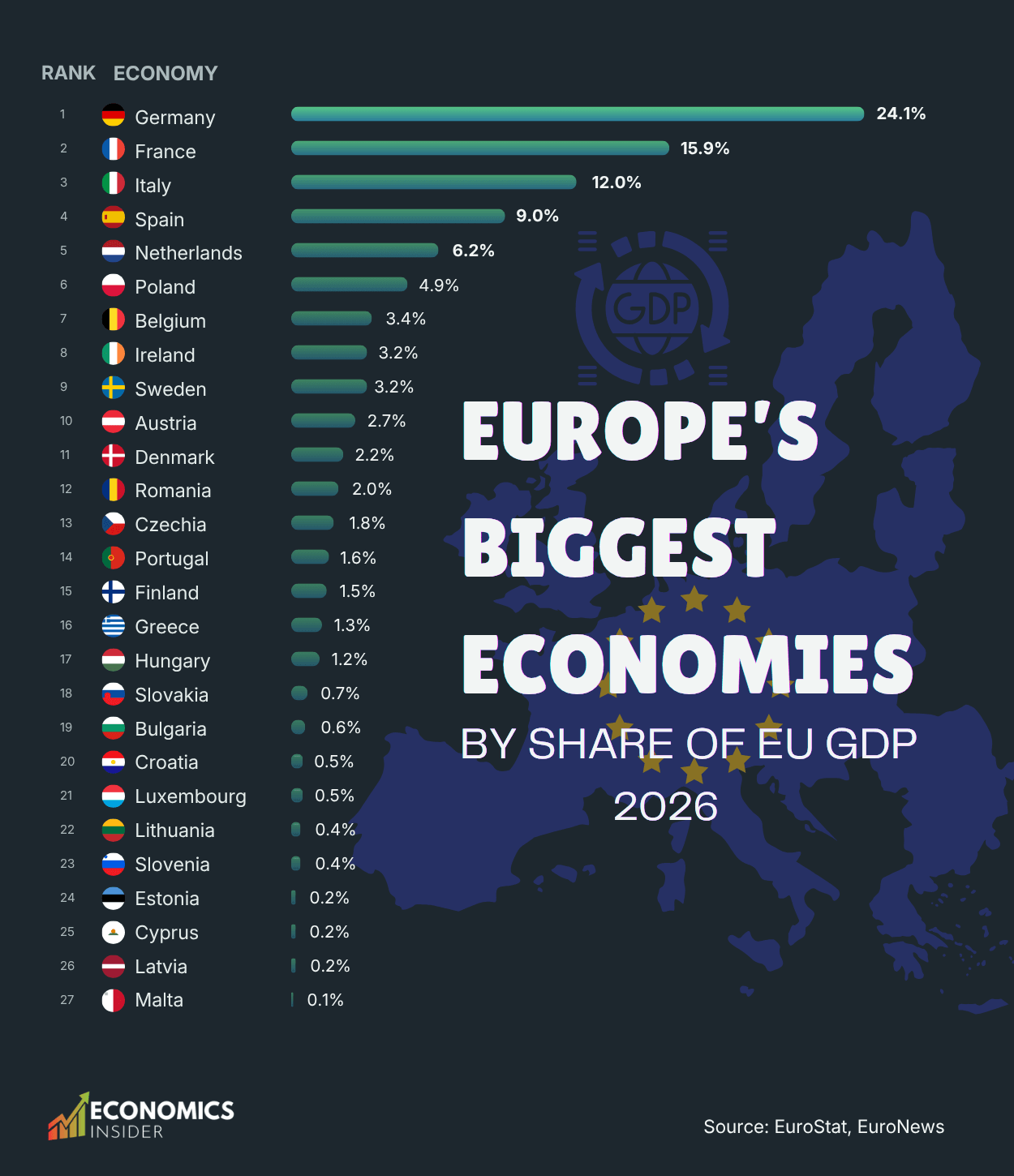
The table below ranks EU countries by their share of the bloc’s total GDP in 2025. The figures show how much each country’s economy contributes to the overall EU economy, rather than GDP per person or economic growth. This ranking of the largest economies in the EU shows the relative economic weight of each member.
| Rank | Country | 2025 Share of EU GDP |
|---|---|---|
| 1 | 🇩🇪 Germany | 24.10% |
| 2 | 🇫🇷 France | 15.90% |
| 3 | 🇮🇹 Italy | 12.00% |
| 4 | 🇪🇸 Spain | 9.00% |
| 5 | 🇳🇱 Netherlands | 6.20% |
| 6 | 🇵🇱 Poland | 4.90% |
| 7 | 🇧🇪 Belgium | 3.40% |
| 8 | 🇮🇪 Ireland | 3.20% |
| 9 | 🇸🇪 Sweden | 3.20% |
| 10 | 🇦🇹 Austria | 2.70% |
| 11 | 🇩🇰 Denmark | 2.20% |
| 12 | 🇷🇴 Romania | 2.00% |
| 13 | 🇨🇿 Czechia | 1.80% |
| 14 | 🇵🇹 Portugal | 1.60% |
| 15 | 🇫🇮 Finland | 1.50% |
| 16 | 🇬🇷 Greece | 1.30% |
| 17 | 🇭🇺 Hungary | 1.20% |
| 18 | 🇸🇰 Slovakia | 0.70% |
| 19 | 🇧🇬 Bulgaria | 0.60% |
| 20 | 🇭🇷 Croatia | 0.50% |
| 21 | 🇱🇺 Luxembourg | 0.50% |
| 22 | 🇱🇹 Lithuania | 0.40% |
| 23 | 🇸🇮 Slovenia | 0.40% |
| 24 | 🇪🇪 Estonia | 0.20% |
| 25 | 🇨🇾 Cyprus | 0.20% |
| 26 | 🇱🇻 Latvia | 0.20% |
| 27 | 🇲🇹 Malta | 0.10% |
Germany Leads Europe’s Economy
Germany is the largest economy of Europe and third largest globally. It accounted for 24.1% of total EU GDP in 2025, meaning that almost one quarter of the whole EU economy was produced by Germany.
This is due to the scale of Germany’s industrial sector, manufacturing, exports and huge internal market. Germany’s economy had an estimated value of about $5.45 trillion in 2026, according to IMF.
Nevertheless, being the biggest economy doesn’t mean that Germany had the highest growth rate. On the contrary, Germany had 0.2% real GDP growth in 2025, one of the lowest in EU member states.
Average Salaries in Europe 2026: Which Countries Pay the Most and Least?
France Second in Size
France was the second-biggest economy of the EU with 15.9% share of total EU GDP. It is also the seventh largest economy with gdp of approximately $3.6 trillion in 2026, according to World Economic Outlook (April 2026).
France has a diverse economy, which includes different industries such as manufacturing, energy, finance, tourism and consumer market. Its large population also gives it one of the biggest domestic markets in Europe.
Together, Germany and France represented 40% of the EU economy based on the figures in the table.
Italy Remains Europe’s Third-Largest Economy
Italy ranked third, accounting for 12% of EU GDP in 2025. It is also the eighth largest economy with gdp of approximately $2.74 trillion in 2026, according to World Economic Outlook (April 2026).
Italy’s economy is supported by manufacturing, machinery, automotive production, pharmaceuticals, fashion, tourism and other services. Despite its large economic base, Italy’s share is considerably smaller than Germany’s and France’s.
Still, its 12% contribution makes Italy one of the central economic powers of the European Union.
Spain Ranks Fourth
Spain accounted for 9% of total EU GDP, making it the fourth-largest economy in the bloc. It is also the fouthenties largest economy with gdp of approximately $2 trillion in 2026, according to World Economic Outlook (April 2026).
Spain has a large services sector and is also an important economy in tourism, manufacturing, construction, agriculture and renewable energy. Its large population and domestic market help make it one of Europe’s major economies.
The four largest economies — Germany, France, Italy and Spain — together accounted for 61% of EU GDP in the table.
The Netherlands Ranks Fifth
The Netherlands accounted for 6.2% of EU GDP, putting it in fifth place.
Although it has a much smaller population than Germany, France, Italy or Spain, the Netherlands has a highly developed and internationally connected economy. Trade, logistics, finance, technology, manufacturing and agriculture all play important roles.
It is also the largest economy in the ranking after the four major European powers.
Poland Is Europe’s Rising Economic Power
Poland ranked sixth, with a 4.9% share of EU GDP. Its position is particularly notable because Poland is the largest economy in Central and Eastern Europe. Its large population, growing industrial base and expanding domestic market have helped it become an increasingly important part of the EU economy. Poland’s economy is now larger, in relative EU terms, than those of Sweden, Belgium and Austria.
The Middle of the Ranking
Below the six largest economies, the shares become much smaller.
Sweden accounted for 3.2% of EU GDP, followed by Ireland at 3.2% and Belgium at 3.4%. Austria contributed 2.7%, while Denmark accounted for 2.2%.
These countries are relatively small compared with Germany or France, but several have highly productive and internationally competitive economies.
Romania is another interesting case. It accounted for 2% of EU GDP, placing it ahead of several Western and Northern European economies in the ranking.
Czechia contributed 1.8%, while Portugal accounted for 1.6% and Finland 1.5%. Greece followed at 1.3%, with Hungary at 1.2%.
Europe’s Smallest Economies
At the bottom of the ranking are mostly smaller European countries with relatively small populations.
Slovakia accounted for 0.7% of EU GDP, while Bulgaria contributed 0.6%. Croatia and Luxembourg each represented 0.5%, while Lithuania and Slovenia each accounted for 0.4%.
The smallest shares came from Estonia and Cyprus at 0.2% each, followed by Latvia at 0.2% and Malta at just 0.1%.
These small percentages do not necessarily mean these countries are poor or economically unimportant. GDP share mainly reflects the overall size of an economy. A country can have a small total economy while still having relatively high GDP per person.
Luxembourg is a good example. Its economy represents only 0.5% of EU GDP, but it has one of the highest GDP-per-person levels in the EU.
What Does the Ranking Tell Us About Europe?
The biggest fact is that Europe’s economic power is concentrated in a handful of countries.
Germany alone accounts for roughly one-quarter of EU GDP. Add France, Italy and Spain, and the four largest economies account for 61% of the total in the table.
The next group is much smaller. The Netherlands contributes 6.2%, Poland 4.9%, and Belgium, Sweden and Ireland are each around 3%.
This creates a clear economic structure: a small group of very large economies sits at the top, followed by a wider group of medium-sized economies and then many smaller economies.
There is also an important regional pattern. The Western part of Europe remains dominant regarding the economic contribution to the EU, as Germany, France, Italy, Spain and the Netherlands hold the first five places respectively.
On the other hand, economies of Central and Eastern Europe like Poland, Romania and Czechia have come to represent an important part of the EU’s economic foundation.
One more aspect that should be considered is the difference between the share of GDP and economic performance. The first may be significant in case the state is populous and economically developed while the second may be far higher for smaller countries. For instance, according to the data provided by Eurostat, the GDP of the EU grew by 1.5% in 2025.
The Bottom Line
Europe’s economy is made up of 27 countries, but its economic weight is heavily concentrated among a few major powers. Germany leads with 24.1% of EU GDP, followed by France at 15.9%, Italy at 12% and Spain at 9%. Together, these four countries account for more than three-fifths of the EU economy.
Behind them, the Netherlands and Poland stand out as the next two largest economies. Further down the ranking, dozens of smaller economies each contribute a much smaller share.