









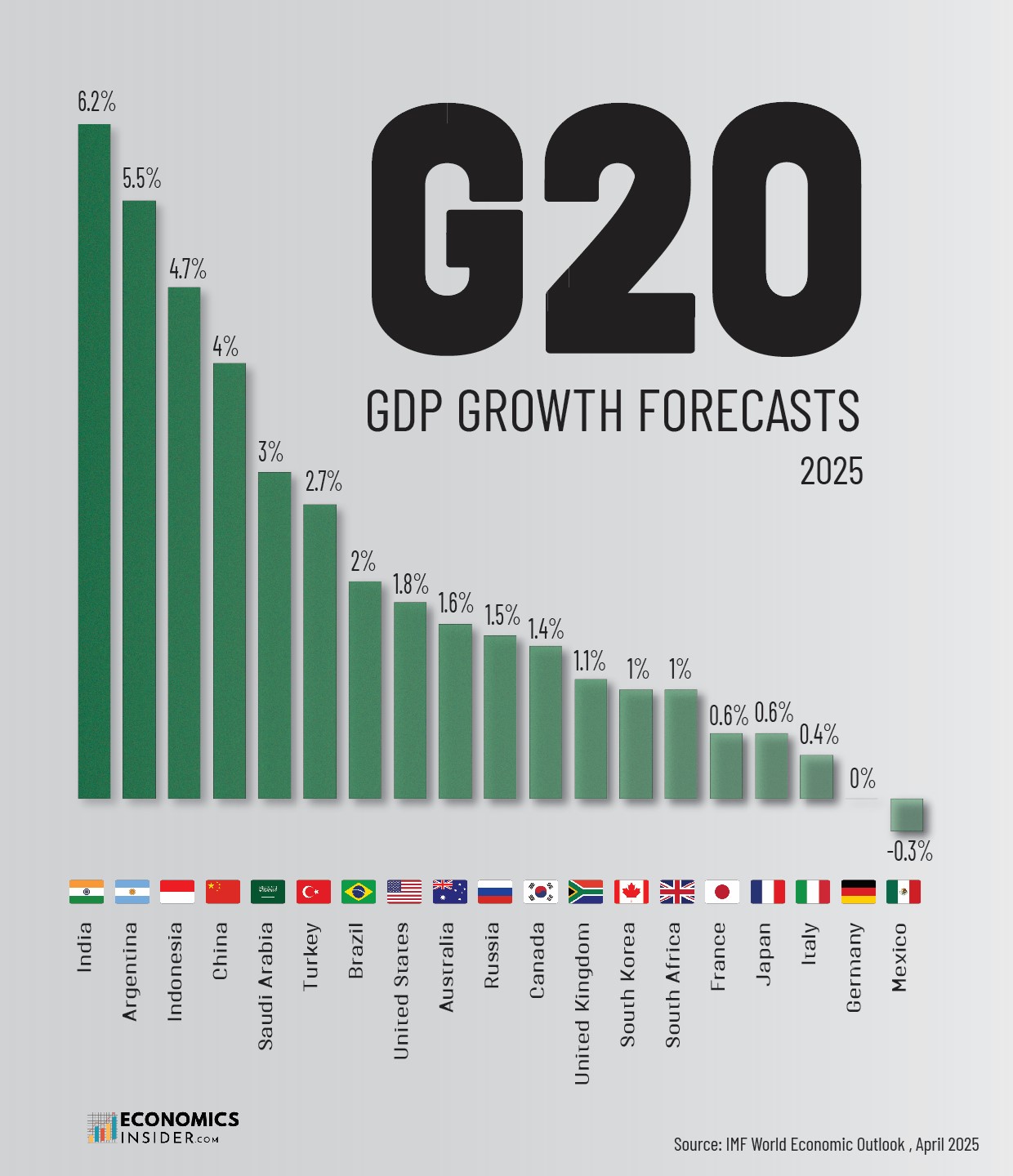
The G20 is an intergovernmental forum comprising 19 sovereign countries. It includes both advanced and emerging markets, which together account for more than 80% of the world’s GDP and about two-thirds of the global population. Among G20 countries some nations like India and Argentina are forecasted to achieve strong GDP growth, while others like Germany and Mexico are facing contraction or stagnant growth projections.
The average GDP growth rate of the listed G20 countries is approximately 2.11%. Additionally, emerging economies in G20 group are growing faster than the developed ones.
Key Takeaways
- Among Asian G20 countries, India, Indonesia, and China are growing faster, while Japan and South Korea are growing more slowly.
- Many developed economies such as Germany, Japan, and France are growing slowly or even shrinking.
- The average GDP growth rate among the G20 countries is about 2.11%.
G20 Growth Rates
The following table shows the GDP growth rates of G20 countries for the current year, ranked from highest to lowest. These figures represent how fast each economy is expanding or contracting in 2025.
| Rank | Country/Region | GDP Growth Rate (%) |
|---|---|---|
| 1 | 🇮🇳 India | 6.2 |
| 2 | 🇦🇷 Argentina | 5.5 |
| 3 | 🇮🇩 Indonesia | 4.7 |
| 4 | 🇨🇳 China | 4 |
| 5 | 🇸🇦 Saudi Arabia | 3 |
| 6 | 🇹🇷 Turkey | 2.7 |
| 7 | 🇧🇷 Brazil | 2 |
| 8 | 🇺🇸 United States | 1.8 |
| 9 | 🇦🇺 Australia | 1.6 |
| 10 | 🇷🇺 Russia | 1.5 |
| 11 | 🇨🇦 Canada | 1.4 |
| 12 | 🇬🇧 United Kingdom | 1.1 |
| 13 | 🇰🇷 South Korea | 1 |
| 14 | 🇿🇦 South Africa | 1 |
| 15 | 🇫🇷 France | 0.6 |
| 16 | 🇯🇵 Japan | 0.6 |
| 17 | 🇮🇹 Italy | 0.4 |
| 18 | 🇩🇪 Germany | 0 |
| 19 | 🇲🇽 Mexico | -0.3 |
Data Source: International Monetary Fund (IMF).
The data shows that while some G20 members are experiencing solid growth, others are facing economic stagnation or decline. Overall, emerging markets like India, Argentina, and Indonesia are leading in terms of growth, while many Western economies are seeing modest to weak performance.
🇮🇳 India
India tops the list with a 6.2% growth rate, maintaining its status as the fastest-growing major economy. It is home to the highest population globally. The country is also the fourth-largest economy in the world, with a GDP of approximately $4 trillion. The major factors that contribute to the fast growth in India include its strong domestic demand, a growing tech and services sector, and government-led infrastructure projects. Despite global headwinds, India’s large consumer base and favorable demographics give it a steady and strong growth pattern.
🇦🇷 Argentina
Argentina, located in South America, ranks second with a GDP growth rate of 5.5%. This surge in growth could be due to a temporary rebound from previous contractions, possibly due to a rise in agricultural exports. However, high inflation, currency instability, and unemployment remain major economic problems that could affect its long-term growth.
🇮🇩 Indonesia
Indonesia, Southeast Asia’s largest economy, is growing at a steady pace of 4.7%. The country benefits from a young population and a rising middle class, which helps it to keep strong growth momentum.
EU Countries GDP Ranked: Which Nations Have the Largest Economies in 2025?
🇨🇳 China
China is the second largest economy globally, with a nominal GDP of approximately $19 trillion in 2025. It also has the 2nd largest population, following India. China has been growing steadily for several decades. It has been the fastest-growing economy in the world since the 1980s, with an average annual growth rate of 10% from 1978 to 2005.
Currently, the country’s growth projection stands at 4%, which is slower compared to its past double-digit levels. The country is facing the tariff war with the United States and navigating through challenges such as a shrinking workforce, property sector crises, and shifting global supply chains. However, China’s continued investment in technology and a shift towards a consumption-driven economy are helping its growth on a stable path.
🇸🇦 Saudi Arabia
With 3% growth, Saudi Arabia is performing moderately well. The country relies heavily on its oil exports to drive its economy. However, with declining oil reserves and a continued shift towards non-oil energy resources, the country is trying to diversify its economy. Saudi Arabia’s Vision 2030 plan is a major attempt to diversify the economy beyond energy. Additionally, investments in tourism, infrastructure, and the private sector are also contributing to Saudi Arabia’s growth.
🇹🇷 Turkey
Turkey is projected to achieve a 2.7% growth rate in 2025, which ranks it the 6th highest growth rate in the G20 group. However, the country is grappling with high inflation and currency volatility.
🇺🇸 United States
The U.S. is the largest economy in the world, with a GDP of approximately $30 trillion. It is projected to grow at 1.8%. The ongoing tariff war and trade war with China significantly impacted the US’s growth rate. The International Monetary Fund and other global institutions have already reduced the country’s growth projection. However, due to its innovation and strong labor market, the U.S. economy is still resilient and strong.
Australia, Russia, and Others
Australia (1.6%), Russia (1.5%), and Canada (1.4%) are all growing at a slow pace. Australia is dealing with weak global demand, Russia continues to face sanctions and economic isolation, and Canada is adjusting to high interest rates and slower real estate growth.
The Slower Growing G20 Countries
Countries like the UK (1.1%), Japan (0.6%), France (0.6%), Italy (0.4%), and especially Germany (0%) are seeing very low growth in the G20 group. Structural issues such as aging populations, low productivity, and energy challenges are holding back these economies.
Additionally, Mexico is the only country in the G20 group that is projected to have a negative growth rate of -0.3%. It is due to the country’s declining exports and tighter financial conditions.
Conclusion
The G20 countries are projected to grow at an average growth rate of about 2.11%. India leads the group with the highest growth rate at 6.2%. Argentina follows with 5.5%, despite facing inflation and currency challenges. Among Asian economies, India, Indonesia, and China show relatively higher growth, while Japan and South Korea are growing more slowly. In contrast, major European economies like Germany, Italy, and France are experiencing low or no growth. Latin America shows mixed results, with Argentina performing well and Mexico showing negative growth.


Add Comment