




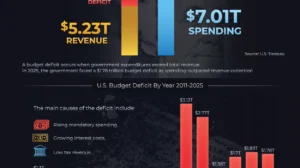







The U.S. government spends money on public expenditures like defense, health care, transportation, and a wide range of other initiatives. However, in most years, its expenditures exceed the revenues it collects through taxation. The difference between expenditures and revenues is called the budget deficit. To finance this deficit, the government borrows money by issuing U.S. Treasury securities.
The Treasury securities are the primary means of government financing. There are various categories of these securities with varying terms and features. The government designs some for short-term needs and others for long-term financing.
Understanding U.S. Treasury securities is key to grasping how the U.S. government borrows money and manages its national debt.
Key Takeaways
- U.S. Treasury securities are used by the government to borrow money.
- They range from short-term to long-term investments with varying terms and features.
- Some U.S. Treasury securities offer fixed returns, while others adjust with inflation or interest rates.
What Are U.S. Treasury Securities?
U.S. Treasury securities are financial instruments issued by the U.S. government to raise money from investors.
When an investor buys a Treasury security, they are lending money to the government. In return, the government agrees to repay the amount later and, in most cases, pay interest.
The U.S. Treasury issues these securities and sells them through auctions. Backed by the full faith and credit of the United States, investors widely consider them a low-risk investment. They also offer high liquidity, which allows easy buying and selling in financial markets.
Main Types of U.S. Treasury Securities
1. Treasury Bills (T-Bills)
Treasury Bills represent short-term Treasury securities with maturity periods of one year or less.
They do not produce any regular interest payments. The Treasury issues bills at a discounted price and redeems them in full when they mature.
These instruments offer the highest safety and liquidity for investment purposes. They also serve as a key benchmark for short-term interest rates in the economy.
2. Treasury Notes (T-Notes)
Treasury Notes refer to Treasury securities with maturities ranging from 2 to 10 years. They pay interest every six months at a fixed rate, which makes them ideal investments for income-seeking individuals.
The 10-year Treasury note is one of the key economic indicators globally. It affects the mortgage and borrowing costs of companies and shapes the general market environment. This makes Treasury Notes critical in government finance and the international market.
3. Treasury Bonds (T-Bonds)
Treasury Bonds are long-term securities issued by the government, which are repayable after 20 or 30 years.
They earn interest every six months in fixed amounts. The government mainly uses Treasury securities for long-term borrowing. Such bonds are highly sensitive to changes in both the price level and interest rates.
They are mostly preferred by pension funds and insurance companies due to the stability of their rates of return.
4. Treasury Inflation-Protected Securities (TIPS)
TIPS are Treasury securities, which are designed to ensure their investors’ protection against inflation. If inflation goes up, the value of TIPS increases; conversely, if inflation goes down, it decreases. Interest is paid in accordance with its adjusted nominal value.
In other words, investors’ return on investment remains unchanged even if the price level goes up. TIPS are widely applied during periods of increasing prices on goods and services.
5. Floating Rate Notes (FRNs)
Floating Rate Notes are Treasury securities with adjustable rates of return on investment. Their rates are linked to short-term Treasury bill rates, which means returns adjust as market interest rates change.
In other words, as soon as interest rates go up, Floating Rate Notes become more profitable. They are mostly used by institutions with high-interest-rate risk management needs.
6. Savings Bonds
Saving bonds are Treasury bonds that are not marketed and are designed to be purchased by individuals. They are straightforward, secure investments intended for long-term holding.
Savings bonds either pay a fixed rate of return or a floating rate based on changes in the price index. Thus, they are appropriate for personal purposes like financing higher education.
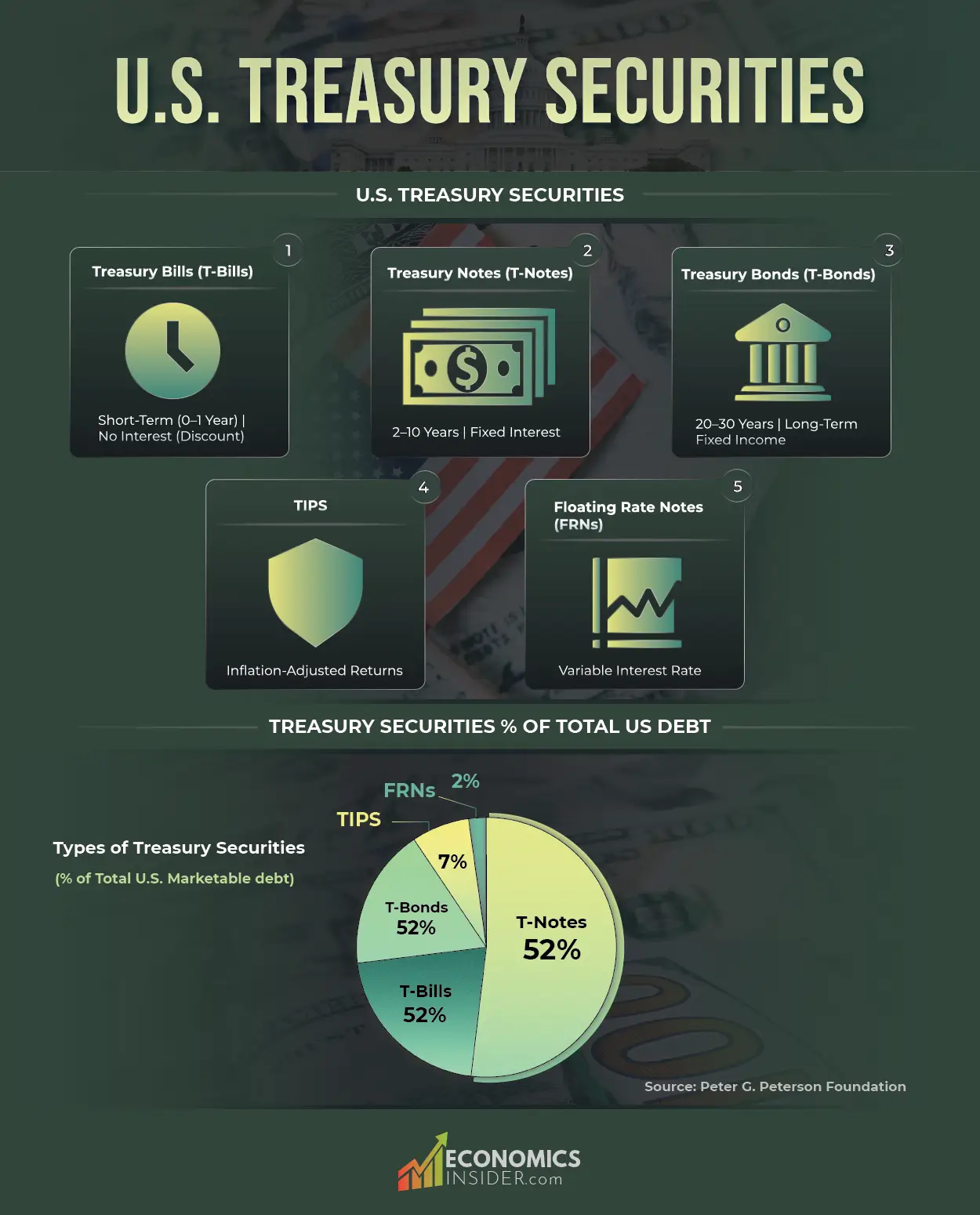
U.S. Treasury Securities (% of Total Marketable Debt)
Treasury notes represent the biggest percentage of marketable debt held by the federal government at about 52 percent, yet the percentage has been decreasing. Additionally, treasury bills have a share of 22 percent, which indicates that they are the most popular U.S. debt instrument after treasury notes. Treasury bonds, TIPS, and Floating Rate Notes hold a percentage of 17 percent, 7 percent, and 2 percent, respectively.
| Security Type | Share (%) |
|---|---|
| Treasury Notes | 52% |
| Treasury Bills | 22% |
| Treasury Bonds | 17% |
| TIPS (Inflation-Protected Securities) | 7% |
| Floating Rate Notes (FRNs) | 2% |
Source: Peter G. Peterson Foundation
The reduction in the percentage of Treasury notes from 66 percent since 2015 is due to an increase in the issuance of Treasury bills and other securities.
How the U.S. Government Borrows Money
Why the U.S. Issues Different Types of Treasury Securities
The U.S. government uses a variety of treasury securities in order to ensure effective management of its funds. Short-term securities assist the government in financing its current expenditures and controlling its cash flow. Medium-term and long-term securities allow the government to lock in borrowing costs over time.
Some of the Treasury securities provide protection against losses caused by an increase in prices. Others have floating interest rates and fluctuate with changes in the rate of interest. All of this contributes to the reduction of risks on the part of the government and attracts diverse groups of investors.
How Treasury Securities Are Sold
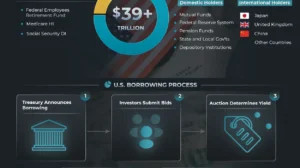
Auctions play a central role in the financing efforts of the U.S. Treasury through the sale of securities like Treasury bills, notes, and bonds. Bidding for participation in this auction process occurs in two forms.
A non-competitive bid occurs when an investor agrees to accept any interest rate, ensuring the acceptance of the security. A competitive bid involves the selection of the investor’s preferred interest rate, with the risk that they may not get anything if their rate is too high.
Once the bids are submitted, the Treasury commences with the acceptance of the lowest interest rates until the total value of the sale is reached. The highest of the accepted interest rates is then the final interest rate for all successful bidders. This system keeps the process fair and clear, and it makes sure the interest rate is based on real demand in the market.
Who Owns U.S. Treasury Securities?
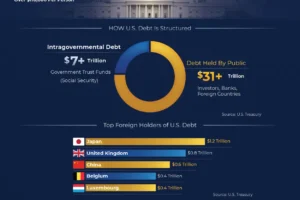
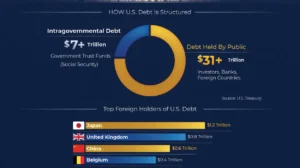
U.S. Treasuries are owned by a variety of investors. The investor groups include commercial banks, mutual funds, pension funds, the Fed itself, and individuals. In addition to these domestic holders, a major portion of U.S. Treasury Securities is owned by foreign investors. The largest foreign holders include Japan, the United Kingdom, and China. These countries invest heavily in U.S. Treasury securities as part of their foreign exchange reserves
Role of Foreign Investors in U.S. Treasury Securities
Investment in U.S. Treasuries is popular among foreign buyers due to the low risk and stability of the U.S. economy.
Central banks and other international institutions have a high investment level in these securities around the world. This is due to their high security, liquidity, and stable economic backing by the United States.
The high investment leads to low borrowing costs for the U.S. government and contributes to making the dollar the world’s primary currency.
Although individual countries’ shares of foreign ownership may vary in time, the global interest in U.S. Treasuries is quite high. However, some countries—particularly China—have been gradually reducing their holdings of U.S. Treasury securities in recent years.
| Country | Holdings (Jan 2026, $ Billion) |
|---|---|
| Japan | 1,225.30 |
| United Kingdom | 895.3 |
| China (Mainland) | 694.4 |
| Belgium | 451 |
| Luxembourg | 446.9 |
| Cayman Islands | 432.7 |
| Canada | 395.8 |
| France | 380.5 |
| Ireland | 342 |
Source: U.S. Treasury
Risks of U.S. Treasury Securities
Although Treasury securities are among the safest assets, there are several types of risks associated with their purchase. Interest rate risk implies the possibility of falling prices when rates increase. Inflation risk may decrease the purchasing power of returns.
Long-term risks include growing government debt levels. Nonetheless, as compared to other investment instruments, the level of U.S. Treasury Securities risks is quite low.
Why U.S. Treasury Securities Matter Globally
U.S. Treasury securities play a pivotal role in the functioning of the global economy. They are used as a safe asset by investors all over the world and act as an indicator of interest rates in many nations. Given the significance of such securities, shifts in the market of Treasury securities may affect the whole global economy.
Conclusion
U.S. Treasury securities are the main instruments of borrowing and financing used by the federal government. In addition to different securities issued by the government, such as bills, bonds, and inflation-indexed securities, there are numerous purposes for which they are intended. Together, they create a flexible and stable system that supports both the U.S. economy and the global financial system.