










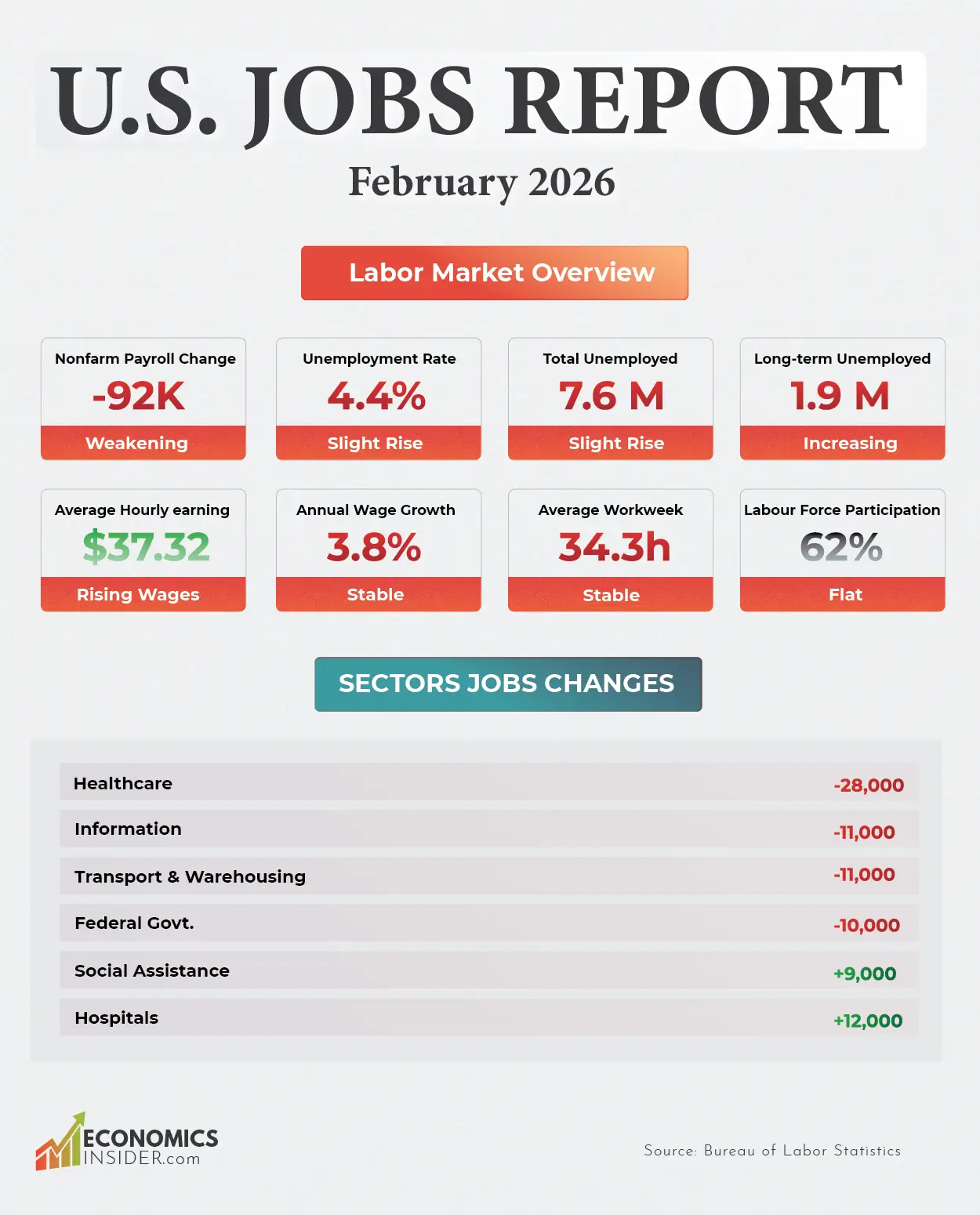
The US labor market showed signs of weakness in February. According to the latest report from the Bureau of Labor Statistics (BLS), total nonfarm payroll employment declined by 92,000 jobs during the month.
Economists had expected the economy to add around 60,000 jobs, making the result a significant negative surprise. The data suggests that the hiring momentum is slowing in various sectors of the economy. The US unemployment rate also went up slightly. This suggests that the labor market may be entering a more fragile state.
US Job Market Report February 2026
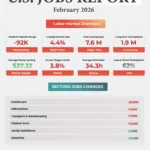
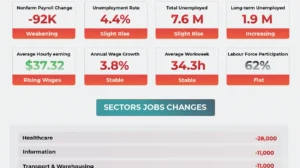
The table below summarizes the key indicators from the February 2026 U.S. jobs report.
| Indicator | Latest Value | Previous Month | Trend |
|---|---|---|---|
| Nonfarm Payroll Change | -92,000 jobs | +126,000 | ↓ Weakening |
| Unemployment Rate | 4.40% | 4.30% | ↑ Slight rise |
| Total Unemployed | 7.6 million | 7.5 million | ↑ Slight rise |
| Average Hourly Earnings | $37.32 | $37.17 | ↑ Rising wages |
| Annual Wage Growth | 3.80% | 3.80% | → Stable |
| Average Workweek | 34.3 hours | 34.3 hours | → Stable |
| Labor Force Participation | 62.00% | 62.00% | → Flat |
Source: Bureau of Labor Statistics
Job Growth Turns Negative
After adding 126,000 jobs in January, the US labor market unexpectedly shifted into negative territory in February.
Economists had predicted modest growth, but payroll employment instead declined by 92,000 jobs. The report also included downward revisions for previous months, which further weakened the overall picture of the labor market.
December job figures were revised down significantly. The economy was initially reported to have added 48,000 jobs, but updated data now show that 17,000 jobs were actually lost that month. January’s job growth was also revised slightly lower, from 130,000 to 126,000 jobs.
With these revisions, total employment for December and January combined is now 69,000 jobs lower than previously reported. These adjustments indicate that job growth has been weaker than originally believed.
Unemployment Rate Edges Higher
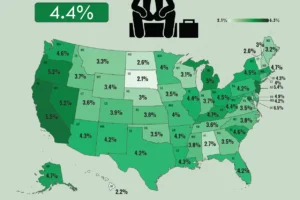
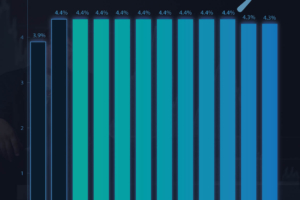
The unemployment rate went up to 4.4 percent. This was up slightly from the forecast of 4.3 percent. The total number of unemployed workers in the US was 7.6 million. Although the overall unemployment rate remains relatively low by historical standards, the increase suggests that the job market is becoming less tight.
Among different demographic groups, unemployment rates showed little change. The unemployment rate was 4.0 percent for adult men and 4.1 percent for adult women.
| Group | Unemployment Rate |
|---|---|
| Adult Men | 4.0% |
| Adult Women | 4.1% |
| White Workers | 3.7% |
| Black Workers | 7.7% |
| Asian Workers | 4.8% |
| Hispanic Workers | 5.2% |
| Teenagers | 14.9% |
Source: Bureau of Labor Statistics
The disparity between the rates of the different workers is an indication of the disparity in the US labor market.
Healthcare Sector Sees Unexpected Job Losses
The most surprising aspect of the employment report was the decline in healthcare employment. The healthcare sector is generally the strongest sector in the US labor market. However, employment in the sector fell by 28,000 jobs during the month.
This represented a major shift from January, when the sector had added 77,000 jobs. Most of the losses came from physician offices, which cut 37,000 jobs, mainly due to strike activity.
Hospitals, however, continued to expand employment and added 12,000 jobs during the month. Despite the February decline, healthcare has still been a strong job creator over the past year, adding an average of 36,000 jobs per month.
Government and Information Sector Job Cuts
Some sectors have been experiencing job losses for several months, and February continued that trend. The information sector, which includes media, telecommunications, and technology-related services, lost 11,000 jobs in February. Over the past year, employment in this sector has been declining at an average rate of around 5,000 jobs per month.
Federal government employment also declined again. Government payrolls fell by 10,000 jobs in February. Since it peaked in October 2024, federal government employment has decreased by 330,000 workers, which is a decline of 11 percent.
Transportation and Logistics Jobs Decline
Employment in the transportation and warehousing sector also declined during February. The sector has shed 11,000 jobs overall. The biggest job loss has been reported by the courier and messenger services industry, which has shed 17,000 jobs. However, air transportation services have picked up 5,000 jobs.
Since it peaked in February 2025, employment in transportation and warehousing has declined by 157,000 jobs, or 2.4 percent. This indicates that demand for transportation services has slightly declined compared to the previous year.
Wage Growth Remains Solid
Even though hiring slowed in February, wages continued to grow. Average hourly earnings for all private-sector employees rose by 15 cents, reaching $37.32 per hour. Over the past year, wages have increased by 3.8 percent.
For production and nonsupervisory workers, average hourly earnings rose by 9 cents, reaching $32.03 per hour. This steady wage growth suggests that companies are still competing for workers in some sectors, even though overall hiring activity is slowing.
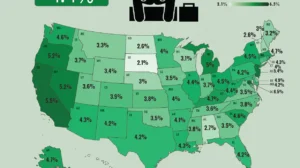
US Unemployment Rate by States 2026
Work Hours Remain Stable
The average workweek for American workers remained unchanged in February. Employees on private nonfarm payrolls worked an average of 34.3 hours per week, the same as in January. In the manufacturing sector, the average workweek declined slightly to 40.1 hours, while overtime hours remained stable at 3.0 hours.
Stable work hours suggest that companies are not yet reducing working time significantly, even as job growth slows.
Long-Term Unemployment Increasing
The number of long-term unemployed Americans increased compared with last year. Long-term unemployed workers are defined as people who have been without a job for 27 weeks or longer. In February, this group totaled 1.9 million people, up from 1.5 million a year earlier.
These workers now account for 25.3 percent of all unemployed Americans, indicating that some individuals are finding it harder to return to the workforce.
Labor Force Participation Shows Little Change
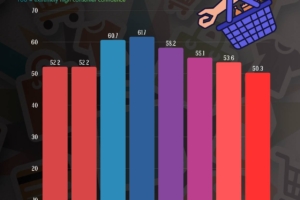
The labor force participation rate remained largely unchanged in February. The participation rate stood at 62.0 percent, while the employment-population ratio was 59.3 percent. Both measures have remained relatively stable over the past year.
At the same time, around 6 million Americans who are not currently in the labor force say they still want a job, suggesting that there is still hidden slack in the labor market.
What This Means for the Federal Reserve
The February jobs report comes just before the Federal Reserve’s policy meeting on March 17 and 18, where officials will decide on the future path of interest rates.
A weaker labor market could prompt the Federal Reserve to consider lowering interest rates to boost the economy. Nevertheless, some officials are hesitant because inflation has not yet returned to the target level of the central bank.
Conclusion
The recent employment report for February implies that the labor market in the US is losing some of its earlier steam. There have been job losses in various industries. The industries that have witnessed job losses include healthcare, government, information services, and transportation.
Additionally, the unemployment levels have risen slightly. The employment gains in the past months have also been reduced. Though the wage gains are strong and the unemployment rates are low, the recent employment report suggests that the US might be entering an era of slow labor market growth after several years of robust labor market expansion.