






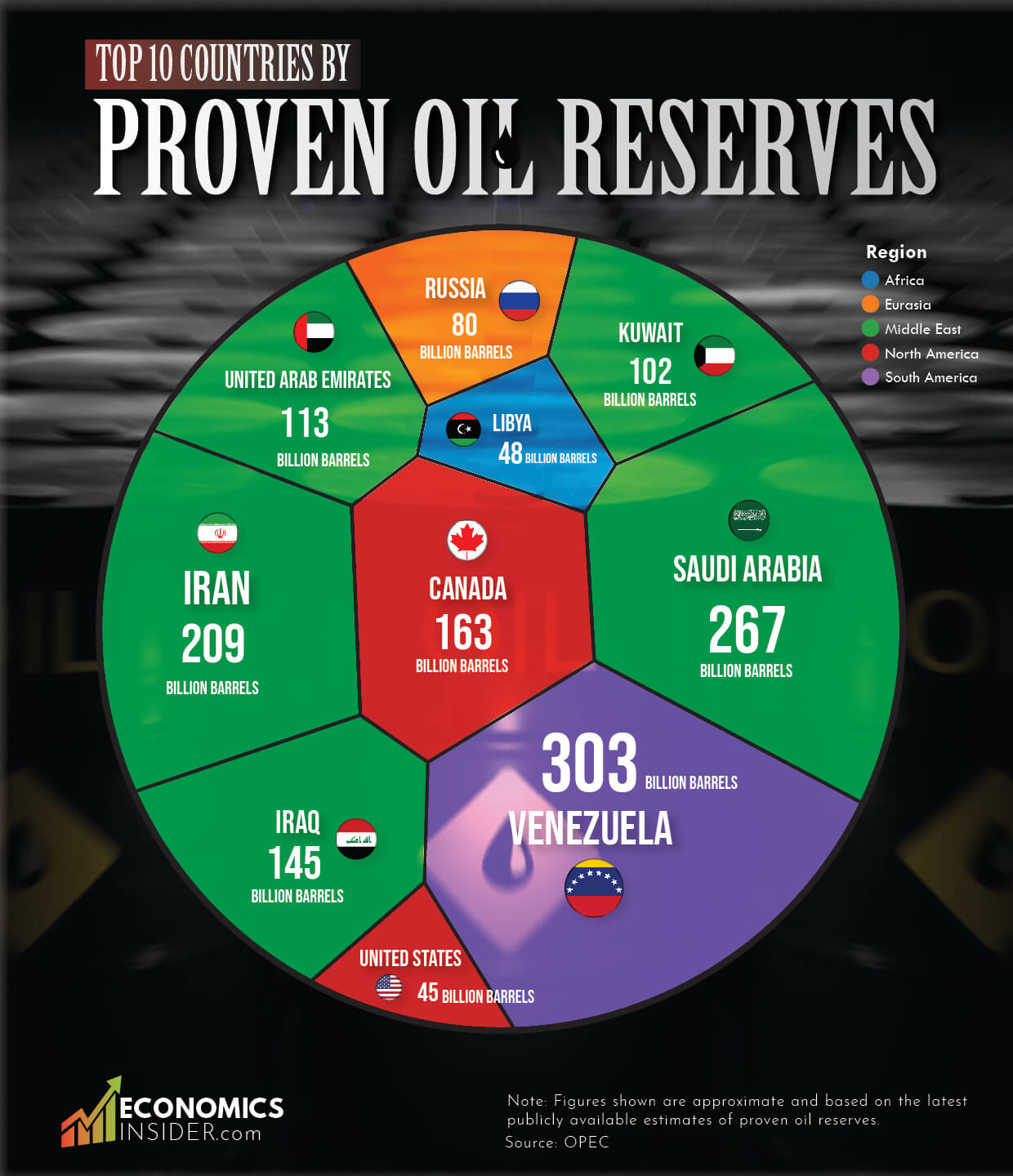
Oil is one of the most powerful natural resources on Earth. Globally, proven oil reserves are measured at over 1.5 trillion barrels of crude that can be extracted with current technology and market conditions. However, these reserves are not evenly distributed; a small number of countries hold the majority of proven oil reserves.
Venezuela holds larger proven oil reserves than any other nation in the world. The country has about 303 billion barrels buried mainly in the Orinoco Belt. The recent capture of President Nicolás Maduro by U.S. forces and announcements about transferring millions of barrels of oil to the U.S. show how oil and politics remain deeply intertwined in this nation.
Alongside Venezuela, countries like Saudi Arabia, Iran, Canada, and Iraq together control roughly half of the world’s known oil reserves.
Key Takeaways
- The Middle East dominates global oil reserves, holding about 48% of the world’s total, with Saudi Arabia, Iran, Iraq, the UAE, and Kuwait all ranking in the global top ten.
- Venezuela ranks first globally with over 303 billion barrels of oil reserves, but it is not the world’s largest oil producer.
- North America has major oil reserves, mainly because of Canada and the United States, together accounting for over 200 billion barrels of proven oil reserves.
Top 10 Countries with Largest Oil Reserves
The table below highlights the top 10 countries with largest oil reserves worldwide. Proven reserves are the amount of oil that is known to exist and could be produced with current technology and under present economic conditions.
| Rank | Country | Region | Oil Reserves (Billion Barrels) |
|---|---|---|---|
| 1 | 🇻🇪 Venezuela | South America | 303.2 |
| 2 | 🇸🇦 Saudi Arabia | Middle East | 267.2 |
| 3 | 🇮🇷 Iran | Middle East | 208.6 |
| 4 | 🇨🇦 Canada | North America | 163 |
| 5 | 🇮🇶 Iraq | Middle East | 145 |
| 6 | 🇦🇪 United Arab Emirates | Middle East | 113 |
| 7 | 🇰🇼 Kuwait | Middle East | 101.5 |
| 8 | 🇷🇺 Russia | Eurasia | 80 |
| 9 | 🇱🇾 Libya | Africa | 48.4 |
| 10 | 🇺🇸 United States | North America | 45 |
Source: OPEC
Note: Figures shown are approximate and based on the latest publicly available estimates of proven oil reserves.
Venezuela
Venezuela is the largest holder of proven oil reserves in the world. With around 303 billion barrels, Venezuela holds close to one-fifth of the world’s proven oil. However, most of that oil is extra-heavy crude, which is harder and more expensive to refine than light crude.
Venezuela’s economy depends heavily on oil revenue; however, political instability, corruption, and international sanctions from the US have crippled its production potential and limited exports. Additionally, recent U.S. policy is rapidly changing Venezuela’s oil landscape. The oil export deals and tanker seizures show Washington’s influence on how Venezuelan crude may be marketed.
Despite headlines, Venezuela currently contributes a small share of global oil supply—under 1 million barrels per day—and would need massive investment to return to historical output levels.
Saudi Arabia
Saudi Arabia remains one of the world’s largest crude oil exporters. With about 267 billion barrels of reserves, it has some of the most accessible and low-cost oil on Earth. Saudi oil fields are easy to tap and produce large volumes, which gives Saudi Arabia an outsized influence on the global market.
Additionally, Saudi Arabia is a central figure in OPEC+ negotiations. Riyadh often acts as a “swing producer,” adjusting output to keep prices stable when global supply shifts.
Iran
Iran ranks third with around 209 billion barrels of oil. Despite this huge reserve base, international sanctions have limited Iran’s ability to sell oil in global markets. Additionally, Iran’s economy depends heavily on oil exports, but geopolitical tensions have restricted its potential production and export capacity.
In 2025, Iran’s oil exports reached their highest levels in seven years, despite renewed sanctions by the United Nations and the U.S. This suggests that Iran has been able to find buyers and keep shipments flowing, even under global legal limits.
Iran’s oil industry continues to deal with sanctions and smuggling issues. Large amounts of fuel are estimated to leave Iran illegally every day.
Canada
Canada ranks fourth with about 163 billion barrels, mostly in oil sands in Alberta. These reserves are technically part of “proven” oil because they can be extracted, but the process is expensive and energy-intensive compared to conventional crude.
Canada remains a major oil exporter, especially to the United States. The recent news about the potential resumption of Venezuelan oil exports to U.S. refiners has prompted concerns that Canadian producers could face stronger competition.
Iraq
Iraq holds roughly 145 billion barrels, which makes it a major oil nation in the Middle East. Oil exports are a backbone of Iraq’s economy, and most of the government’s revenue comes from energy sales.
However, internal conflict, political instability, and weak infrastructure have slowed Iraq’s oil production potential. Despite these issues, Iraq remains a key player in global oil markets, particularly for Asian and European buyers.
Additionally, the United Arab Emirates and Kuwait each hold over 100 billion barrels. Russia has over 80 billion barrels and remains a key energy exporter, especially to Europe and Asia. Though its oil production is usually influenced by politics and sanctions. The United States has the tenth-largest oil reserves, and it is among the largest producers due to its shale technology rather than large underground reserves.
Role of OPEC+
The Organization of the Petroleum Exporting Countries (OPEC) is a group of oil-exporting nations that determines the oil supply to influence oil prices in the global energy market.
Among the top 10 countries with the largest oil reserves, Venezuela, Saudi Arabia, Iran, Iraq, the United Arab Emirates, and Kuwait are OPEC members.
Russia is not an OPEC member, but it often cooperates with the group as part of OPEC+. Also, Canada, Libya, and the United States are not members, though Libya often works with OPEC on production policies.
OPEC members together control a large share of global oil reserves, estimated at around 80 percent of proven reserves.
Conclusion
Oil continues to be one of the most important global resources. A few countries, including Venezuela, Saudi Arabia, Iran, Canada, and Iraq, hold about half of the world’s proven oil reserves. Many of these nations use oil revenue to fund government programs and influence global energy markets. However, having large reserves does not always guarantee economic success. Venezuela’s case shows that political unrest, sanctions, and poor infrastructure can limit a country’s oil potential. On the other hand, countries like Saudi Arabia and Canada use their oil wealth more effectively.