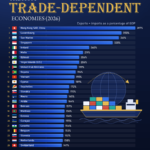









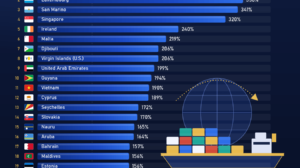
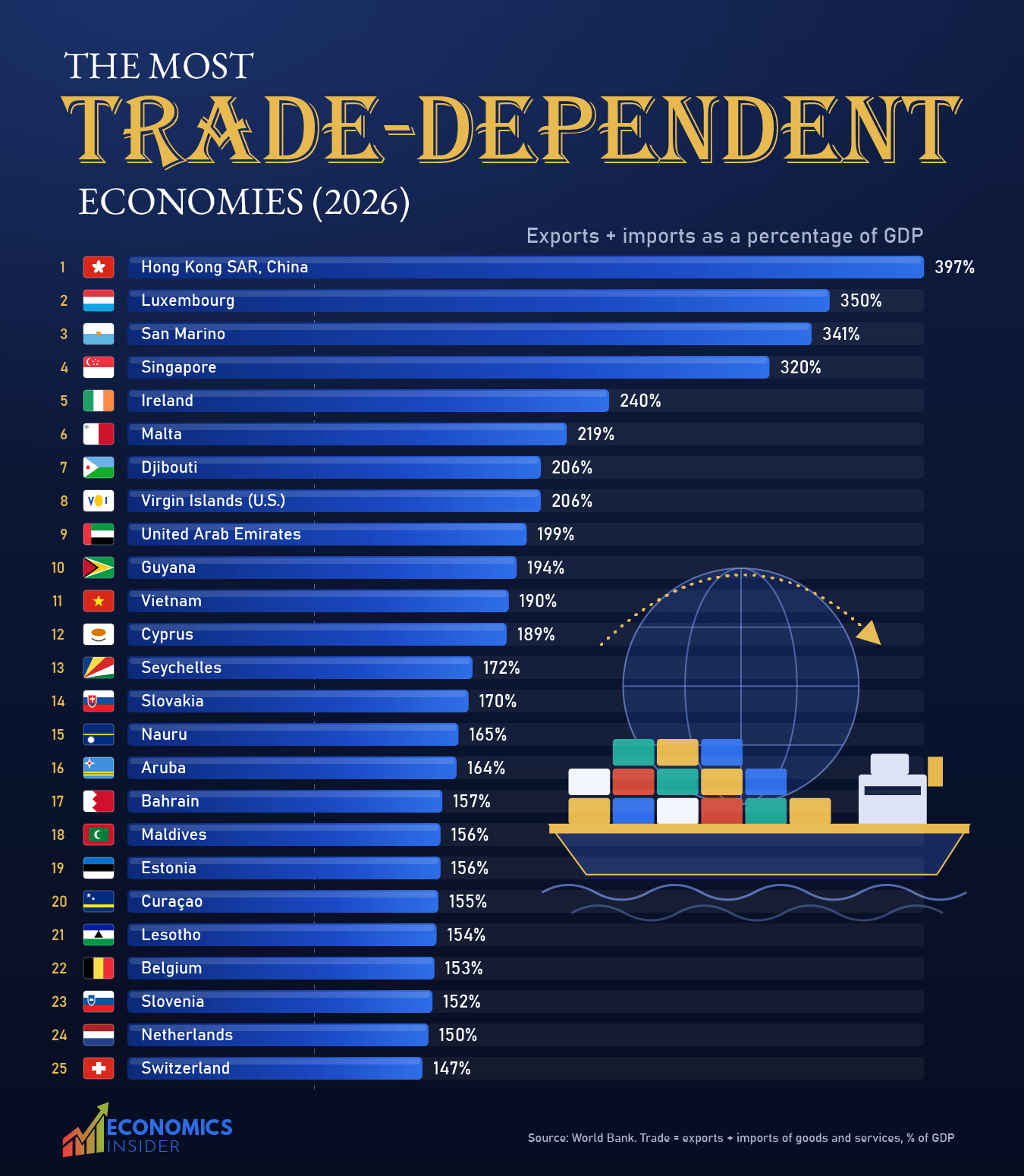
Trade plays a key role in many countries’ economies, but its importance varies widely from one country to another. In Hong Kong, for example, the total value of trade is nearly four times the size of its entire economy. Its trade-to-GDP ratio stands at almost 400%, meaning the value of its exports and imports combined is equal to nearly four times its annual GDP. Luxembourg follows close behind at 350 percent. San Marino, Singapore, Ireland, and Malta all clear 200 percent. These are not the world’s biggest economies. They are some of the smallest.
Key Takeaways
- Hong Kong, Luxembourg, and Singapore lead the rankings, with trade several times larger than their annual GDP.
- The world’s most trade-dependent economies are almost all small — places like Hong Kong, Luxembourg, Singapore and Malta, not the large industrial powers.
- Europe has a strong presence in the rankings, while Asia has major trading hubs and rapidly growing export economies.
Top 25 Countries Rely Most on International Trade?
The figures below show trade as a percent of GDP, using the most recent year available for each country or economy. The data is taken from the World Bank.
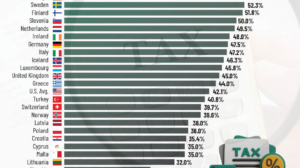
| Country | Trade (% of GDP) |
|---|---|
| 🇭🇰 Hong Kong SAR, China | 397% |
| 🇱🇺 Luxembourg | 350% |
| 🇸🇲 San Marino | 341% |
| 🇸🇬 Singapore | 320% |
| 🇮🇪 Ireland | 240% |
| 🇲🇹 Malta | 219% |
| 🇩🇯 Djibouti | 206% |
| 🇻🇮 Virgin Islands (U.S.) | 206% |
| 🇦🇪 United Arab Emirates | 199% |
| 🇬🇾 Guyana | 194% |
| 🇻🇳 Viet Nam | 190% |
| 🇨🇾 Cyprus | 189% |
| 🇸🇨 Seychelles | 172% |
| 🇸🇰 Slovak Republic | 170% |
| 🇳🇷 Naoero (Nauru) | 165% |
| 🇦🇼 Aruba | 164% |
| 🇧🇭 Bahrain | 157% |
| 🇲🇻 Maldives | 156% |
| 🇪🇪 Estonia | 156% |
| 🇨🇼 Curaçao | 155% |
| 🇱🇸 Lesotho | 154% |
| 🇧🇪 Belgium | 153% |
| 🇸🇮 Slovenia | 152% |
| 🇳🇱 Netherlands | 150% |
| 🇨🇭 Switzerland | 147% |
Hong Kong, Singapore, Luxembourg and Ireland
Singapore and Hong Kong built themselves as global trading hubs. Goods move through their ports and airports on a scale that dwarfs their domestic markets. Hong Kong has a small domestic market, but it serves as a gateway connecting China with international markets. Singapore’s port connects trade routes between Asia, Europe, and the rest of the world.
Luxembourg and Ireland have turned themselves into corporate and financial gateways. Multinationals book large volumes of activity through them, which pushes the trade numbers sky-high relative to the size of the local economy. Ireland’s Pharmaceuticals and technology firms ship enormous volumes in and out of the country, and the numbers are large compared to the size of the local economy.
Then there are places like Djibouti, the Maldives, Seychelles, and Lesotho. These are not financial centers. They are small economies that simply import most of what they consume and export whatever they can — minerals, tourism services, agricultural products, or logistics services.
Vietnam
Most countries on this list are small. Vietnam is not. With a population of around 100 million, its trade sits at 190% of GDP, which is remarkable for an economy of that size.
The reason is manufacturing. Over the past two decades, Vietnam has become a major base for making electronics, clothing, and furniture for global brands. Parts come in from other countries, products get assembled, and finished goods go back out. Every step of that adds to the trade total. As companies look for production bases outside of China, Vietnam has been one of the biggest winners.
Europe’s Trading Core
Slovakia, Estonia, Slovenia, Belgium, the Netherlands and Switzerland all show up between 147% and 170%. These countries are small or mid-sized, sit in the middle of Europe‘s dense trading network, and are deeply tied into regional supply chains.
Slovakia, for instance, is a major car producer for its size, with parts crossing borders several times before a vehicle is finished. The Netherlands and Belgium handle huge volumes through their ports, much of which is just passing through on its way to somewhere else. Switzerland trades heavily in high-value goods and financial services.
Why Small Economies Often Have Higher Trade Ratios
A country’s trade-to-GDP ratio is influenced not only by how much it trades, but also by the size of its domestic economy.
A large economy such as the United States can produce a wide range of goods and services for its own population. Domestic consumption, investment, government spending, and local production make up a large share of its GDP. Even though the United States is one of the world’s biggest trading nations in dollar terms, trade represents a relatively smaller share of its overall economy.
Smaller economies face a different situation. They may not have enough consumers to support large-scale production across every industry. Businesses often need to sell abroad to grow, while households and companies depend on imported products, machinery, energy, and raw materials.
This can push trade above the country’s annual GDP. In fact, a trade-to-GDP ratio above 100% is not unusual for small, internationally connected economies.
It also does not mean that a country is running a trade surplus. The measure includes both exports and imports. A country can have a very high ratio while importing more than it exports, or while exporting more than it imports.
Conclusion
Trade as a share of GDP is a simple measure, but it tells a lot about how a country makes up its GDP. The places at the top are middlemen, ports, financial centers, tourist islands, and factory floors for global brands. They are small enough, or specialized enough, that international trade plays a much bigger role in their economies than domestic activity alone.