







The U.S. dollar, the world’s strongest and most trusted currency, faced a significant setback in 2025. The value ofthe U.S. dollar weakened against many other major currencies. The Swedish krona, Mexican peso, Swiss franc, euro, and several other currencies gained notable ground against the greenback. Decline in the U.S. dollar value influence everything from the cost of imported goods to how attractive a country feels for investment.
Key Takeaways
- In 2025, nearly every major global currency appreciated against the U.S. dollar.
- The Swedish krona appreciated by nearly 20% against the U.S. dollar, followed by the Mexican peso and the Swiss franc.
- The dollar’s decline has been driven by monetary policy changes, trade tensions, and changing investor confidence.
Major Currencies That Appreciated vs the U.S. Dollar in 2025
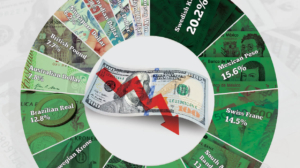
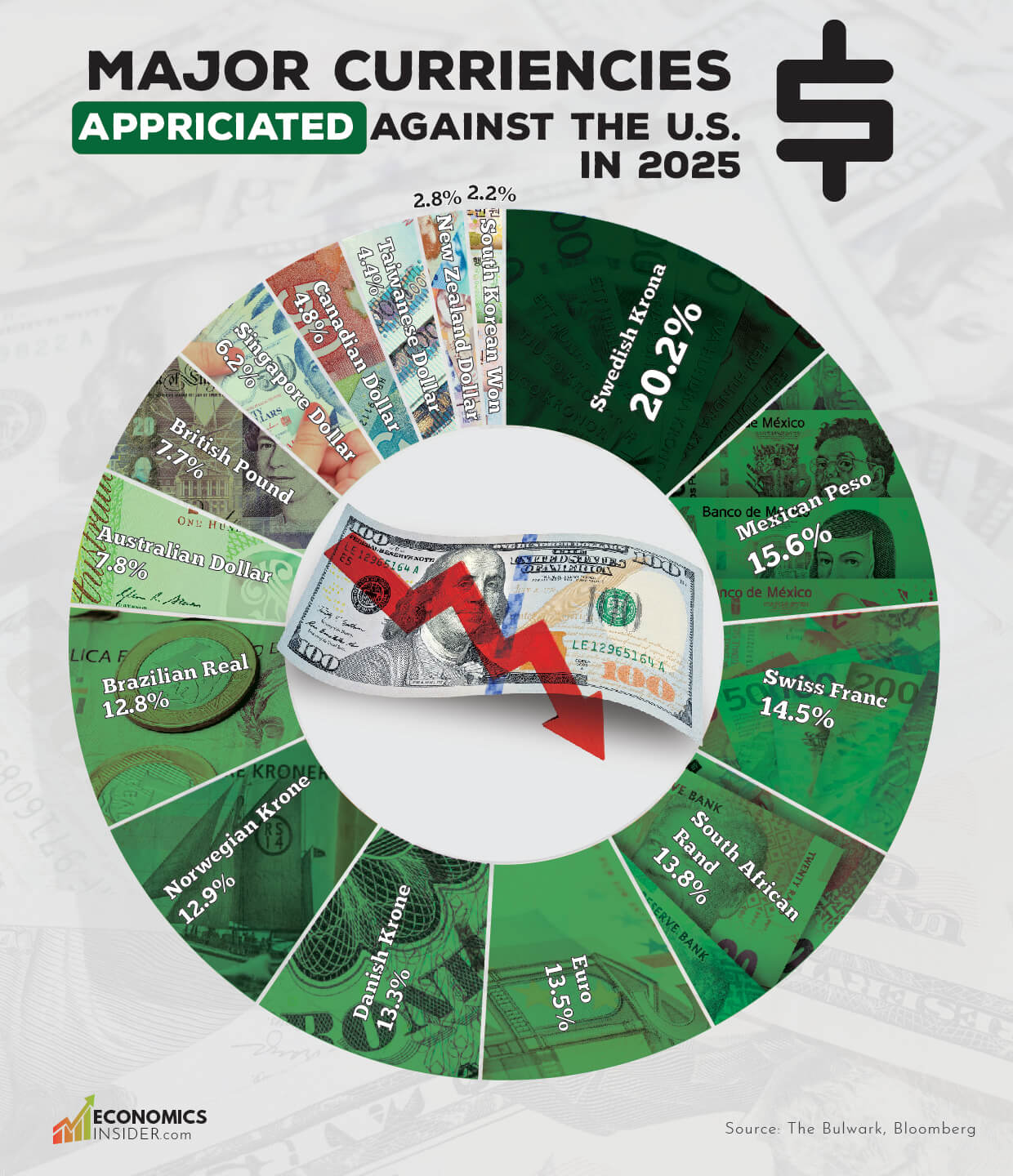
The table below shows the gains of major currencies against the U.S. dollar in 2025.
| Rank | Currency | Appreciation vs USD in 2025 (%) |
|---|---|---|
| 1 | Swedish Krona 🇸🇪 | 20.20% |
| 2 | Mexican Peso 🇲🇽 | 15.60% |
| 3 | Swiss Franc 🇨🇭 | 14.50% |
| 4 | South African Rand 🇿🇦 | 13.80% |
| 5 | Euro 🇪🇺 | 13.50% |
| 6 | Danish Krone 🇩🇰 | 13.30% |
| 7 | Norwegian Krone 🇳🇴 | 12.90% |
| 8 | Brazilian Real 🇧🇷 | 12.80% |
| 9 | Australian Dollar 🇦🇺 | 7.80% |
| 10 | British Pound 🇬🇧 | 7.70% |
| 11 | Singapore Dollar 🇸🇬 | 6.20% |
| 12 | Canadian Dollar 🇨🇦 | 4.80% |
| 13 | Taiwanese Dollar 🇹🇼 | 4.40% |
| 14 | New Zealand Dollar 🇳🇿 | 2.80% |
| 15 | South Korean Won 🇰🇷 | 2.20% |
| 16 | Japanese Yen 🇯🇵 | 0.30% |
Source: The Bulwark, Bloomberg
Several major currencies rose significantly versus the U.S. dollar. The Swedish krona led the list with over 20% appreciation. It means that one krona bought much more than a year before. Additionally, the Mexican peso and Swiss franc both climbed strongly against the dollar. These gains show confidence in these countries’ economies and relative strength against a weakening greenback.
European currencies like the euro, Danish krone, and Norwegian krone also posted double-digit gains against the U.S. dollar. For many of these countries, stable inflation, strong trade balances, or higher interest rates made their money more attractive to investors.
Even emerging market currencies like the South African rand and Brazilian real rose, which is a notable development because such currencies often struggle when the dollar strengthens.
This decline in U.S. dollar value can make imports into the U.S. more expensive, while U.S. exports may become cheaper overseas.
China’s Currency (The Yuan)
China’s currency, the yuan (renminbi), does not appear on the top list because it only gained modestly against the dollar relative to others. Still, it strengthened by about 4-4.5% in 2025, marking its best yearly performance in several years. Reuters reports that the yuan was helped by the broad weakness of the dollar and by China’s strong trade surplus.
Additionally, the yuan’s gains came more from reduced demand for dollars than from a strong belief in China’s currency fundamentals. China’s central bank also manages the yuan’s value and lets it move within a controlled range rather than float freely like some other currencies.
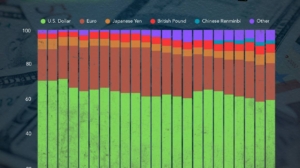
Share of Global Foreign Exchange Reserves by Currency And the US Dollar Dominance
Why the U.S. Dollar Is Declining
There are multiple reasons that push the U.S. dollar lower in 2025.
1. Monetary Policy
One of the factors responsible for the weakness of the U.S. dollar in the year 2025 is the change in expectations of interest rates within the U.S. economy. In 2025, the U.S. Federal Reserve lowered its benchmark interest rate multiple times as economic growth slowed. Lower interest rates imply lower returns on U.S. investments such as bonds and savings. Consequently, foreign investors choose to move their investments to other countries where interest rates are high. This means a lower demand for the U.S. dollar.
2. Trade and Political Uncertainty
Another factor that contributed to the depreciation of the US dollar is the escalating trade and political uncertainties. In 2025, the Trump administration introduced a broad range of reciprocal tariffs on several countries. This move led to higher import costs for U.S. businesses and consumers, while also undermining confidence among companies and investors. Therefore, when uncertainty prevails in trade rules, firms put off investments, and foreign investors become more risk-averse about holding U.S. assets.
Some economists believe that the dollar has reached the point where it is far too strong and is correcting itself. This is because the value of the dollar has dropped by some 10-11%, its sharpest fall since the early 1970s.
3. Global Reserve Shifts
Nations and investors are diversifying their assets away from dollars, which include the Euro, the Swiss Franc, and Gold. The share of dollar holdings in global foreign-exchange reserves has dropped over time, which weakens the dollar’s dominance.
Conclusion
The US dollar weakened against other major currencies. The Swedish Krona, Mexican Peso, Swiss Franc, Euro, and many other currencies had double-digit appreciation. China’s yuan, too, appreciated, but its appreciation is as much related to its managed currency regime as to its market power.