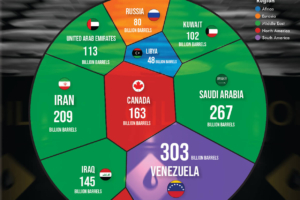








Oil is the lifeline of Iran’s economy. The country holds about 9% of the world’s proven oil reserves, making it the fourth-largest holder of oil reserves in the world. In total, Iran is estimated to have around 157 billion barrels of crude oil.
Oil exports remain one of the most important sources of income for the country. Oil contributes more than half of Iran’s total export revenues and also supports a large part of the government budget. According to the International Energy Agency, Iran’s oil exports averaged about 1.7 million barrels per day in the first half of 2025.
Key Takeaways
- Over the past decade, Iran’s export earnings have ranged from over $50 billion to as low as $6 billion, mainly due to sanctions.
- China is by far the largest importer of Iranian crude oil, taking around 90 % of Iran’s total oil exports, far more than any other buyer.
- In early 2025, Iran’s oil exports rebounded to an average of 1.7 million barrels per day, showing a fast recovery after years of low export volumes.
Iran Oil Export Value by Year
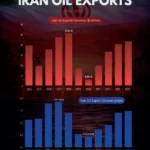
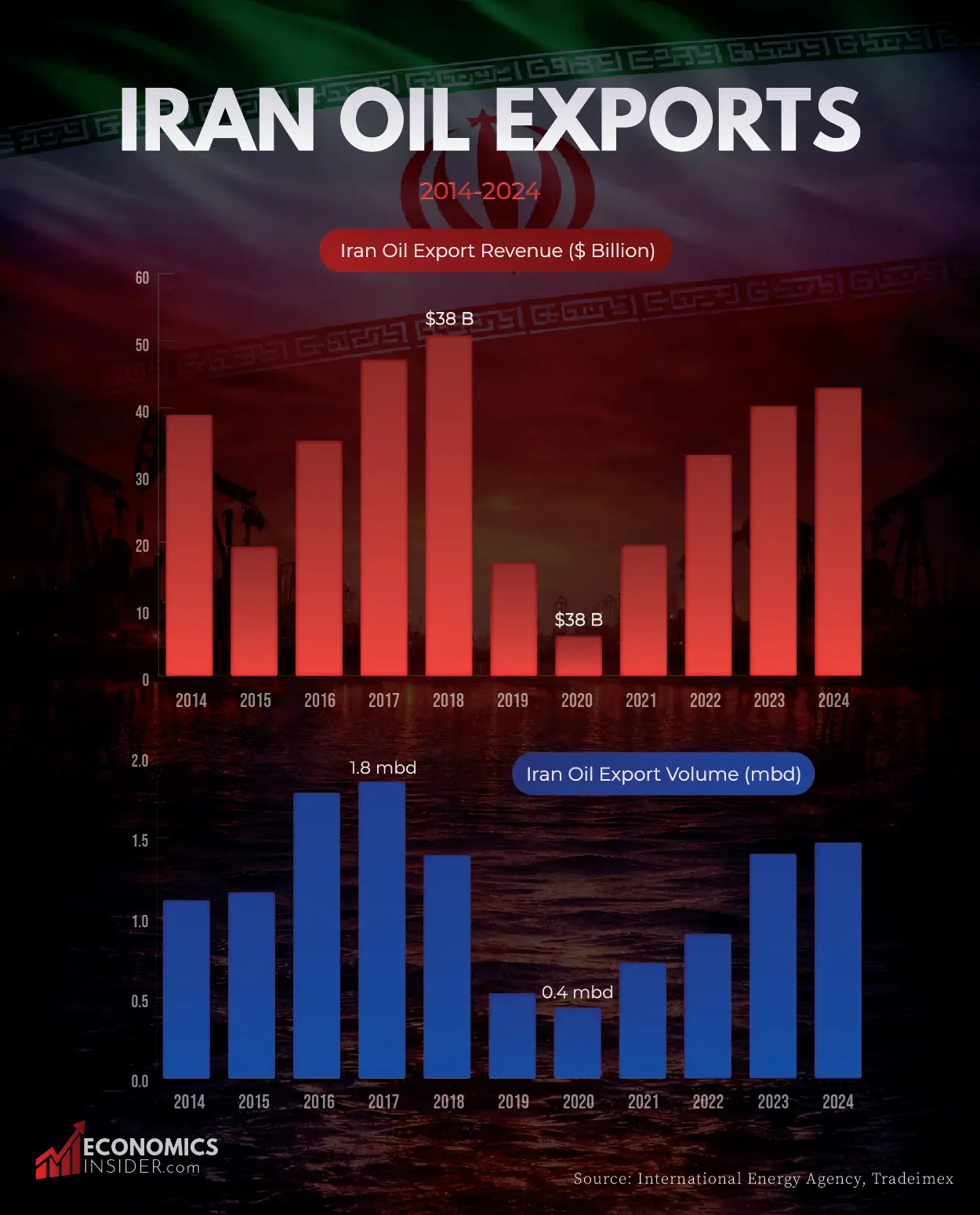
The table below shows how Iran’s oil export earnings and export volumes have changed from 2014 to 2024.
| Year | Iran Oil Export Value ($) | Export Volume (mb/d) |
|---|---|---|
| 2014 | $38.93 billion | 1.11 million barrels per day |
| 2015 | $19.25 billion | 1.16 million barrels per day |
| 2016 | $35.07 billion | 1.78 million barrels per day |
| 2017 | $47.18 billion | 1.85 million barrels per day |
| 2018 | $50.82 billion | 1.39 million barrels per day |
| 2019 | $16.85 billion | 0.53 million barrels per day |
| 2020 | $6.01 billion | 0.44 million barrels per day |
| 2021 | $19.51 billion | 0.72 million barrels per day |
| 2022 | $32.98 billion | 0.90 million barrels per day |
| 2023 | $40.28 billion | 1.40 million barrels per day |
| 2024 | $43 billion | 1.47 million barrels per day |
Source: International Energy Agency, Tradeimex
Iran’s Oil Export Value Reached Its Peak in 2018
Iran’s oil export earnings reached their highest level in 2018, when the country generated about $50.82 billion from crude oil exports.
Iran’s oil export earnings reached their highest level in 2018, when the country generated about $50.82 billion from crude oil exports. At that time, global oil prices were relatively high, and Iran was exporting large volumes of crude to international markets. The 2015 nuclear deal (JCPOA) had lifted many international sanctions, allowing Iran to return to global oil markets and sharply increase exports
Sanctions Caused a Massive Collapse in Oil Revenues
After 2018, Iran’s oil exports dropped sharply as international sanctions tightened. By 2019, export revenue had fallen to only $16.85 billion, a massive decline of about 67% compared with the 2018 level of $50.82 billion.
The situation became even worse in 2020, when oil export earnings plunged to just $6.01 billion. Export volumes also dropped to only 0.44 million barrels per day. This decline was caused by renewed international sanctions, strict restrictions on banking and shipping, and a sharp drop in global oil demand due to the COVID‑19 pandemic.
Top 10 Countries With Largest Oil Reserves in the World (2026)
Iran’s Oil Exports Are Gradually Recovering
After the sharp collapse in 2019 and 2020, Iran’s oil exports began to recover gradually. By 2021, export revenue had increased to $19.51 billion. This recovery continued in the following years as shipments slowly increased. In 2022, export earnings climbed to $32.98 billion, and by 2023, revenues reached about $40.28 billion.
The upward trend also continued in 2024, with Iran generating $43 billion in revenue from oil exports, while the volume of oil exports increased to 1.47 million barrels per day. According to the International Energy Agency, Iran’s oil exports continued to remain robust, with the country exporting an average of 1.7 million barrels per day in the first half of 2025.
While these figures are still much lower than the pre-sanctions highs, they indicate that Iran has succeeded in rebuilding a large proportion of its oil trade.
China Is the Largest Buyer of Iranian Oil
Today, China is the dominant buyer of Iranian crude oil. China imported around $32 billion worth of Iranian oil, which makes it the largest market for Iran’s energy exports.
After China, Syria, and the United Arab Emirates (UAE) are the largest importers of Iran’s oil. Syria imported around $1.1 billion worth of Iranian oil. And the United Arab Emirates (UAE) imported about $716 million worth of Iranian crude.
Oil Still Dominates Iran’s Economy
Oil remains one of the most important pillars of Iran’s economy. It accounts for more than 50% of Iran’s total export earnings. Moreover, due to its huge reserves of 157 billion barrels, it is expected to remain a major energy supplier to the Middle East region for a long time to come.
Because a large part of Iran’s export earnings comes from oil revenues, any fluctuations in export earnings due to sanctions can have a significant impact on the economy.
Conclusion
Iran’s export earnings from oil have seen ups and downs in recent years. In 2018, Iran earned more than $50 billion from export earnings, but in 2020, due to sanctions, it earned only $6 billion. Since then, Iran’s export earnings have shown a steady improvement and have reached $43 billion in 2024. Despite sanctions, Iran has been able to export a large