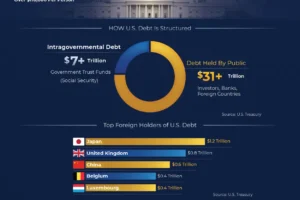




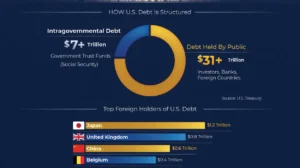











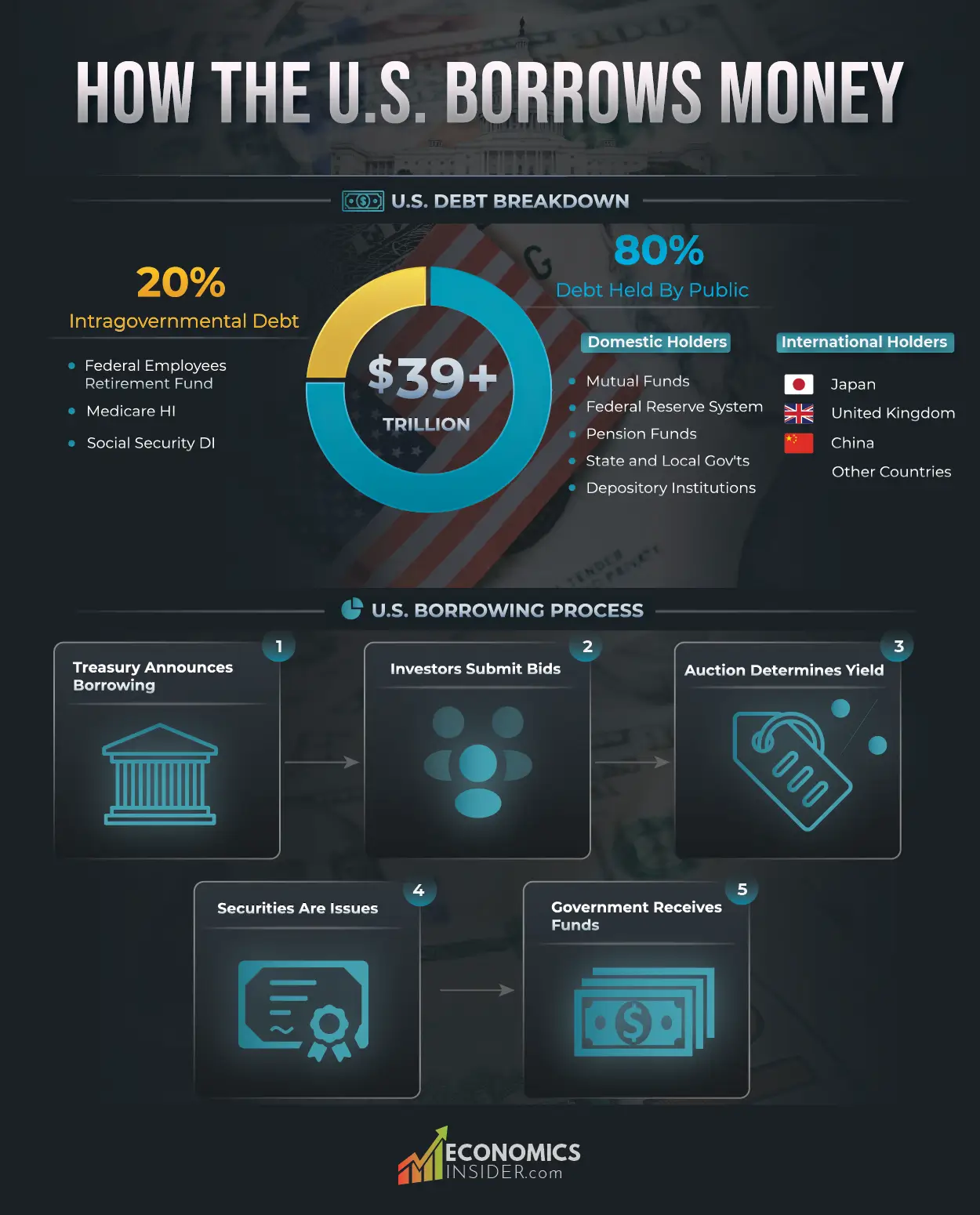
America has the largest national debt in the world, which has surpassed $39 trillion. Out of this debt, 80% belongs to the public sector, which includes investors, banks, and countries. The remaining 20% of the debt is referred to as intragovernmental debt. This is the debt owed by the government to itself.
The interesting fact about the American government borrowing money is that it does not borrow like an ordinary person or business. Instead, it has an organized system.
But how does the U.S. government actually borrow trillions of dollars every year—and who is lending all this money?
In this guide, we’ll break it down in the simplest way possible.
What It Means When the U.S. Government Borrows Money
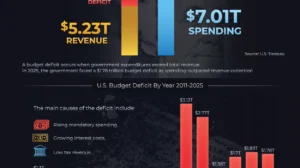
The U.S. government spends money every year on various things like defense, health, infrastructure, and social services. However, every year, the government spends more than it collects through taxes and other sources. This is called the budget deficit.
To make up for this deficit, the government needs to collect more money. Rather than reducing expenditure or increasing taxes, the government adopts a different approach. It borrows money to make up the deficit.
When the U.S. government borrows money, it does not go to a single lender. Instead, it reaches out to millions of investors around the world. In simple terms, the government is saying: “If you lend us money today, we promise to pay you back later, along with some extra money as interest.”
This promise is turned into a financial product called a Treasury security. These securities are issued by the U.S. Treasury Department, which manages the country’s finances. Investors who buy these securities are essentially lending money to the government.
How Treasury Auctions Actually Work
The U.S. government does not randomly sell its debt. It uses a structured and transparent system known as a Treasury auction.
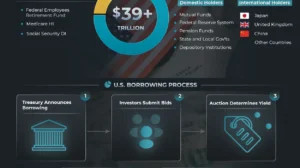
First, the Treasury announces how much money it wants to borrow and what type of security it will issue. This could be a short-term bill or a long-term bond. Then, investors place bids. These investors include large banks, investment funds, and even foreign governments. Some investors are large and actively compete, while others simply accept the market rate.
Once all bids are collected, the auction determines the interest rate. This rate is based on demand. If many investors want the security, the interest rate tends to be lower. If demand is weak, the government has to offer a higher return. After the auction ends, the securities are issued, and the government receives the money.
Understanding the Main Types of U.S. Debt Instruments
The U.S. government mainly uses three types of borrowing instruments. Each one is designed for a different time period.
1. Treasury Bills (T-Bills): Short-Term Borrowing
Treasury bills are used when the government wants to borrow money for a short time, i.e., less than a year. These are slightly different from other securities because they do not pay interest on a regular basis. Instead, they are issued at a discounted price and redeemed at face value when they mature.
For instance, the government might accept $900 today and pay back $1000 in a few months. The difference represents the profit earned by the investor. This makes Treasury bills simple and low-risk instruments.
2. Treasury Notes (T-Notes): Medium Term Borrowing
Treasury notes are used for medium-term borrowing, i.e., borrowing money for a period ranging from two to ten years. Unlike Treasury bills, Treasury notes pay interest every six months. This makes them attractive to investors seeking to earn a regular income.
A 10-year Treasury note is one of the most important financial instruments in the world. It is a benchmark for the interest rate in the global economy.
3. Treasury Bonds (T-Bonds): Long-Term Borrowing
Treasury bonds are long-term borrowing instruments used by the U.S. government to borrow money. They are usually issued for twenty to thirty years. The interest rate on these bonds is paid every six months, and the rate is fixed over a very long period.
Because the rate is fixed, investors know exactly how much income they will receive over time. This makes Treasury bonds a stable and predictable investment. At the end of the bond’s term, the government repays the full original amount, known as the principal.
Why Different Types of Debt Are Important
The government does not rely on just one type of borrowing. It uses a mix of short-term and long-term debt. Short-term debt helps manage immediate cash needs. Long-term debt helps lock in borrowing costs for the future. This balance is important. If the government relies too much on short-term borrowing, it may face higher risks when interest rates rise. If it relies too much on long-term debt, it may end up paying more interest over time.
Who Is Lending Money to the U.S. Government
The U.S. government borrows money from various investors, both domestically and globally. These investors include American banks, mutual funds, pension funds, and other financial institutions. The Federal Reserve is also holding a large portion of U.S. government debt.
Currently, the total U.S. government debt is over $39 trillion. Out of this, 80% is referred to as public debt, meaning it is the amount borrowed from investors. The remaining 20% is referred to as intragovernmental debt, which is the amount borrowed from its own agencies.
1. Public Debt
More than two-thirds of public debt is held by domestic investors. The largest portion of this is held by mutual funds, pension funds, and the Federal Reserve System. On the international side, countries such as Japan, the U.K., and China are among the largest holders of U.S. debt. However, China’s share has been decreasing over time.
Individual investors can also participate by buying Treasury securities directly.
2. Intragovernmental Debt
Intragovernmental debt is different from public debt because it represents money the government owes to itself. It is essentially a transfer from one part of the government to another.
Most of this debt comes from federal trust funds, such as Social Security and Medicare. These funds collect money through taxes and invest the surplus in U.S. Treasury securities. In return, the government uses this money for other spending needs, while keeping a record of what it owes to these programs.
U.S. National Debt: History, Causes, Risks, and Future (2026)
Why U.S. Government Debt Is Trusted Worldwide
U.S. Treasury securities are considered to be one of the safest investment instruments in the world. These securities are backed by the U.S. government, and the government has a long history of honoring its debt obligations.
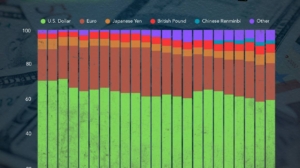
Secondly, the U.S. government has the privilege of borrowing money at low interest rates due to the demand and usage of the U.S. dollar worldwide. Since the dollar is the world’s reserve currency, the demand is always high. Currently, Japan holds the largest amount of U.S. debt in the form of treasury securities.
Rising Debt and Future Challenges
Although Debt helps the government manage its finances, it has its own disadvantages. As the debt rises, it increases the expenditure for interest payments. This, in turn, can become a burden for the federal budget.
In addition to this, as old debts mature, they need to be replaced with new debts. If interest rates rise, it can become more difficult for the U.S. to refinance its debts.
Conclusion
The system through which the U.S. government borrows its debts is quite simple, yet powerful. They issue treasury securities, sell them through auctions, and raise funds from investors all over the world. This system helps them to bridge deficits and run the economy smoothly.
However, as the U.S. debt rises, it is clear that it cannot borrow more and more without any limit. The question is not how it can borrow more, but for how long it can continue to do so without suffering any serious economic consequences.