
















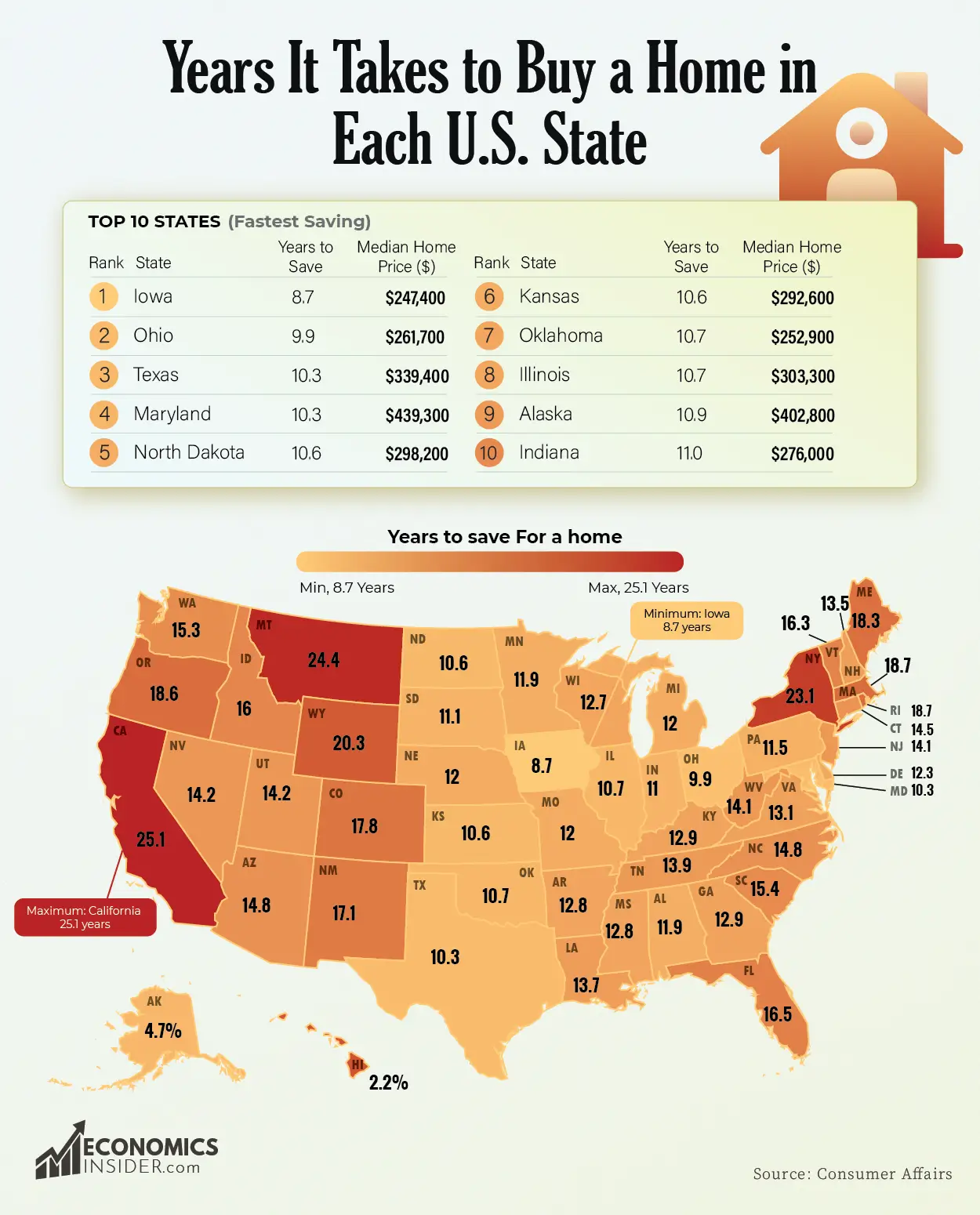
Buying a home in the United States has become increasingly difficult—but the level of difficulty varies widely depending on where you live.
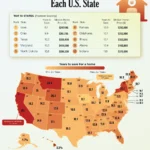
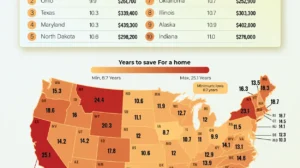
At the low end, states like Iowa require 8.7 years to save money to buy a house. This makes it the most affordable housing market that requires the shortest time to buy a property out of all states in the USA. On the other hand, California stands at the extreme, which requires 25.1 years to save for a house.
As far as housing prices are concerned, West Virginia is known to offer the cheapest property, costing approximately $239,900. Meanwhile, California offers the highest-priced homes at an average cost of $832,400.
Key Takeaways
- The time required to save for a home ranges from under 9 years to over 25 years, depending on the state.
- Affordable states are mostly located in the Midwest and South, while expensive states are concentrated on the coasts.
- High home prices are the main reason why some states require significantly more years of saving.
📋 Years Required to Save for a Home by State
The table below shows how long it takes to save for a home across all 50 states, along with median home prices.
| Rank | State | Years to Save | Median Home Price ($) |
|---|---|---|---|
| 1 | Iowa | 8.7 | $247,400 |
| 2 | Ohio | 9.9 | $261,700 |
| 3 | Texas | 10.3 | $339,400 |
| 4 | Maryland | 10.3 | $439,300 |
| 5 | North Dakota | 10.6 | $298,200 |
| 6 | Kansas | 10.6 | $292,600 |
| 7 | Oklahoma | 10.7 | $252,900 |
| 8 | Illinois | 10.7 | $303,300 |
| 9 | Alaska | 10.9 | $402,800 |
| 10 | Indiana | 11 | $276,000 |
| 11 | South Dakota | 11.1 | $326,800 |
| 12 | Pennsylvania | 11.5 | $306,800 |
| 13 | Alabama | 11.9 | $293,600 |
| 14 | Minnesota | 11.9 | $363,600 |
| 15 | Missouri | 12 | $280,100 |
| 16 | Michigan | 12 | $284,600 |
| 17 | Nebraska | 12 | $303,600 |
| 18 | Delaware | 12.3 | $359,500 |
| 19 | Wisconsin | 12.7 | $337,900 |
| 20 | Arkansas | 12.8 | $267,800 |
| 21 | Mississippi | 12.8 | $263,400 |
| 22 | Georgia | 12.9 | $374,500 |
| 23 | Kentucky | 12.9 | $271,000 |
| 24 | Virginia | 13.1 | $456,400 |
| 25 | New Hampshire | 13.5 | $510,700 |
| 26 | Louisiana | 13.7 | $253,200 |
| 27 | Tennessee | 13.9 | $392,000 |
| 28 | West Virginia | 14.1 | $239,900 |
| 29 | New Jersey | 14.1 | $564,200 |
| 30 | Nevada | 14.2 | $460,300 |
| 31 | Utah | 14.2 | $589,000 |
| 32 | Connecticut | 14.5 | $461,700 |
| 33 | Arizona | 14.8 | $446,900 |
| 34 | North Carolina | 14.8 | $379,900 |
| 35 | Washington | 15.3 | $631,100 |
| 36 | South Carolina | 15.4 | $382,600 |
| 37 | Idaho | 16 | $495,800 |
| 38 | Vermont | 16.3 | $428,500 |
| 39 | Florida | 16.5 | $404,300 |
| 40 | New Mexico | 17.1 | $415,600 |
| 41 | Colorado | 17.8 | $617,500 |
| 42 | Maine | 18.3 | $395,700 |
| 43 | Oregon | 18.6 | $507,800 |
| 44 | Massachusetts | 18.7 | $639,300 |
| 45 | Rhode Island | 18.7 | $570,100 |
| 46 | Wyoming | 20.3 | $448,300 |
| 47 | Hawaii | 21 | $744,400 |
| 48 | New York | 23.1 | $573,000 |
| 49 | Montana | 24.4 | $548,500 |
| 50 | California | 25.1 | $832,400 |
Source: Consumer Affairs
🧾 Methodology
This study by ConsumerAffairs estimates how long it would take an average person in each U.S. state to save enough for a 10% down payment on a typical home.
To estimate this, ConsumerAffairs used information about the median income of households, tax payments, and average living expenses (food, rent or mortgage, transport, and medical care). After subtracting these basic expenses, they calculated how much income is left each year. So, the remaining amount represents what a person can realistically save toward buying a home.
We then compared this savings capacity with the median home price in each state. The model assumes that a person saves a portion of their remaining income every year until they reach the required down payment.
⏳ U.S. States Where Buying a Home Takes Less Time
In several states, buying a home is still relatively achievable within a decade of saving. These are mostly located in the Midwest and parts of the South.
States such as Iowa, Ohio, Kansas, and Oklahoma take about 9-11 years of saving period to buy a house. The home costs in these states are usually cheaper, with an overall lower cost of living. This enables individuals to achieve homeownership at a much quicker rate compared to the national average.
This makes these states attractive not just for first-time buyers, but also for people looking to relocate for affordability.
How the U.S. Government Borrows Money
⏱️ U.S. States Where Buying a Home Takes the Longest Time
At the other extreme, some states require nearly two decades or more of saving to buy a house. California, Montana, New York, and Hawaii stand out as the most unaffordable housing markets. In these states, it can take anywhere from 20 to 25 years to save for a home.
These lengthy timelines are primarily driven by extremely high home prices, particularly in major cities and coastal regions. Even relatively high incomes are often not enough, as rising home prices increase faster than wages,
Additionally, some of the most well-known states give a clear picture of the broader U.S. housing challenge.
- Texas remains a relatively affordable housing market, with a median home ownership time of 10.3 years for a household.
- Florida and Arizona are moderately affordable, taking around 14 to 16 years of saving to buy a home, due to an increase in demand recently.
- New York and California, which have two of the largest economies in the United States, are among the least affordable, taking more than 23 and 25 years, respectively.
💰 The Role of Home Prices
The cost of a house is one of the key determinants of the time needed to save money. For instance, in states where homes are cheap, like West Virginia, Iowa, and Mississippi, less time is needed to save for homes. In contrast, states with high prices—like California, Hawaii, and Massachusetts—push the required savings period much higher.
In summary, the more expensive the home, the more time it will take to buy it. Income levels do matter too; they often do not rise fast enough to match the increase in housing costs.
🧾 Conclusion
The U.S. housing market is deeply divided. In some states, buying a home is still achievable within a decade. In some cases, it can even take almost an entire career’s worth of time to buy a house.
The primary reason for the discrepancy is the difference in home prices, which fluctuate wildly from state to state. Some states near the coasts continue to push affordability out of reach, while many central states remain accessible.