


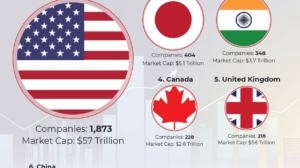



Advanced economies are the largest and most developed economies in the world. Together, they produce goods and services worth around 68.6 trillion US dollars. These countries comprise the United States, the euro area nations, Japan, the United Kingdom, Canada, and other industrialized economies.
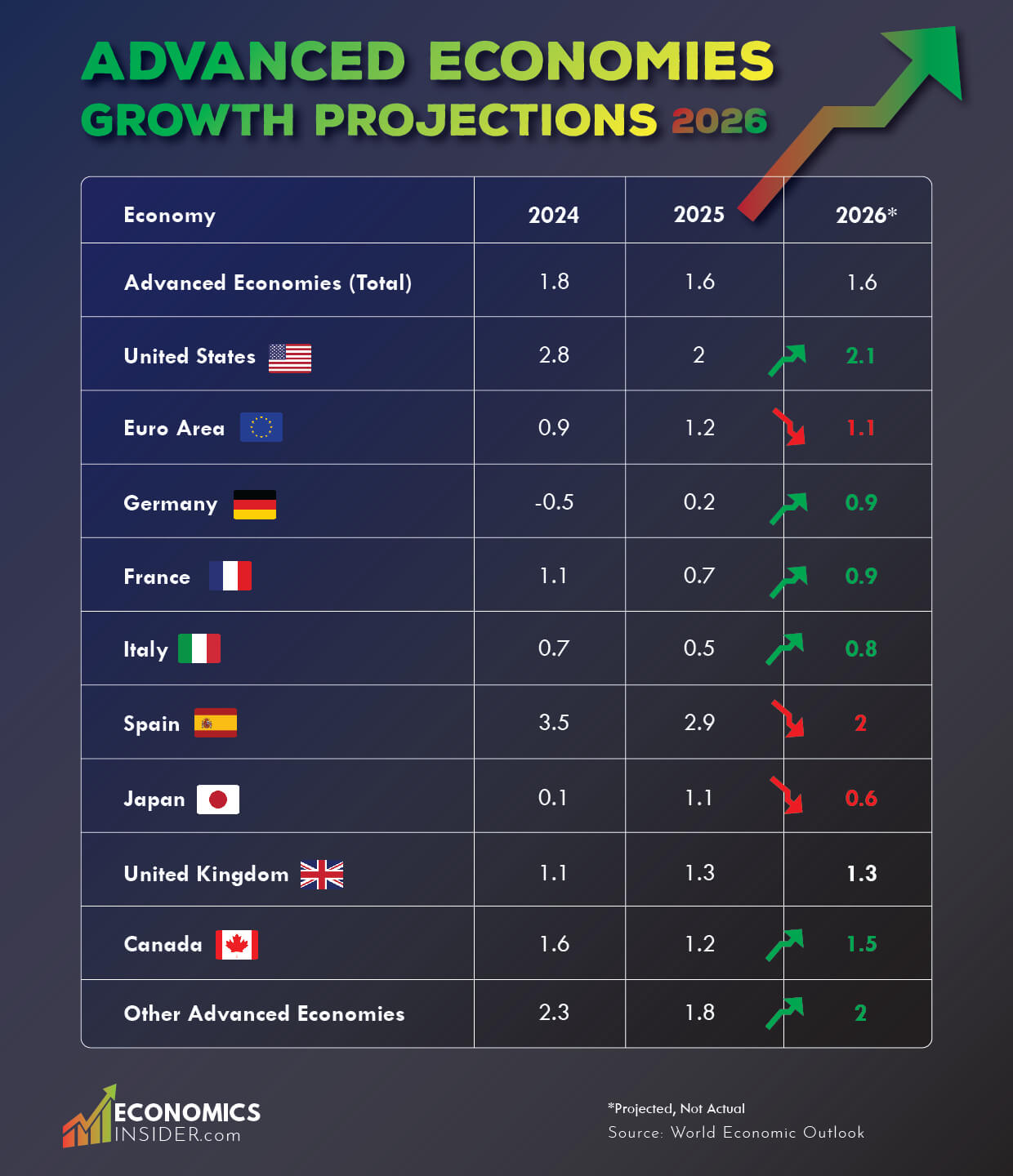
Among the advanced economies, the United States is by far the biggest economy, with a total GDP of about 30.62 trillion US dollars. This means the U.S. alone accounts for nearly half of all output produced by advanced economies. According to the World Economic Outlook, advanced economies are expected to grow by 1.6 percent in 2025 and again by 1.6 percent in 2026. This shows that advanced economies’ growth is stable but weak. It is well below the levels seen before the pandemic or during earlier economic expansions.
Key Takeaways
- Growth in advanced economies is weak but stable. The growth rate of 1.6 percent in both 2025 and 2026 suggests these economies are avoiding recession, but they are not gaining strong momentum either.
- The United States remains the growth leader among advanced economies. With growth projected at 2.1 percent in 2026, the U.S. is expected to outperform Europe, Japan, and other developed economies.
- Growth differences inside advanced economies are large. Some countries, like Spain, are growing relatively fast, while others, such as Germany and Japan, are struggling with much slower growth.
Growth Projections for Advanced Economies in 2026
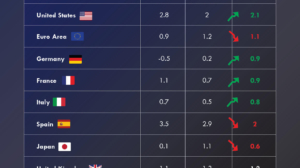
The following table shows the real GDP growth projections for advanced economies in 2026. The data highlights how growth remains uneven across countries, even within the same economic group.
| Economy | 2024 | 2025 | 2026 |
|---|---|---|---|
| 🌍 Advanced Economies (Total) | 1.8 | 1.6 | 1.6 |
| 🇺🇸 United States | 2.8 | 2 | 2.1 |
| 🇪🇺 Euro Area | 0.9 | 1.2 | 1.1 |
| 🇩🇪 Germany | -0.5 | 0.2 | 0.9 |
| 🇫🇷 France | 1.1 | 0.7 | 0.9 |
| 🇮🇹 Italy | 0.7 | 0.5 | 0.8 |
| 🇪🇸 Spain | 3.5 | 2.9 | 2 |
| 🇯🇵 Japan | 0.1 | 1.1 | 0.6 |
| 🇬🇧 United Kingdom | 1.1 | 1.3 | 1.3 |
| 🇨🇦 Canada | 1.6 | 1.2 | 1.5 |
| 🌐 Other Advanced Economies | 2.3 | 1.8 | 2 |
Source: World Economic Outlook
United States
The United States is the world’s largest economy, with a GDP of about 30.62 trillion US dollars. Its economic size gives it a major influence over global demand, trade flows, and financial conditions.
According to the World Economic Outlook, the U.S. economy expanded by 2.0 percent in 2025 and is projected to edge up slightly to 2.1 percent growth in 2026. This makes it the fastest-growing large advanced economy in the outlook.
The United States faces several key economic challenges as it moves into 2026, even though the economy is still growing. One major problem is trade and policy uncertainty. High tariffs and ongoing trade disputes have increased costs for many businesses. This makes imported goods more expensive and disrupts supply chains.
Another challenge is a slowing labor market. Job growth has weakened in 2025, and layoffs have become more common in some sectors. Additionally, the US is also facing the high inflation and government debt. Although inflation has come down from its earlier highs, prices are still rising faster than long-term targets.
Euro Area
The euro area, which includes countries such as Germany, France, Italy, and Spain, continues to face slow growth. According to the World Economic Outlook, the euro area is projected to grow by 1.1 percent in 2026, lower than the United States and well below historical averages.
Several challenges hold back the euro area. Energy costs remain one of the biggest challenges in Europe. Industrial production is weak in some countries. In addition, many euro area countries face aging populations and slow productivity growth. These issues limit the region’s ability to expand at a higher rate.
Despite these challenges, growth within the euro area is not uniform. Some countries are performing better than others, which reflects differences in labor markets, domestic demand, and economic structure.
Highest and Lowest Performers in Europe
Among major European economies, Spain is projected to grow at a higher rate. It is projected to grow by 2.0 percent in 2026, well above the euro area average. Strong tourism and improved labor market conditions play a key role in Spain’s growth outlook.
On the other hand, Germany is projected to grow at the lowest rate in Europe. Although growth is expected to improve to 0.9 percent in 2026, this remains low for Europe’s largest economy and the global third-largest economy.
Japan
Japan is the fourth-largest advanced economy, with a GDP of about 4.28 trillion US dollars. Despite its size, Japan is projected to be the worst-performing advanced economy in 2026, with growth of just 0.6 percent.
Japan is facing the biggest challenge in its history, which is demographics. The country has one of the oldest populations in the world and a very low fertility rate. Each year, the population shrinks as deaths far exceed births. This reduces the workforce and limits the long-term growth potential of the country.
Additionally, Japan is facing weak domestic demand and limited productivity growth. While inflation has recently increased, wages have not risen fast enough to support consumer spending. The country is also one of the world’s largest debtors, with its debt-to-GDP ratio exceeding 230 percent.
Conclusion
The outlook for advanced economies shows that a large size does not guarantee fast growth. Despite producing nearly 69 trillion US dollars in output, advanced economies are expected to grow by just 1.6 percent in 2026. The United States remains the strongest performer, due to its large domestic market and flexible economy. However, even the U.S. is growing more slowly than in the past. The euro area continues to struggle with uneven growth, while Japan faces the most severe long-term challenges, especially from population decline.