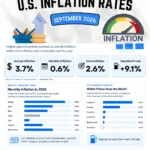

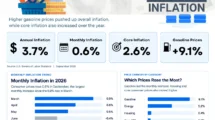











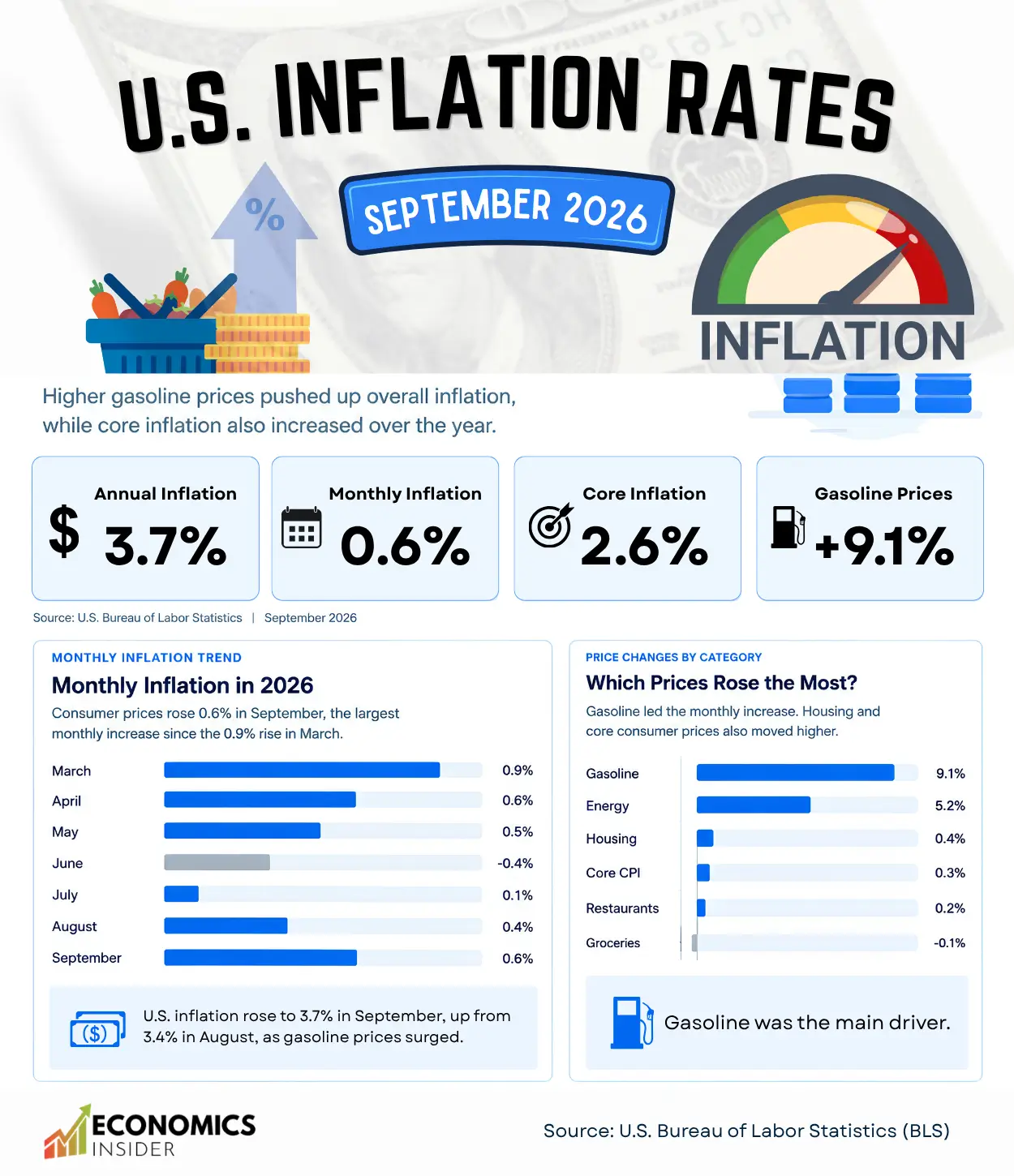
The U.S. Bureau of Labor Statistics (BLS) reports that consumer prices increased by 3.7% over the 12 months up to September 2026, which is an increase from 3.4% in August. In September gasoline prices alone increased by 9.1 per cent and this accounted for more than half of the total monthly increase in consumer prices.
The latest report also indicated that housing costs had increased and that the prices of a number of other goods and services had risen. At the same time, grocery prices were about the same as in the previous month.
Key Takeaways
- Between the end of August and the end of September U.S. consumer prices rose by 3.7 per cent, compared with 3.4 per cent in August.
- The higher cost of fuel was responsible for more than half of the total monthly rise in consumer prices.
- The core inflation, excluding food and energy, increased by 2.6% over the year, which was an increase from 2.4% in August.
Key figures relating to U.S. inflation in September 2026
The most recent Consumer Price Index (CPI) report indicates that inflation picked up in September, the rates of price increase in the month being higher than they had been in August.
| Inflation Measure | Sep-26 | Aug-26 |
|---|---|---|
| Overall inflation, year over year | 3.70% | 3.40% |
| Monthly change in consumer prices | 0.60% | 0.40% |
| Core inflation, year over year | 2.60% | 2.40% |
| Monthly core inflation | 0.30% | 0.30% |
| Food prices, monthly change | 0.00% | 0.10% |
| Gasoline prices, monthly change | 9.10% | 3.90% |
What caused inflation in the United States to go up in September?
In September, rising energy prices were the main cause of the increase in overall inflation. In August the gasoline index went up by 3.9 per cent and during the month of September it rose by 9.1 per cent. The wider energy index, which covers gasoline and other energy-related expenses, increased by 5.2 per cent.
The higher price of fuel goes beyond what Americans pay at the pump. Firms use fuel for the purpose of transporting goods, delivering products and carrying out their operations. If these expenses rise, certain businesses might increase their prices in order to meet the higher costs.
For ordinary households, higher prices for petrol can leave less money left for buying groceries, for housing, for entertainment and for other expenses. The most recent report also indicated that housing costs had on going increases. This is important since housing is one of the biggest expenses for a great many American families.
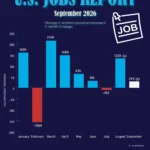
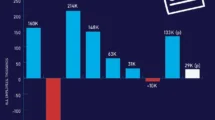
U.S. Jobs Report September 2026: Just 29,000 Jobs Added, Unemployment at 4.2%
Gas Prices Jump as Energy Costs Rise
The monthly increase of 9.1 percent was so substantial that it explained more than half of the total rise in consumer prices in September. Energy prices are prone to quick changes since they are influenced by oil supplies, global demand, transportation difficulties, and conflicts which disturb energy markets.
The energy index rose by 20.4% over the 12 months up to September, illustrating the extent to which energy costs had increased when compared with the same period the previous year.
For those Americans who drive a lot, this could mean that a greater part of their monthly budget is allocated to fuel.
What Happened to Grocery Prices?
In September, grocery prices dropped by 0.1 per cent whereas those for restaurants and other food eaten away from home rose by 0.2 per cent.
It therefore meant that individuals who bought food in supermarkets noticed a slight decrease in prices, whereas those who ate at restaurants experienced a bit higher costs.
The fact that grocery prices fell over one month does not imply that food has once again become cheap. The food index was still 2.5 per cent higher than it had been a year before. This meant that American households were having to pay more for food than they had in September 2025.
Housing Costs Continue to Rise
Housing was still another factor contributing to pressure on prices. The shelter index, which covers housing costs such as rent, rose by 0.4 percent in September, which was a faster increase than the 0.3 percent rise it had in August.
Housing costs are important since they make up a large part of the amount that most households spend each month. When their leases are renewed renters might have to pay more, and homeowners too may have to cope with increasing costs due to the maintenance and running of their homes.
Core Inflation Also Moves Higher
Core inflation refers to the changes in consumer prices with food and energy excluded. Since these prices can undergo sharp changes over short periods, excluding them allows economists to look at price rises in other areas of the economy.
In September core inflation increased by 2.6% on an annual basis, which was an increase from the 2.4% recorded in August.
What does rising inflation mean for average American households?
The primary worry for American households is the effect that increasing prices will have on their budgets. In most cases, when prices rise, families find that they need a greater amount of money in order to purchase the same goods and services.
Imagine a household which currently spends $500 each month on a certain set of ordinary expenses. In that case, the cost of those same purchases would be about $518.50 if the prices increased by 3.7% over the course of a year. That amounts to an extra $18.50 each month, or $222 in a year.
The following is merely an example; the amount by which different households experience price rises will depend on the amount of money they spend on gasoline, food, housing and other items.
The Bottom Line
In September 2026 U.S. inflation rose to 3.7 per cent from 3.4 per cent in August. The rise in petrol prices was the principal reason for the increase month by month, while costs for housing and a number of other categories also went up. Although grocery prices were generally stable over the month, food prices were still higher than they had been a year before.