



















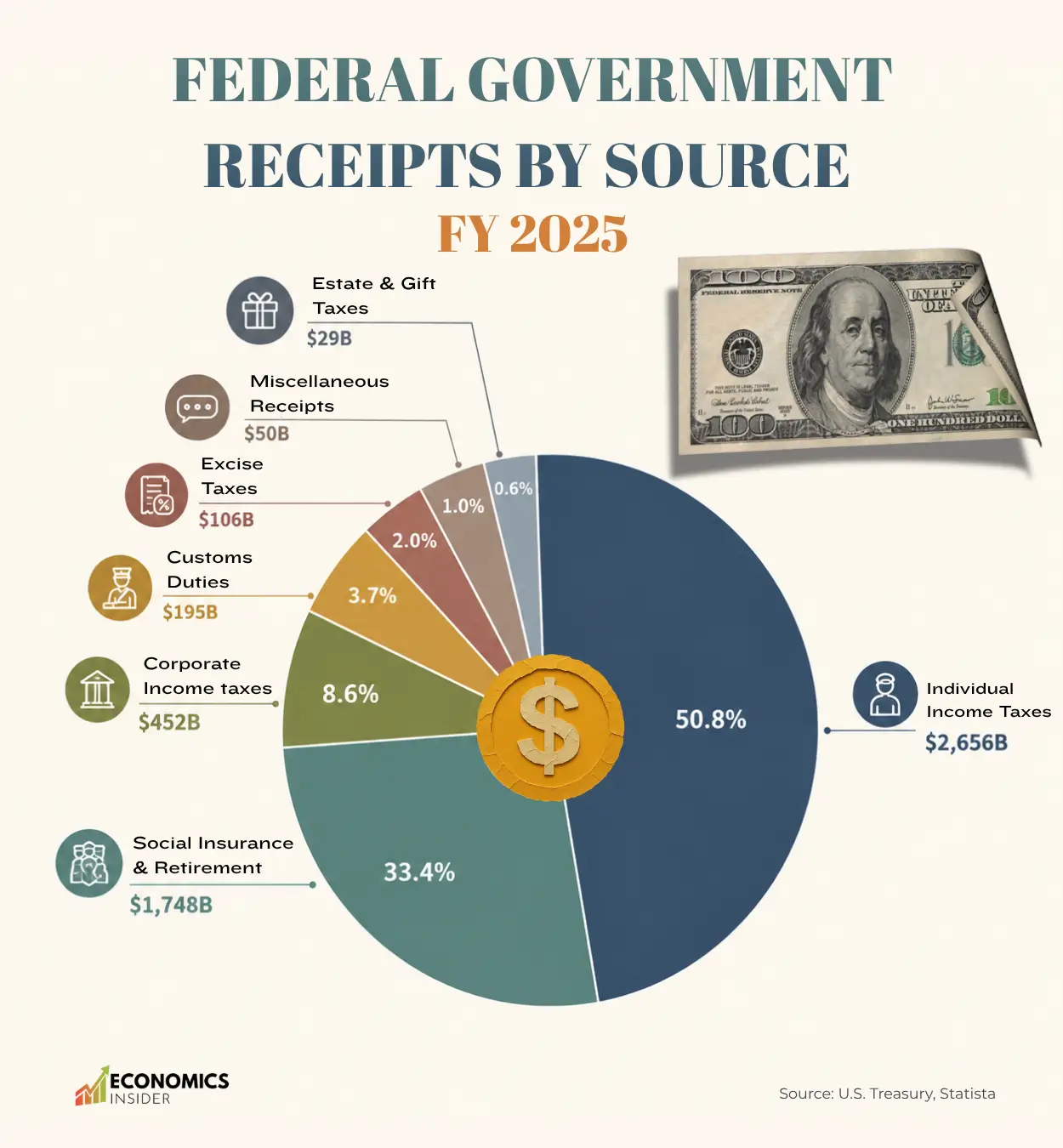
Every year the U.S. government collects trillions of dollars to keep the country running. In fiscal year 2025, total federal receipts hit roughly $5.2 trillion. At the top, individual income taxes brought in $2.65 trillion, making them by far the biggest source of federal money. At the very bottom sits estate and gift taxes, which raised just $29 billion.
Key Takeaways
- Individual income taxes alone made up over half of all federal revenue in FY 2025, more than every other source combined.
- Tariffs surged to a record $195 billion after President Trump’s 2025 trade actions, but they still made up less than 4% of total federal income.
- Payroll taxes for Social Security and Medicare came in a close second to income taxes, forming the backbone of the two programs most Americans will eventually rely on.
U.S. Government Receipts by Source in FY 2025
The following table shows U.S. government receipts by source in fiscal year 2025. The figures come from the U.S. Department of the Treasury.
| Source of Government Receipts | FY 2025 |
|---|---|
| Individual income taxes | $2,656 billion |
| Social insurance & retirement | $1,748 billion |
| Corporation income taxes | $452 billion |
| Customs duties | $195 billion |
| Excise taxes | $106 billion |
| Miscellaneous receipts | $50 billion |
| Estate & gift taxes | $29 billion |
| Total receipts | $5,235 billion |
Individual income taxes: the biggest source of federal revenue
At $2.656 trillion, individual income taxes made up just over half of everything the federal government collected in FY 2025. This is the tax taken out of paychecks, freelance income, investment gains, and pretty much anything else a person earns. It has been the single largest source of federal revenue for decades, and nothing else comes close.
Social insurance and retirement: the second-largest source
Coming in at $1.748 trillion, this category covers Social Security and Medicare payroll taxes, the money automatically deducted from every paycheck under FICA. Unlike income tax, this money is tied to specific programs. It’s meant to fund retirement benefits and health coverage for older Americans. Because it’s collected from almost every paycheck in the country, it stays remarkably steady year to year.
U.S. Budget Deficit by Year (2011–2025): Why the US Deficit Keeps Growing
Corporate Income Taxes
Corporate taxes brought in $452 billion, a fraction of what individuals paid. This number often surprises people because corporations are frequently blamed for not “paying their fair share.” Part of the reason this number is smaller is structural: many businesses are set up as pass-through entities, meaning their profits get taxed as personal income for the owners rather than as corporate income. Corporate tax revenue also swings more with the economy than individual taxes do, since it depends directly on company profits.
Customs Duties
Customs duties, or tariffs collected on imported goods, reached $195 billion in FY 2025, up from about $77 billion the year before. Much of this increase came after President Trump expanded tariffs in 2025, including the “Liberation Day” tariffs announced in April, along with higher duties on steel, aluminum, cars, and goods from several countries. Tariff collections rose sharply during the year, but the increase did not make tariffs a major source of federal revenue.
Despite the sharp increase, customs duties accounted for only 3.7% of the $5.23 trillion collected by the U.S. government in FY 2025. Individual income taxes alone brought in $2.66 trillion, while social insurance and retirement receipts generated another $1.75 trillion. In other words, tariffs brought in a large amount of money, but compared with the government’s main revenue sources, their contribution was still relatively small.
Excise Taxes
Excise taxes added $106 billion in FY 2025. These are taxes baked into the price of specific goods, things like gasoline, alcohol, tobacco, and airline tickets. Because they’re built into the price at checkout, most people never think about them as a separate tax, even though they pay them constantly.
Miscellaneous Receipts
At $50 billion, this category covers a mix of smaller income sources, things like Federal Reserve earnings, fees, fines, and other odds and ends that don’t fit neatly into the other categories.
Estate and Gift Taxes
Estate and gift taxes brought in just $29 billion, making them the smallest line item on the list. These are taxes applied when wealth is passed down, either through inheritance or large gifts, and they only kick in above fairly high thresholds.
The bigger picture
Individual income taxes and payroll taxes together cover more than 83% of everything the federal government collects. Corporate taxes add a meaningful but much smaller share. Tariffs, despite a record-breaking year and a genuinely dramatic policy shift, still land in the single digits as a share of total revenue. Yet tariffs have become much more important than they were a few years ago. Treasury reported that customs duties increased by 153% in FY 2025.