
















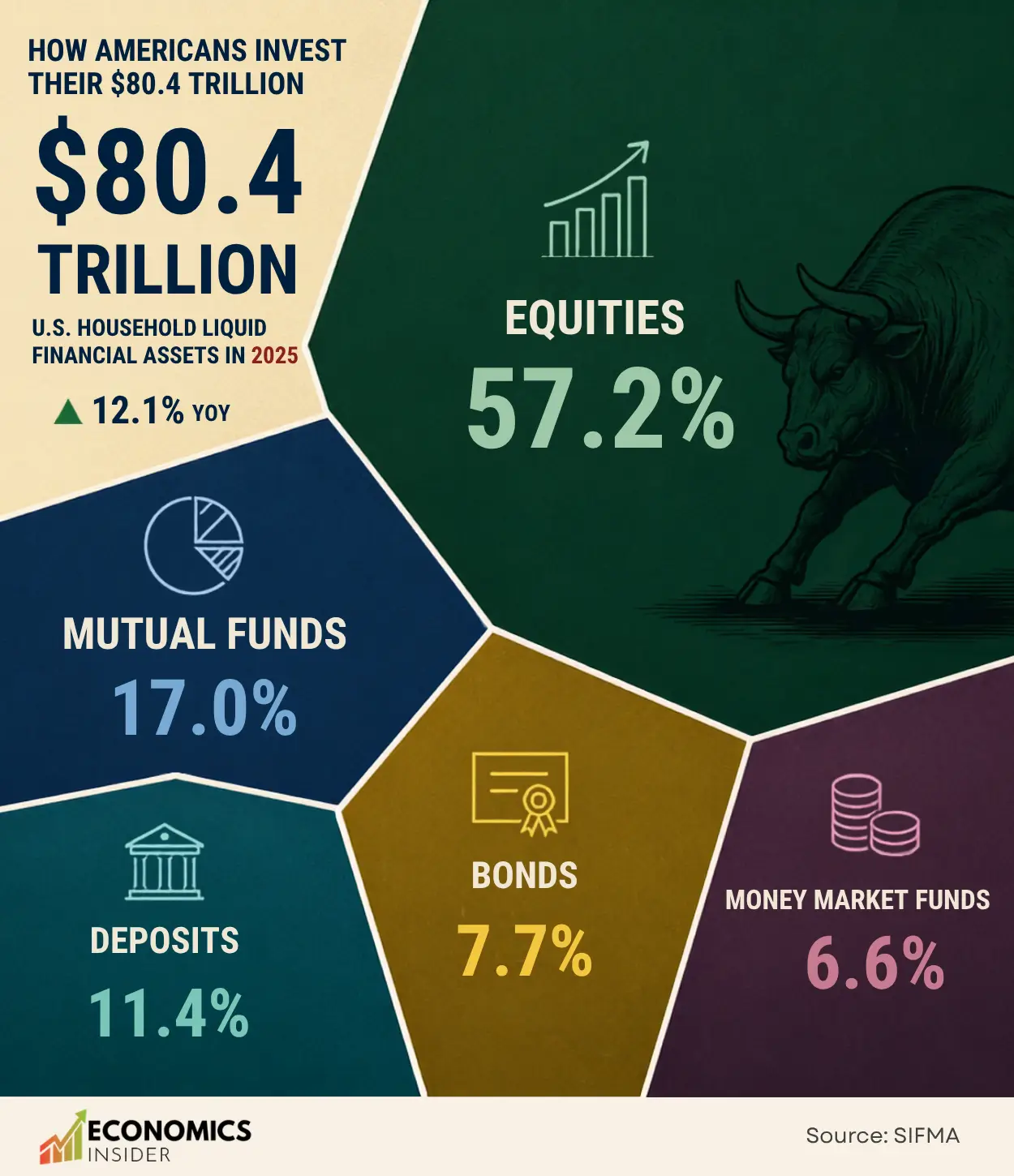
The total value of American households liquid financial assets — things like stocks, bank accounts, and bonds — hit $80.4 trillion in 2025. That’s up 12.1% from just a year before. According to SIFMA’s 2026 Capital Markets Fact Book, equities made up the largest share of these assets, followed by mutual funds, deposits, bonds, and money market funds.
Most of American households money is in the stock market. But people also keep a lot of their savings in mutual funds, bank deposits, bonds, and money market funds. New data from the Federal Reserve shows that 58% of U.S. households now own stocks, up from a smaller share in the last survey.
Key Takeaways
- U.S. households held $80.4 trillion in financial assets in 2025, up 12.1% from the year before.
- Stocks made up 57.2% of the total $80.4 trillion, by far the biggest slice.
- Bank deposits and mutual funds together account for close to a third of everything households hold.
U.S. Household Financial Assets by Type
SIFMA’s 2026 Capital Markets Fact Book, shows that U.S. households held $80.4 trillion in liquid financial assets in 2025, up 12.1% from the previous year. Theses financial assets are made up by mutual funds, deposits, bonds, and money market funds.
According to the Fed, 58% of U.S. households now own equities. That’s 5.3 percentage points higher than before. This includes stocks people buy directly, plus stocks held inside retirement accounts and other investment accounts. So when the market moves, it doesn’t just affect Wall Street. It affects regular people’s retirement savings too.
| Asset | Share |
|---|---|
| Equities | 57.20% |
| Mutual funds | 17.00% |
| Deposits | 11.40% |
| Bonds | 7.70% |
| Money market funds | 6.60% |
1. Stocks Make Up More Than Half
Stocks are the biggest piece of the puzzle, making up 57.2% of everything American households own. This shows just how tied household wealth is to the stock market.
Over time, stocks tend to grow faster than almost anything else people can put their money into. That growth adds up, especially for people who hold onto their investments for years through retirement accounts.
But there’s a flip side. Because so much household wealth is tied up in stocks, a rough year in the market can shrink people’s savings fast. When stock prices swing, so does the value of what families own.
2. Mutual Funds Give People an Easier Way In
Mutual funds make up 17% of the total, the second-largest chunk. Instead of selecting individual companies to invest in, mutual funds enable people to buy into a collection of investments at once. It’s a less hands-on way to be part of the market without having to watch every stock closely and it’s easier.
A lot of retirement plans lean heavily on mutual funds for exactly this reason. They spread the risk around instead of betting everything on one company.
3. Bank Deposits Are the Money People Actually Use
Bank deposits, things like checking accounts, savings accounts, and CDs, make up 11.4% of household money.
This is the cash people count on. It’s not meant to grow fast. It’s meant to be there when the car breaks down, the rent is due, or an emergency shows up out of nowhere. Unlike stocks, this money doesn’t lose value overnight. That stability is exactly why people keep it around.
4. Bonds Offer a Middle Ground
Bonds make up 7.7% of what households hold. Bonds work differently than stocks. Instead of betting on a company’s growth, people are essentially lending money and getting paid back with interest over time. It’s usually more stable, but the reward is smaller as well. Often people look to bonds when they want some safety in their portfolio.
5. Money Market Funds Round It Out
Money market funds represent the smallest portion at 6.6%. They are low-risk, short-term investments, so they are a good fit for people who want their money to be easily accessible, but still earn a little more than a regular savings account.
The Bottom Line
American households had $80.4 trillion saved and invested in 2025, and most of that money was in stocks. With over half of all household money in stocks, and 58% of households owning some, the stock market touches the lives of everyday people more than ever.
But it’s not just about stocks. Families also keep money in mutual funds, bank accounts, bonds, and money market funds. Put together, all of this shows just how much money American households really have, and how much of it rises and falls with the stock market.